Aperçu en situation
 Envoyer
 Partager
 Détails de l'œuvre

 Télécharger
 Articles similaires
 Radiographie
 Diaporama
Mural


 Lire la suite
Giclées et impressions d'art
Impressions giclées ou sur toile de qualité musée, avec une production rapide et des finitions au choix. ( Acheter la peinture faite à la main Acheter l'image)




P118B $10

P118H $10

P118W $10

P438Z $10

P508JH $12

P508YH $12

P805H $10

P805Z $10

P919BZ $10

P919G $10

P919XJ $10

P959ZH $10

P968JZ $12

W106C $8

W218G $10

W218JH $8

W218Y $10

W307PJ $10

W316G $10

W316PJ $8

W316Y $10

W398PJ $8

W4111J $10

W500HY $15

W500JH $15

W692G $12

W849H $8

W940BG $15

W953PJ $8




Choisissez parmi nos formats prédéfinis qui respectent les proportions originales de l’œuvre.

Vous pouvez saisir vos propres dimensions pour vous adapter à un cadre ou à un espace spécifique. Si la taille sélectionnée ne correspond pas aux proportions de l'image originale, nous recadrerons l'œuvre ou étendrons l'image avec une bordure en miroir ou une couleur unie. Une maquette numérique vous sera envoyée pour approbation avant le début de la production.
Veuillez noter que l'aperçu à l'écran ne reflète pas le recadrage ou l'extension réelle. Seule la maquette montrera avec précision la composition finale.
Bien que des tailles personnalisées soient disponibles, nous vous recommandons de choisir une dimension dans la liste prédéfinie afin de préserver les proportions originales.
Livraison dans le monde entier () en 2 semaines au lieu des 4/5 semaines habituelles. (12 août)

Livraison express gratuite dans le monde entier

Toile de lin de qualité supérieure

Assurance transport complète

Garantie de remboursement des droits de douane

Garantie de fidélité des couleurs

Politique de retour de 60 jours (uniquement en cas de défaut)

Garantie de remboursement à 100%

Offre de tarifs dégressifs
 L'option verre n'est disponible que pour les dimensions inférieures à 110 cm.

Mural
Giclées et impressions d'art
Format de la reproduction
-


Prix total
$ 64
Description de la pièce
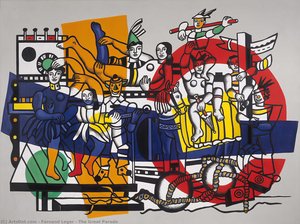
Fernand Léger’s Mural: A Symphony of Form and Movement
Fernand Léger's "Mural," completed in 1951, stands as an arresting embodiment of Cubist principles interwoven with a palpable fascination for the burgeoning machine age. Born Joseph Fernand Henri Léger in Argentan, Normandy, in 1881, Léger’s formative years amidst rural landscapes instilled a grounding appreciation for physicality that would later inform his groundbreaking artistic explorations. Rejecting the prevailing trend toward pure abstraction, Léger embarked on a daring endeavor to synthesize modernity – its relentless pace, its geometric precision – into a visual language simultaneously intellectually stimulating and emotionally resonant. This ambition propelled him from architectural studies towards painting in Paris around 1900, where he found patronage and collaborated with fellow avant-garde artists, establishing himself as a crucial voice within the Parisian artistic milieu.Cubist Foundations: Fragmented Perspectives
“Mural” exemplifies Léger’s unwavering commitment to Cubism's core tenets. Unlike Impressionists who sought to capture fleeting moments of light and color, Léger dissected subjects into fragmented planes—a technique pioneered by Picasso and Braque—presenting multiple viewpoints simultaneously. The resulting image isn’t a straightforward depiction but rather an orchestration of geometric shapes – cubes, cylinders, spheres – meticulously arranged to convey not just visual information but also the dynamism inherent in industrial processes. These forms overlap and intersect, creating a sense of instability and suggesting that reality itself is constantly shifting under scrutiny. Léger deliberately avoided smooth surfaces, favoring rough textures that mirrored the materiality of machines and reinforced the artwork’s connection to its historical context.The Palette of Industry: Color as Symbolic Gesture
Léger's color palette—primarily dominated by reds, yellows, and blues—is far from arbitrary; it serves as a deliberate symbolic gesture reflecting the industrial landscape of his time. Red signifies energy, passion, and perhaps even danger – mirroring the heat generated by factories and the urgency of technological advancement. Yellow embodies optimism and illumination, representing the promise of progress and highlighting Léger’s belief in the transformative power of innovation. Blues convey calmness and depth, hinting at the vastness of industrial spaces and subtly underscoring the artwork's contemplative quality despite its energetic composition. The careful selection of hues contributes significantly to the emotional impact of “Mural,” inviting viewers to contemplate both the beauty and complexity of the modern world.A Reflection of Postwar Anxiety
Created in 1951 shortly after World War II, "Mural" speaks to a broader cultural preoccupation with anxieties surrounding technological change and societal upheaval. Léger’s depiction of figures engaged in repetitive tasks—a motif recurring throughout his oeuvre—captures the pervasive sense of alienation experienced by many individuals during the postwar period. However, amidst this apprehension lies an undeniable affirmation of human creativity and resilience. The artwork's bold geometric forms and vibrant colors convey a defiant spirit, suggesting that despite facing daunting challenges, humanity can still find beauty and meaning in its surroundings. Léger’s vision transcends mere stylistic imitation; it embodies a profound engagement with the intellectual currents shaping the postwar era.Emotional Resonance: Capturing Movement and Rhythm
Ultimately, “Mural” succeeds in conveying an extraordinary emotional resonance—a palpable sense of movement and rhythm that draws viewers into its captivating visual universe. Léger’s masterful manipulation of perspective and texture creates a dynamic interplay between form and space, mirroring the ceaseless activity of industrial life. The artwork compels contemplation, prompting us to consider not only what we see but also how it feels. It's a testament to Léger’s ability to transform abstract concepts into emotionally charged images—a feat that continues to inspire artists and collectors alike. “Mural” remains an unforgettable masterpiece, securing its place as one of Fernand Léger’s most enduring achievements.Œuvres similaires


Biographie de l'artiste
jeune vie et formation
fernand léger, peintre, sculpteur et cinéaste français, est né le 4 février 1881 à Argentan, Orne, en Normandie inférieure. Son père élevait du bétail, et léger a initialement été formé à l'architecture de 1897 à 1899. Il s’est ensuite installé à Paris en 1900, se débrouillant comme dessinateur architectural.développement artistique
Le travail précoce de léger a été influencé par l'impressionnisme, comme le montrent le jardin de ma mère (mon jardin) (1905). Après avoir fréquenté l'école des beaux-arts et l’académie Julian, il a commencé à travailler sérieusement comme peintre à 25 ans. Son style s'est développé en une forme personnelle de cubisme, que les critiques ont qualifié de "tubisme" pour son accent sur les formes cylindriques.cubisme et le groupe des Puteaux
En 1910, léger a exposé au Salon d’automne aux côtés de jean metzinger et henri le fauconnier. Il a rejoint le groupe des Puteaux, également connu sous le nom de section d’or (la section dorée), avec d'autres artistes tels que francis picabia et marcel duchamp.guerre et son influence sur le travail de léger
Les expériences de léger à la Première Guerre mondiale ont eu un impact significatif sur son œuvre. Pendant son séjour au front, il a produit des croquis d'artillerie, d'avions et de soldats. Sa peinture soldier avec un tuyau (1916) reflète cette période.œuvre ultérieure et héritage
L'œuvre post-guerre de léger, caractérisée par des formes machine-like élégantes, le lia à la tradition de la peinture figurative française. Ses paysages animés de 1921 ont présenté des figures et des animaux dans des formes harmonieuses et rationalisées.- voir les œuvres de fernand léger sur AllPaintingsStore
- en savoir plus sur fernand léger sur wikipedia
- découvrez le musée national fernand léger (france) avec AllPaintingsStore
- la femme assise (100 x 81 cm, tubisme)
- élément de machine (cubisme)
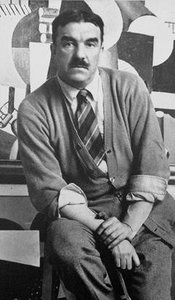
Fernand Léger
1881 - 1955 , France
L'essentiel de l'artiste
- Artistes Influents:
- Cézanne
- Impressionnisme
- Date De Décès: 1955
- Date De Naissance: 4 février 1881
- Influences Artistiques: ['Pop Art']
- Lieu De Naissance: Argentan, France
- Mouvement Artistique: Cubisme, Tubisme
- Nationalité: Française
- Nom Complet: Fernand Léger
- Oeuvres Notables:
- La Grande Parade
- Machine Élément
- Femme assise
- Paysages animés
Articles connexes

The Energetic Canvas: Exploring Dynamic Composition in Art History & Contemporary Practice
Explore the history of dynamic composition in art, from Renaissance chiaroscuro to modern asymmetry. Learn how masterful artists used balance & symmetry – and what collectors should look for.

The Eloquence of Arrangement: Compositional Strategies in Western Art from the Renaissance to Modernism
Explore the evolution of compositional strategies in Western art! Discover how masters like Raphael & Zurbaran used perspective, proportion, and dynamic arrangement to create timeless masterpieces. Enhance your art appreciation today!

The Embodiment of Motion: Dynamic Composition & Energetic Expression in Art History
Explore the evolution of dynamic composition in art history – from chiaroscuro masters to abstract expressionism. Discover how artists like Kandinsky & Pollock embodied energy and movement on canvas. Expert insights for discerning collectors.

Crimson Threads of Narrative: Exploring Symbolism & Representation in Artworks Featuring the Red Dress
Explore the rich symbolism of the red dress in art history! From ancient power displays to iconic portraits like Cézanne’s 'Madame Cezanne', discover the cultural and artistic significance behind this captivating color. Expert analysis & insights.
John Singer Sargent : Les 25 Œuvres Maîtresses d'un Portraitiste Éminent | AllPaintingsStore
Plongez dans l'univers de John Singer Sargent : découvrez les 25 œuvres qui ont marqué l'histoire de l'art. Portraits impressionnants, réalisme exquis et couleurs vibrantes. Retrouvez ces chefs-d'œuvre en reproduction haute définition sur AllPaintingsStore.com.