Aperçu en situation
 Envoyer
 Partager
 Détails de l'œuvre

 Télécharger
 Articles similaires
 Radiographie
 Diaporama
Stalingrad
 Acrylic On Canvas
- WallArt
- Naïve Art
 Modern
 16.0 x 13.0 cm
 Lire la suite
Giclées et impressions d'art
Impressions giclées ou sur toile de qualité musée, avec une production rapide et des finitions au choix. ( Acheter la peinture faite à la main Acheter l'image)




P118B $10

P118H $10

P118W $10

P438Z $10

P508JH $12

P508YH $12

P805H $10

P805Z $10

P919BZ $10

P919G $10

P919XJ $10

P959ZH $10

P968JZ $12

W106C $8

W218G $10

W218JH $8

W218Y $10

W307PJ $10

W316G $10

W316PJ $8

W316Y $10

W398PJ $8

W4111J $10

W500HY $15

W500JH $15

W692G $12

W849H $8

W940BG $15

W953PJ $8




Choisissez parmi nos formats prédéfinis qui respectent les proportions originales de l’œuvre.

Vous pouvez saisir vos propres dimensions pour vous adapter à un cadre ou à un espace spécifique. Si la taille sélectionnée ne correspond pas aux proportions de l'image originale, nous recadrerons l'œuvre ou étendrons l'image avec une bordure en miroir ou une couleur unie. Une maquette numérique vous sera envoyée pour approbation avant le début de la production.
Veuillez noter que l'aperçu à l'écran ne reflète pas le recadrage ou l'extension réelle. Seule la maquette montrera avec précision la composition finale.
Bien que des tailles personnalisées soient disponibles, nous vous recommandons de choisir une dimension dans la liste prédéfinie afin de préserver les proportions originales.
Livraison dans le monde entier () en 2 semaines au lieu des 4/5 semaines habituelles. (13 août)

Livraison express gratuite dans le monde entier

Toile de lin de qualité supérieure

Assurance transport complète

Garantie de remboursement des droits de douane

Garantie de fidélité des couleurs

Politique de retour de 60 jours (uniquement en cas de défaut)

Garantie de remboursement à 100%

Offre de tarifs dégressifs
 L'option verre n'est disponible que pour les dimensions inférieures à 110 cm.

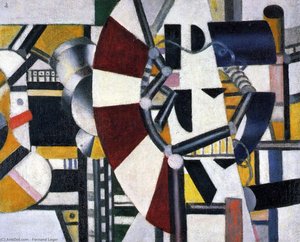
Stalingrad
Giclées et impressions d'art
Format de la reproduction
-


Prix total
$ 64
Description de la pièce
A Vision of Mechanized Conflict: Fernand Léger’s Stalingrad
Stalingrad, created by Fernand Léger in 1954, stands as a striking embodiment of Naïve Art—a movement that deliberately eschewed academic conventions to prioritize direct observation and emotional expression. More than just a depiction of the brutal realities of World War II, Léger's canvas delves into profound questions about humanity’s relationship with technology and its impact on warfare. This artwork isn’t merely *seen*; it’s *felt*.Style and Technique: Embracing Simplicity
Léger’s approach to painting distinguishes itself from the prevailing artistic trends of his time. Rejecting illusionistic realism, he opted for a deliberately simplified visual language characterized by bold lines and flattened planes—a technique directly influenced by his fascination with industrial forms and machines. The artist employed a distinctive linear style, prioritizing geometric shapes – circles, squares, triangles – to construct the scene. These elements aren’t merely decorative; they actively convey movement and dynamism, mirroring the relentless pace of battle. Léger deliberately avoided shading and blending colors, favoring instead a palette of primary hues that heighten visual impact and reinforce the artwork's expressive power.Historical Context: The Siege of Stalingrad
Stalingrad served as a focal point for Nazi Germany’s ambitious offensive into Soviet territory during Operation Barbarossa in 1941-1942. The siege itself was marked by horrific conditions—constant bombardment, starvation, and relentless fighting—resulting in staggering casualties on both sides. Léger's painting captures this atmosphere of desperation and determination with remarkable acuity. It portrays a group of soldiers confronting the enemy amidst a chaotic landscape dominated by vehicles and architectural fragments – remnants of buildings destroyed during the siege. The artist’s intention wasn’t to offer a literal representation of the battle; rather, he sought to convey its psychological intensity—the courage, resilience, and unwavering spirit of those involved.Symbolism: Machines as Agents of Fate
The prominent presence of motorcycles and trucks within Stalingrad is laden with symbolic significance. Léger deliberately utilized these vehicles to represent not merely transportation but also the pervasive influence of machinery on human experience. They embody the unstoppable force of technological progress—a force that both threatens and empowers humanity. Furthermore, the geometric shapes composing the scene – circles, squares, triangles – symbolize stability and order amidst the turmoil of war. These forms serve as a counterpoint to the fragmented architectural ruins, highlighting the enduring values of human dignity and perseverance.Emotional Impact: A Powerful Meditation on Resilience
Ultimately, Stalingrad transcends its historical subject matter to become a profound meditation on the human condition—specifically, our capacity for courage and resilience in the face of adversity. Léger’s masterful use of line and color evokes a palpable sense of urgency and emotion, compelling viewers to confront the horrors of war while simultaneously celebrating the indomitable spirit of humanity. The artwork's stark simplicity underscores its emotional core, allowing it to resonate with audiences across generations—a testament to Léger’s enduring artistic legacy.Œuvres similaires


Biographie de l'artiste
jeune vie et formation
fernand léger, peintre, sculpteur et cinéaste français, est né le 4 février 1881 à Argentan, Orne, en Normandie inférieure. Son père élevait du bétail, et léger a initialement été formé à l'architecture de 1897 à 1899. Il s’est ensuite installé à Paris en 1900, se débrouillant comme dessinateur architectural.développement artistique
Le travail précoce de léger a été influencé par l'impressionnisme, comme le montrent le jardin de ma mère (mon jardin) (1905). Après avoir fréquenté l'école des beaux-arts et l’académie Julian, il a commencé à travailler sérieusement comme peintre à 25 ans. Son style s'est développé en une forme personnelle de cubisme, que les critiques ont qualifié de "tubisme" pour son accent sur les formes cylindriques.cubisme et le groupe des Puteaux
En 1910, léger a exposé au Salon d’automne aux côtés de jean metzinger et henri le fauconnier. Il a rejoint le groupe des Puteaux, également connu sous le nom de section d’or (la section dorée), avec d'autres artistes tels que francis picabia et marcel duchamp.guerre et son influence sur le travail de léger
Les expériences de léger à la Première Guerre mondiale ont eu un impact significatif sur son œuvre. Pendant son séjour au front, il a produit des croquis d'artillerie, d'avions et de soldats. Sa peinture soldier avec un tuyau (1916) reflète cette période.œuvre ultérieure et héritage
L'œuvre post-guerre de léger, caractérisée par des formes machine-like élégantes, le lia à la tradition de la peinture figurative française. Ses paysages animés de 1921 ont présenté des figures et des animaux dans des formes harmonieuses et rationalisées.- voir les œuvres de fernand léger sur AllPaintingsStore
- en savoir plus sur fernand léger sur wikipedia
- découvrez le musée national fernand léger (france) avec AllPaintingsStore
- la femme assise (100 x 81 cm, tubisme)
- élément de machine (cubisme)

Fernand Léger
1881 - 1955 , France
L'essentiel de l'artiste
- Artistes Influents:
- Cézanne
- Impressionnisme
- Date De Décès: 1955
- Date De Naissance: 4 février 1881
- Influences Artistiques: ['Pop Art']
- Lieu De Naissance: Argentan, France
- Mouvement Artistique: Cubisme, Tubisme
- Nationalité: Française
- Nom Complet: Fernand Léger
- Oeuvres Notables:
- La Grande Parade
- Machine Élément
- Femme assise
- Paysages animés
Articles connexes

Modern Geometry & Machine Age Beauty: A Collector's Guide to the Cubist Vision of Fernand Léger
Explore the profound geometric mastery of Fernand Léger. Discover how his 'Tubism' and Machine Age aesthetics redefined modern art, offering timeless inspiration for discerning collectors seeking to integrate Cubist dynamism into sophisticated contemporary interiors.

The Essence of Naïve Art: A Professional Guide to Unfiltered Creativity and Aesthetic Sincerity
Explore the profound beauty of Naïve Art. Discover its unique characteristics, historical significance, and how this unfiltered, sincere aesthetic can elevate professional interior design through high-quality, hand-painted reproductions.