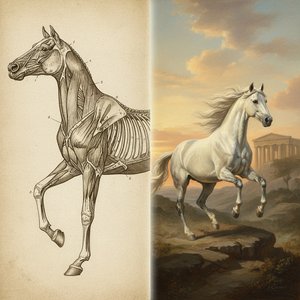
1785. Huile sur toile, 89.0 x 132.0 cm. Tate Gallery.

§ 1Données du catalogue

- 89.0 x 132.0 cm


§ 2Abstrait
Description de la pièce
Haymaking (1785) de George Stubbs saisit la vie rurale avec réalisme. Un chef-d'œuvre du paysage britannique sur le travail et l'anatomie.
 Lire la suite
Biographie de l'artiste
George Stubbs (1724-1806) : Peintre anglais renommé pour son exactitude anatomique & ses représentations magistrales des chevaux. Pionnier du Romantisme, célèbre pour 'Whistlejacket'. Découvrez son art équin et son héritage.
§ 3Commentaire
George Stubbs’ « Le foin » : Une symphonie de la vie rurale et de la précision anatomique
Peint en 1785, « Le foin » de George Stubbs n'est pas un simple paysage ; c'est un tableau vivant méticuleusement élaboré — un instantané du travail communautaire rendu avec un niveau de détail presque troublant et imprégné d'une beauté calme et profonde. Conservée à la Tate Gallery de Londres, cette huile sur toile offre un aperçu rare des rythmes de l'Angleterre rurale du XVIIIe siècle, capturant non seulement l'acte physique de la fenaison, mais aussi la dynamique sociale et la dignité intrinsèque de ceux qui y participent.
La scène se déploie avec une clarté remarquable. Un groupe de personnages — hommes et femmes — est engagé dans la tâche ardue de la récolte du foin sous un ciel vaste et ouvert. Le génie de Stubbs ne réside pas seulement dans sa capacité à dépeindre l'effort physique du travail — les muscles tendus, les mouvements rythmés — mais aussi dans sa compréhension magistrale de l'anatomie humaine. Chaque individu est rendu avec une précision presque scientifique, reflétant la fascination de toute une vie de Stubbs pour les formes animales et humaines. Les figures ne sont pas idéalisées ; elles possèdent une physicalité palpable, leurs corps exprimant à la fois la force et la fatigue. Cette rigueur anatomique élève la peinture au-delà d'une simple représentation de la vie rurale, la transformant en une étude de la condition humaine.
Composition et technique : un dialogue entre la nature et l'art
La composition de Stubbs est soigneusement équilibrée, attirant l'œil vers le groupe central tout en établissant simultanément une sensation de profondeur grâce à l'utilisation de la perspective atmosphérique. La vaste étendue du champ s'étire derrière les travailleurs, s'effaçant dans une distance brumeuse ponctuée par un arbre solitaire — un détail qui ancre subtilement la scène dans son contexte naturel. La touche de l'artiste est remarquablement maîtrisée, créant une surface lisse, presque polie, qui contraste avec la texture rugueuse des meules de foin et les vêtements usés des laboureurs. L'utilisation de l'ombre et de la lumière est particulièrement remarquable, projetant des rehauts dramatiques sur les personnages et renforçant le sentiment de tridimensionnalité.
La palette du tableau est dominée par des tons terreux — ocres, bruns et verts — reflétant les couleurs du champ et du foin lui-même. Cependant, Stubbs introduit de subtiles touches de couleur à travers les vêtements portés par les travailleurs, ajoutant un intérêt visuel et soulignant leur individualité. L'effet global est celui d'une élégance sobre et d'une observation silencieuse.
Symbolisme et commentaire social
« Le foin » transcende la simple représentation du travail agricole ; il porte des couches de significations symboliques. La nature communautaire du travail suggère un fort sentiment de communauté et de but partagé. L'inclusion d'hommes et de femmes travaillant ensemble souligne l'importance de l'égalité des sexes dans la société rurale, un sujet relativement rare pour les artistes de l'époque. De plus, le regard direct des personnages vers le spectateur crée une connexion puissante, nous invitant à contempler notre propre relation avec la nature et le travail.
Il est intéressant de noter que le choix de Stubbs de dépeindre ces travailleurs avec une telle dignité — leurs corps présentés avec une exactitude anatomique et un sentiment de force tranquille — peut être interprété comme une critique subtile des hiérarchies sociales. En élevant le statut de la classe ouvrière, il défie les attitudes prédominantes de son temps, suggérant que chaque individu mérite respect et reconnaissance.
Un héritage de maîtrise anatomique et de vision romantique
« Le foin » témoigne du talent artistique extraordinaire de George Stubbs et de son approche unique pour dépeindre à la fois les animaux et les humains. C'est une œuvre qui récompense l'observation attentive, invitant les spectateurs à plonger dans ses strates de signification et à apprécier l'attention méticuleuse de l'artiste aux détails. Les reproductions de cette œuvre emblématique capturent l'essence de la vision de Stubbs, permettant aux amateurs d'art de faire l'expérience de la beauté et de la puissance de ce chef-d'œuvre remarquable dans leur propre foyer. Le tableau illustre un moment charnière de l'art britannique — une synthèse de l'observation scientifique, de la précision anatomique et de la sensibilité romantique qui continue de résonner auprès du public aujourd'hui.
Questions et réponses
Comment les couleurs de "Le foin" s'harmonisent-elles entre elles ?
Les couleurs de «Le foin» de George Stubbs présentent une harmonie Forte unité chromatique. L'harmonie décrit la relation entre les couleurs.
Quel format et quelle orientation sont recommandés pour l'impression de « Le foin » ?
Pour « Le foin », la configuration d'impression recommandée est un format Grand format avec une orientation Format paysage.
En quelle année "Le foin" a-t-il été réalisé ?
«Le foin» date de 1785. Cette date inscrit l'œuvre dans la carrière de George Stubbs ainsi que dans son époque.


 Passer au format impression


 Pour les œuvres ou reproductions dont un côté mesure plus de 105 cm (environ 41 pouces), le cadre sera expédié sous forme de kit démonté. Cette méthode garantit une livraison sécurisée et prévient tout dommage pendant le transport.