


 Aperçu en situation
 Partager
 Partager
 Détails
 Guide imprimable

 Télécharger
 Articles similaires
 Radiographie
 Voir le diaporama
 Statistiques
James DeLancey
 Huile sur toile
- Art mural
- Néoclassicisme
 1785
1785- L'époque moderne
 102.0 x 89.0 cm
 Metropolitan Museum of Art
 Afficher la suite
Giclées et impressions d'art
Impressions giclées ou sur toile de qualité musée, avec une production rapide et des finitions au choix. ( Acheter la peinture faite à la main Passer au format image numérique)




P118B €10

P118H €10

P118W €10

P438Z €10

P508JH €12

P508YH €12

P805H €10

P805Z €10

P919BZ €10

P919G €10

P919XJ €10

P959ZH €10

P968JZ €12

W106C €8

W218G €10

W218JH €8

W218Y €10

W307PJ €10

W316G €10

W316PJ €8

W316Y €10

W398PJ €8

W4111J €10

W500HY €15

W500JH €15

W692G €12

W849H €8

W940BG €15

W953PJ €8




Choisissez parmi nos formats prédéfinis qui respectent les proportions originales de l’œuvre.

Saisissez la largeur et la hauteur souhaitées pour qu'elles s'adaptent à votre cadre ou à votre mur. Une impression ne peut être que découpée, elle ne peut jamais être agrandie au-delà de l'image originale ; ainsi, un format de forme différente entraînera la perte d'une partie de l'image. Nous vous envoyons une maquette numérique pour approbation avant toute impression. L'image présentée sur cette page ne montre pas le recadrage réel — seule la maquette le permet.
Livraison dans le monde entier () en 2 semaines au lieu des 4/5 semaines habituelles. (24 octobre)

Livraison express gratuite dans le monde entier

Toile de lin de haute qualité

Assurance transport complète

Garantie de remboursement des droits de douane

Garantie de fidélité des couleurs

Garantie de retour de 100 jours (uniquement en cas de défaut)

Garantie de remboursement à 100%

Tarifs dégressifs sur quantité
 L'option verre n'est disponible que pour les dimensions inférieures à 110 cm.

James DeLancey
Giclées et impressions d'art
Format de la reproduction
-


Prix total final
€ 56
A Glimpse into Georgian Grandeur: James DeLancey
To stand before a portrait such as "James DeLancey" is to step directly across the threshold of the late eighteenth century. This oil on canvas, executed by Gilbert Stuart Newton in 1785, is far more than a mere likeness; it is a meticulously preserved moment of masculine elegance and societal standing. The subject commands attention with an air of confident composure. Dressed in a striking suit accented by a vibrant red jacket, he presents himself to the viewer with direct, unwavering gaze. His beard and mustache frame a countenance that speaks of experience, while the carefully styled wig anchors him firmly within the fashionable aesthetics of the Georgian era.
The Artistry of Gilbert Stuart Newton
Gilbert Stuart Newton’s hand is evident in every brushstroke. The technique employed—oil on canvas—allows for a richness of tone and texture that breathes life into the painted surface. One can almost feel the weight of the velvet, the crispness of the white shirt, and the subtle sheen of the wig's curls. While Newton’s career spanned decades, this portrait captures him at a height of his skill, inheriting and building upon the legacy of his renowned family—a lineage deeply rooted in American portraiture. The painting is a testament to formal portraiture, where technical mastery serves the purpose of immortalizing character.
Historical Echoes and Social Portraiture
The year 1785 places this work at a fascinating juncture in American history, a time of burgeoning self-identity following revolutionary upheaval. Portraits like this served crucial functions; they were visual declarations of status, success, and belonging within the established social order. The formality of the pose, combined with the richness of the attire, suggests that James DeLancey was a man of means and influence. Owning such a piece today allows one to curate an interior space steeped in historical gravitas, connecting modern life with the refined tastes of the late colonial period.
Emotional Resonance for the Modern Collector
What truly endures about this painting is its emotional directness. Despite the formality of the era's portraiture, DeLancey meets the viewer’s eye without artifice. There is a compelling narrative in that gaze—a mixture perhaps of self-possession and quiet contemplation. For the collector or designer, acquiring a high-quality reproduction of "James DeLancey" offers an immediate infusion of sophisticated character into any room. It acts as a conversation starter, inviting admiration for both the sitter's perceived stature and the sheer artistry required to capture such a nuanced human presence on canvas.
Questions et réponses
Quand et avec quels matériaux James DeLancey a-t-il été réalisé ?
«James DeLancey» a été réalisé en 1785, en Huile sur toile.
Quelle couleur domine la composition de «James DeLancey» de Gilbert Stuart Newton ?
La couleur dominante de «James DeLancey» de Gilbert Stuart Newton est le Brun espresso (#392d1f).
Quel format choisir pour l'impression de "James DeLancey" afin qu'il s'adapte à ma pièce ?
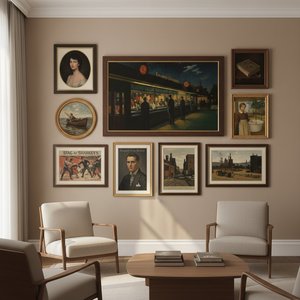
Dans une Espaces de vie, nous suggérons un format d'impression de Format standard pour « James DeLancey ».
Œuvres similaires


Biographie de l'artiste
Gilbert Stuart Newton : Vie et Héritage
Jeunesse et Origines Familiales
- Naissance et Origines : Gilbert Stuart Newton est né le 2 septembre 1795 à Halifax, en Nouvelle-Écosse. Il était le benjamin d'une fratrie de douze enfants.
- Liens Familiaux : Son père, Henry Newton, était un fonctionnaire des douanes, tandis que sa mère, Ann, portait en elle une lignée artistique prestigieuse – elle était la fille de Gilbert Stuart, le célèbre portraitiste américain.
- Jeunesse et Retour aux États-Unis : La famille résidait initialement à Boston, mais est revenue s'installer à Charlestown, près de Boston, en 1803 après le décès de son père.
Formation Artistique et Influences
- Chemin Initial et Encadrement par Son Oncle : Bien qu’il ait été initialement destiné à une carrière commerciale, Newton fut placé en apprentissage auprès de son oncle, Gilbert Stuart, marquant ainsi le véritable début de son voyage artistique.
- Études en Europe : Il voyagea en Europe accompagné d'un frère aîné et étudia la peinture à Florence. Ses visites ultérieures à Paris en 1817 lui firent découvrir des artistes tels que Charles Robert Leslie, Washington Allston et David Wilkie.
- Royal Academy et Formation Formelle : Newton poursuivit son éducation à la Royal Academy de Londres après une période passée aux Pays-Bas.
Style Artistique et Thèmes Majeurs
- Sensibilités Romantiques : L'œuvre de Newton est généralement classée au sein du mouvement romantique, se distinguant par son intensité émotionnelle et ses récits dramatiques.
- Inspirations Littéraires et Poétiques : Il acquit une renommée particulière pour ses peintures inspirées de la littérature et de la poésie. Des sujets tirés d'œuvres telles que *Don Quichotte* ou les pièces de Shakespeare occupent une place prédominante dans son œuvre.
- Portraiture et Scènes de Genre : S'il réalisa des portraits, notamment ceux de figures notables comme Washington Irving, Newton excella également dans les scènes de genre, capturant avec brio des instants suspendus issus de récits littéraires.
Réalisations Clés et Reconnaissance
- Affiliation à la Royal Academy : Newton fut élu académicien honoraire de la National Academy of Design en 1827, associé de la Royal Academy en 1829, et enfin membre titulaire en 1832.
- Expositions et Mécénat : Il exposa régulièrement à la Royal Academy à partir de 1818, s'attirant ainsi la reconnaissance du public et le soutien de mécènes tels que le marquis de Lansdowne.
- Collections Publiques : Ses œuvres ont intégré de prestigieuses collections publiques, notamment la National Gallery et le South Kensington Museum (aujourd'hui le V&A).
Fin de Vie et Héritage
- Santé Mentale et Dernières Années : Peu après son élection à la Royal Academy, Newton commença à souffrir de troubles mentaux. Il fut admis dans un asile à Chelsea, où il continua à peindre jusqu'à son décès, le 5 août 1835.
- Lieu de Sépulture : Il repose en l'église St Mary de Wimbledon, à Londres.
- Importance Historique : Bien que parfois éclipsé par la renommée de son oncle Gilbert Stuart, Newton a su se forger une identité propre en tant qu'artiste habile et imaginatif de l'ère romantique. Ses peintures d'inspiration littéraire offrent un regard précieux sur les goûts culturels et les tendances artistiques de la Grande-Bretagne du XIXe siècle.

Gilbert Stuart Newton
1795 - 1835 , Nouvelle-Écosse
En bref
- Movement: Romantisme
- Name: Gilbert Stuart Newton
- Nationality: Britannique
Articles connexes

American Regionalism: The Soul of the Heartland and the Mastery of Grant Wood
Explore the profound history of American Regionalism. Discover how Grant Wood captured the heart of the Midwest through masterpieces like American Gothic. An expert guide to the movement, its cultural impact, and the enduring beauty of American Realism.

The Enduring Legacy of Oil on Canvas: Technique, History & Aesthetic Impact
Explore the rich history & techniques of oil painting – from Renaissance masters to Impressionism. Discover pigments, layering methods, and why this timeless medium endures. Expert insights for artists & art enthusiasts.

Grant Wood & American Regionalism: Identity, Myth & the Rural Landscape
Explore the world of Grant Wood & American Regionalism with AllPaintingsStore. Discover the symbolism behind 'American Gothic', recurring themes, and the movement's lasting impact on art history. High-quality reproductions available.
Réalisme Américain : 10 Chefs-d'œuvre Incontournables pour une Déco Inspirée
Plongez au cœur du Réalisme Américain avec 10 chefs-d'œuvre d'Edward Hopper, Andrew Wyeth et plus. Découvrez l'histoire et les techniques de ces artistes emblématiques. Reproductions de tableaux de qualité musée sur AllPaintingsStore.com !

L'Huile sur Toile : Exploration Historique et Technique d'un Médium Artistique Intemporel
Explorez l'histoire fascinante de la peinture à l'huile, des techniques ancestrales aux maîtres flamands comme Van Eyck. Découvrez les secrets des pigments, liants et glacis pour comprendre cet art intemporel.


