


 Aperçu en situation
 Envoyer
 Partager
 Détails de l'œuvre
 Guide
Guide

 Télécharger l'image
 Articles similaires
 Radiographie
 Diaporama
 Statistiques
A Mountain Scene


 Lire la suite
Giclées et impressions d'art
Impressions giclées ou sur toile de qualité musée, avec une production rapide et des finitions au choix. ( Commander la reproduction peinte à la main Passer au format numérique)




P118B €10

P118H €10

P118W €10

P438Z €10

P508JH €12

P508YH €12

P805H €10

P805Z €10

P919BZ €10

P919G €10

P919XJ €10

P959ZH €10

P968JZ €12

W106C €8

W218G €10

W218JH €8

W218Y €10

W307PJ €10

W316G €10

W316PJ €8

W316Y €10

W398PJ €8

W4111J €10

W500HY €15

W500JH €15

W692G €12

W849H €8

W940BG €15

W953PJ €8




Choisissez parmi nos formats prédéfinis qui respectent les proportions originales de l’œuvre.

Saisissez la largeur et la hauteur souhaitées pour qu'elles s'adaptent à votre cadre ou à votre mur. Une impression peut être recadrée, mais jamais agrandie au-delà de l'image originale ; ainsi, un format de forme différente entraînera la perte d'une partie de l'image. Nous vous envoyons une maquette numérique pour approbation avant toute impression. L'image présentée sur cette page ne montre pas le recadrage réel — seule la maquette le permet.
Livraison dans le monde entier () en 2 semaines au lieu des 4/5 semaines habituelles. (27 octobre)

Livraison express gratuite dans le monde entier

Toile de lin de qualité supérieure

Assurance transport complète

Garantie de remboursement des droits de douane

Garantie de fidélité des couleurs

Politique de retour de 100 jours (uniquement en cas de défaut)

Garantie de remboursement à 100%

Offre de tarifs dégressifs
 L'option verre n'est disponible que pour les dimensions inférieures à 110 cm.

A Mountain Scene
Giclées et impressions d'art
Format de la reproduction
-


Prix total
€ 56
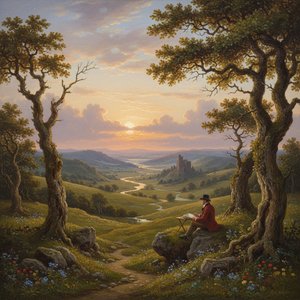
A Mountain Scene by John Crome
The Norfolk landscape holds a special place in British artistic memory, largely thanks to the unwavering dedication of artists like John Crome who tirelessly sought to capture its sublime beauty. Painted in 1806, “A Mountain Scene” exemplifies the Norwich School’s distinctive approach to landscape painting—a style characterized by understated tonal harmonies and an acute sensitivity to atmospheric conditions. This piece isn't merely a depiction of mountains; it’s an embodiment of Romantic ideals, reflecting a profound connection between humanity and the natural world.Subject Matter & Composition
The artwork presents a panoramic vista of East Anglian hills dominated by a substantial rock outcrop. The artist skillfully employs perspective to convey depth, drawing the viewer's eye upwards towards the cloudy sky—a crucial element in establishing mood and conveying the grandeur of the landscape. Two figures stand prominently positioned near the left side of the canvas, gazing out upon this breathtaking panorama. Their presence serves not only as compositional anchor but also subtly suggests contemplation and admiration for the majesty of nature.Style & Technique: Norwich School Characteristics
Crome’s technique is rooted in the Norwich School's core principles—a deliberate rejection of flamboyant brushwork favored by earlier Romantic painters. Instead, he achieves remarkable tonal gradation through meticulous layering of thin washes of oil paint, creating a velvety surface that captures the subtle nuances of light and shadow. This understated approach prioritizes observation and accuracy, mirroring the Norfolk landscape’s muted palette. The artist's masterful use of color—primarily browns, greys, and blues—creates an atmosphere of quiet contemplation and reinforces the painting’s emotional resonance.Historical Context & Romantic Ideals
“A Mountain Scene” emerged during a period marked by significant intellectual ferment – the burgeoning Romantic movement. Artists like Crome were deeply influenced by thinkers such as Edmund Burke and William Wordsworth, who championed emotion and imagination as pathways to understanding the sublime—that feeling of awe and wonder experienced when confronted with overwhelming natural beauty. The painting reflects this philosophical preoccupation, conveying not just visual information but also a spiritual appreciation for the power and majesty of the mountains.Symbolism & Emotional Impact
The rock formation itself symbolizes resilience and permanence against the forces of time and weather—a recurring motif in Romantic art reflecting anxieties about mortality alongside an affirmation of enduring natural order. The figures observing the landscape represent humanity's yearning for connection with something larger than oneself, inviting viewers to contemplate their place within the vastness of creation. Ultimately, “A Mountain Scene” succeeds in evoking a feeling of tranquility and reverence—a testament to Crome’s ability to translate visual observation into profound emotional experience. It remains an enduring symbol of Norfolk's artistic heritage and a captivating example of Romantic landscape painting at its finest.Questions et réponses
Quelle est la couleur dominante de «A Mountain Scene» de John Crome ?
La couleur qui prédomine dans « A Mountain Scene » est le Driftwood (#85734f). La couleur dominante est un atout précieux pour harmoniser une œuvre d'art avec un intérieur.
Quel format et quelle orientation d'impression sont suggérés pour «A Mountain Scene» de John Crome ?
Pour une impression de «A Mountain Scene» de John Crome, un format Large avec une orientation Portrait est recommandé.
«A Mountain Scene» de John Crome est-il une composition en portrait, en paysage ou carrée ?
L'œuvre « A Mountain Scene » est au format Portrait. Cette information est utile pour prévoir l'emplacement de sa reproduction.
Œuvres similaires


Biographie de l'artiste
Premières années et formation
- Né: Norwich, Royaume-Uni (1768)
- Décédé: 1821
- Les premières années de Crome ont été marquées par des origines modestes. Il est né à Norwich, Norfolk, fils d'un tisserand.
- À partir de l'âge de douze ans, il a travaillé comme coursier pour un médecin avant d'être apprenti chez Francis Whisler, peintre en bâtiment, de voitures et enseignes. Cela lui a permis d'acquérir des compétences fondamentales en peinture et en design.
- Une amitié importante s’est nouée pendant cette période avec Robert Ladbrooke, un apprenti imprimeur qui est également devenu un peintre paysagiste renommé. Ils partageaient une chambre et esquissaient fréquemment ensemble dans la campagne du Norfolk.
- Les influences initiales comprenaient la copie d'estampes qu'ils acquéraient, démontrant un intérêt marqué pour l'apprentissage auprès d'artistes établis.
Développement en tant qu’artiste et l’École de Norwich
- Le développement artistique de Crome a été facilité par Thomas Harvey d'Old Catton, qui lui a donné accès à sa collection d'art, lui permettant d'étudier les œuvres de Gainsborough et Hobbema.
- Il a reçu davantage de conseils et d’encouragements de Sir William Beechey R.A. et John Opie R.A., ce qui témoigne d’un lien avec des artistes importants de l’époque.
- En 1803, aux côtés de Robert Ladbrooke, Crome a fondé la Norwich Society of Artists. Cela a marqué le début officiel de l'École de Norwich, un mouvement artistique important en dehors de Londres.
- L'École de Norwich mettait l'accent sur l'observation directe de la nature et cherchait à capturer le caractère unique du paysage du Norfolk.
- Crome a été président de la société à plusieurs reprises, consolidant ainsi son rôle de leader au sein du mouvement.
Style artistique et influences
- Le style de Crome se caractérise par une sensibilité romantique, évidente dans ses coups de pinceau expressifs et ses représentations atmosphériques des paysages.
- Son sujet principal était le paysage du Norfolk, reflétant un lien profond avec son environnement local.
- Influences clés : La peinture néerlandaise du XVIIe siècle (en particulier Hobbema) et l'œuvre de Richard Wilson ont été des influences significatives sur l’approche artistique de Crome.
- Il fut parmi les premiers artistes anglais à représenter avec précision des espèces d'arbres identifiables, allant au-delà des formes généralisées dans ses paysages.
- Crome a travaillé efficacement à la fois en aquarelle et en huile, produisant plus de 300 peintures à l’huile tout au long de sa carrière.
Réalisations majeures et héritage
- La contribution de Crome à l'École de Norwich a établi une identité artistique régionale distincte, favorisant une communauté de peintres dévoués à capturer la beauté du Norfolk.
- Il a exposé treize œuvres à la Royal Academy entre 1806 et 1818, obtenant ainsi une reconnaissance au niveau national.
- Ses gravures, bien que non publiées de son vivant, ont démontré un autre aspect de son talent artistique.
- Une exposition commémorative organisée après sa mort a présenté plus de 100 de ses œuvres, soulignant l’estime dans laquelle il était tenu par ses pairs.
- L'héritage de Crome s'étend au-delà de ses œuvres d'art ; des lieux tels que Crome’s Broad et la ward Crome sont nommés en son honneur, signifiant ainsi son impact durable sur Norwich et le Norfolk.
Dernières années et décès
- En 1814, Crome a visité Paris après la défaite de Napoléon, intégrant des vues de la ville dans ses œuvres.
- Il a été maître de dessin à Norwich School pendant de nombreuses années, cultivant les talents d'artistes futurs tels que James Stark et Edward Thomas Daniell.
- Crome est décédé le 22 avril 1821, à Norwich. Ses derniers mots auraient été : « Oh Hobbema, mon cher Hobbema, comme je vous ai aimé », reflétant son profond admiration pour le maître néerlandais.

John Crome
1768 - 1821 , Royaume-Uni
L'essentiel de l'artiste
- Artistes Influencés: ['École de Norwich']
- Artistes Influents:
- Thomas Gainsborough
- Meindert Hobbema
- Richard Wilson
- Date De Décès: 22 avril 1821
- Date De Naissance: 22 décembre 1768
- Lieu De Naissance: Norwich, Royaume-Uni
- Mouvement Artistique: Romantisme, École de Norwich
- Nationalité: Anglais
- Nom Complet: John Crome
- Oeuvres Notables:
- The Lime Kiln
- Grove Scene
- Mousehold Heath
- Marlingford Grove
- Paysage avec rivière
- Clair de lune sur la Yare
Articles connexes
John Varley I: Intimate Observation & the British Romantic Landscape
Explore the serene landscapes of John Varley I, a key figure in British Romanticism. Discover his unique watercolour style, collaboration with William Blake & lasting artistic legacy. Learn about collecting Varley's work.

Les 10 Chefs-d'œuvre du Paysage Romantique : Artistes et Décor d'Intérieur
Plongez dans l'émotion du Romantisme avec les 10 plus beaux paysages de Friedrich, Turner & Delacroix. Découvrez leur histoire et trouvez l'inspiration déco idéale sur AllPaintingsStore.com !

Le Sublime et le Pittoresque : Exploration de l'Émotion et de la Nature dans la Peinture Romantique du Paysage
Explorez l'univers fascinant du sublime et du pittoresque dans la peinture romantique. Analyse approfondie de Friedrich, Kandinsky et des maîtres de ce mouvement artistique majeur. Découvrez l'émotion et la nature comme jamais auparavant.

Constable : Les 25 Chefs-d'Œuvre du Maître Anglais | AllPaintingsStore
Plongez dans l'univers de John Constable avec les 25 œuvres incontournables du maître anglais. Découvrez l'histoire, la technique et l'émotion derrière ses paysages romantiques. Reproductions de qualité muséale sur AllPaintingsStore.com.

John Singer Sargent : Les 25 Œuvres Maîtresses d'un Portraitiste Éminent | AllPaintingsStore
Plongez dans l'univers de John Singer Sargent : découvrez les 25 œuvres qui ont marqué l'histoire de l'art. Portraits impressionnants, réalisme exquis et couleurs vibrantes. Retrouvez ces chefs-d'œuvre en reproduction haute définition sur AllPaintingsStore.com.


