Aperçu en situation
 Partager
 Partager
 Détails
 Guide imprimable

 Télécharger
 Articles similaires
 Radiographie
 Voir le diaporama
 Statistiques
Dr. Richard Wright
 Acrylic On Canvas
- WallArt
- Industrial Revolution Art
 1789
1789- 19th Century
 76.0 x 64.0 cm
 Yale Center for British Art
 Afficher la suite
Reproduction à l'huile faite à la main
Huile sur toile peinte à la main, avec cadre et dimensions personnalisés, réalisée sur commande par nos artistes. ( Passer au format impression Passer au format image numérique)




P118B €10

P118H €10

P118W €10

P438Z €10

P508JH €12

P508YH €12

P805H €10

P805Z €10

P919BZ €10

P919G €10

P919XJ €10

P959ZH €10

P968JZ €12

W106C €8

W218G €10

W218JH €8

W218Y €10

W307PJ €10

W316G €10

W316PJ €8

W316Y €10

W398PJ €8

W4111J €10

W500HY €15

W500JH €15

W692G €12

W849H €8

W940BG €15

W953PJ €8




Choisissez parmi nos formats prédéfinis qui respectent les proportions originales de l’œuvre.

Vous pouvez saisir vos propres dimensions pour l'adapter à un cadre ou à un espace spécifique. Si la taille sélectionnée ne correspond pas aux proportions de l'image d'origine, nous recadrerons l'œuvre ou prolongerons la peinture avec des éléments peints à la main supplémentaires. Une maquette numérique vous sera envoyée pour approbation avant le début de la production.
Veuillez noter que l'aperçu à l'écran ne reflète pas le recadrage ou l'extension réels. Seule la maquette montrera fidèlement la composition finale.
Bien que des tailles personnalisées soient disponibles, nous vous recommandons de sélectionner une dimension dans la liste prédéfinie afin de préserver les proportions d'origine.
Après la commande, l’équipe AllPaintingsStore.com contactera le client par e-mail pour recueillir ses instructions et lui fournira une maquette d’aperçu
Livraison dans le monde entier () en 3 à 4 semaines au lieu des 5 semaines habituelles. (10 octobre). Aucun compromis sur la qualité.

Livraison express gratuite dans le monde entier

Toile de lin de haute qualité

Assurance transport complète

Garantie de remboursement des droits de douane

Garantie de fidélité des couleurs

Garantie de retour de 100 jours (uniquement en cas de défaut)

Garantie de remboursement à 100%

Tarifs dégressifs sur quantité
 L'option verre n'est disponible que pour les dimensions inférieures à 110 cm.

Dr. Richard Wright
Technique de reproduction
Format de la reproduction
-


Prix total final
€ 222
A Portrait of Disquiet: Dr. Richard Wright by Joseph Wright
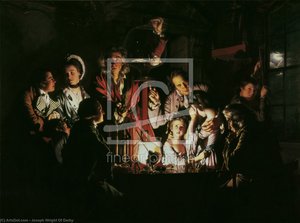
Joseph Wright’s “Dr. Richard Wright,” painted in 1789, is more than simply a likeness; it's a carefully constructed tableau that speaks volumes about the anxieties and intellectual currents swirling around England at the close of the 18th century. This intimate portrait, measuring 76 x 64 cm, immediately draws the eye to its subject – a man distinguished by his white hair, meticulously styled wig, and an expression of palpable displeasure. The dark background isn’t merely a backdrop; it actively amplifies the sitter's mood, creating a sense of contained tension that resonates with the viewer.
- The Man Himself: Dr. Richard Wright was a prominent physician and surgeon in Derby, a figure deeply involved in the burgeoning medical practices of his time. His colonial attire – a deliberate choice – situates him firmly within the historical context of 18th-century England, hinting at the era’s fascination with classical antiquity and its influence on fashion and social standing.
- Wright's Revolutionary Vision: Wright was a pivotal figure in British art, often considered the first artist to truly engage with the Industrial Revolution. While many artists of his time focused on grand historical scenes or aristocratic portraits, Wright’s work increasingly explored themes of scientific discovery, philosophical inquiry, and the dramatic impact of technological change – all powerfully evident here.
Technique and Style: A Study in Dramatic Light
Wright's masterful technique is immediately apparent. He employs a dramatic chiaroscuro—a bold contrast between light and dark—to sculpt Dr. Wright’s features and imbue the scene with an almost theatrical quality. The meticulous rendering of the wig, the subtle details of his clothing, and the careful attention to texture all contribute to the painting's remarkable realism. Wright’s brushwork is loose yet controlled, creating a sense of movement and immediacy that draws the viewer into the subject’s emotional state. This technique was influenced by Caravaggio and Rembrandt, demonstrating Wright’s deep understanding of classical artistic principles.
- Oil on Canvas: The painting is executed in oil paint on canvas, a standard medium for portraiture at the time, allowing for rich color saturation and detailed rendering.
- Chiaroscuro Mastery: Wright’s skillful use of light and shadow creates depth, volume, and dramatically emphasizes Dr. Wright's expression.
Symbolism and Historical Context
“Dr. Richard Wright” transcends a simple portrait; it’s a reflection of the intellectual ferment of the late 18th century. The subject’s demeanor – his furrowed brow, pursed lips – suggests a man grappling with complex ideas or perhaps frustrated by the limitations of contemporary medicine. The wig itself, a symbol of status and learning, underscores Wright's profession and social standing. Painted in 1789, just before the French Revolution, the painting subtly hints at the growing unrest and questioning of established authority that would soon engulf Europe.
Emotional Impact and Collector’s Value
This reproduction captures not only a likeness but also the very essence of Joseph Wright's artistic vision. “Dr. Richard Wright” is a compelling study in human emotion, rendered with technical brilliance and imbued with historical significance. A hand-painted reproduction offers an unparalleled opportunity to own a piece of art history – a window into the mind of one of England’s most innovative artists and a poignant reflection on the anxieties and aspirations of his time. Its size (76 x 64 cm) makes it suitable for a variety of interior spaces, from formal studies to more contemporary living areas.
Questions et réponses
Quels sont les droits de reproduction pour « Dr. Richard Wright » au Yale Center for British Art ?
Le statut des droits d'auteur de «Dr. Richard Wright» de Joseph Wright de Derby est clair : l'œuvre est dans le dans le domaine public - ses droits d'auteur ont expiré. Sa présence au Yale Center for British Art ne modifie pas ce statut.
À quel courant artistique «Dr. Richard Wright» de Joseph Wright de Derby appartient-il ?
«Dr. Richard Wright» de Joseph Wright de Derby appartient au mouvement Industrial Revolution Art. Ce mouvement apporte le contexte stylistique de l'œuvre.
À quelle période de la carrière de Joseph Wright de Derby appartient « Dr. Richard Wright » ?
Au cours de la carrière de Joseph Wright de Derby, « Dr. Richard Wright » s'inscrit dans la période Mature Period. Cette phase permet de le comparer aux autres œuvres de l'artiste.
Qui est l'artiste derrière « Dr. Richard Wright » ?
« Dr. Richard Wright » a été créé par Joseph Wright de Derby. Les informations présentes sur cette page décrivent l'œuvre originale de Joseph Wright de Derby.
Quel âge avait Joseph Wright de Derby lors de la création de « Dr. Richard Wright » ?
Joseph Wright de Derby a réalisé « Dr. Richard Wright » à l'âge de 55. L'artiste est né en 1734 et l'œuvre date de 1789.
Quelle est la recommandation d'impression pour « Dr. Richard Wright » : quel format et quelle orientation ?
Pour une impression de «Dr. Richard Wright» de Joseph Wright de Derby, un format Large avec une orientation Portrait est recommandé.
Quelle est la date de création de «Dr. Richard Wright» de Joseph Wright de Derby ?
L'œuvre «Dr. Richard Wright» de Joseph Wright de Derby date de 1789.
Œuvres similaires


Biographie de l'artiste
Joseph Wright de Derby : Une Vie Illuminée par la Science et l'Art
Joseph Wright de Derby, né le 3 septembre 1734 à Irongate, près de Derby, et décédé le 29 août 1797 dans la même ville, est un peintre britannique majeur, reconnu pour son rôle pionnier dans la représentation de l’esprit de la révolution industrielle. Il fut le premier artiste professionnel à saisir cette période de transformation avec une sensibilité unique.Formation et Premières Œuvres
Wright a reçu sa première formation artistique en autodidacte, copiant des gravures. En 1751, il s'installe à Londres pour étudier auprès du portraitiste Thomas Hudson, où il perfectionne ses compétences techniques. De retour à Derby, il se consacre initialement au portrait, mais rapidement, son style évolue vers une exploration audacieuse de la lumière et des ombres, influencée par les œuvres de Alexander Cozens. Ses premières œuvres témoignent déjà d'une maîtrise du clair-obscur qui deviendra sa marque distinctive.Le Maître du Clair-Obscur et des Scènes Éclairées
La technique du clair-obscur est au cœur de l’œuvre de Wright. Il utilise la lumière artificielle, souvent celle des bougies ou des lampes à huile, pour créer des effets dramatiques et révéler les détails avec une précision saisissante. Ses tableaux représentant des expériences scientifiques, comme Un Expérimental sur un Oiseau dans la Pompe à Air, sont particulièrement emblématiques de cette approche. Ces scènes, souvent inspirées des réunions de la Lunar Society, un groupe d'intellectuels et d’industriels influents, témoignent de son intérêt pour les progrès scientifiques et leur impact sur la société. Il peint également des paysages nocturnes, comme Dovedale par Lune, où la lumière lunaire transforme le paysage en une scène onirique.Influences et Évolution Artistique
Bien que Wright ait été influencé par les maîtres flamands et hollandais dans son utilisation du clair-obscur, il a su développer un style personnel et original. Son séjour à Rome de 1773 à 1775 lui permet d'étudier l’art classique et d’approfondir sa compréhension de la lumière. À son retour en Angleterre, il explore également des thèmes plus littéraires et historiques, témoignant d'une évolution artistique constante. Ses portraits, comme Le Révérend Basil Bury Beridge, révèlent une grande finesse psychologique et un souci du détail dans la représentation des personnages.Héritage et Importance Historique
Joseph Wright de Derby a laissé une œuvre considérable qui témoigne de son talent exceptionnel et de sa vision novatrice. Il est considéré comme l'un des artistes britanniques les plus importants du XVIIIe siècle, un précurseur de la peinture industrielle et un témoin privilégié des transformations sociales et scientifiques de son époque. Son utilisation audacieuse du clair-obscur et sa capacité à capturer l’atmosphère particulière des scènes éclairées par une lumière artificielle ont fait de lui un artiste unique dans l'histoire de l'art britannique. Il a contribué à façonner la perception de la science et de l'industrie au XVIIIe siècle, offrant aux générations futures un regard fascinant sur cette période charnière de l’histoire.
Joseph Wright de Derby
1734 - 1797 , Royaume-Uni
En bref
- Artistes Influents:
- Alexander Cozens
- Thomas Hudson
- Date De Décès: 29 août 1797
- Date De Naissance: 3 septembre 1734
- Lieu De Naissance: Irongate, Royaume-Uni
- Mouvement Artistique: Clair-obscur, Lumières
- Nationalité: Britannique
- Nom Complet: Joseph Wright de Derby
- Oeuvres Notables:
- Un Expérimental sur un Oiseau
- Le révérend Basil Bury Beridge
- Dovedale par clarté de lune
- A Philosopher Lecturing on the Orrery
Articles similaires

L'Huile sur Toile : Exploration Historique et Technique d'un Médium Artistique Intemporel
Explorez l'histoire fascinante de la peinture à l'huile, des techniques ancestrales aux maîtres flamands comme Van Eyck. Découvrez les secrets des pigments, liants et glacis pour comprendre cet art intemporel.

The Enduring Legacy of Oil on Canvas: Technique, History & Aesthetic Impact
Explore the rich history & techniques of oil painting – from Renaissance masters to Impressionism. Discover pigments, layering methods, and why this timeless medium endures. Expert insights for artists & art enthusiasts.

Illuminating Enlightenment: Joseph Wright of Derby's Scientific Vision
Explore the captivating world of Joseph Wright of Derby, a pioneer of Enlightenment art. Discover his masterful chiaroscuro, scientific themes & investment potential. Expert analysis for collectors.

The Enduring Power of Painting: A Historical & Contemporary Exploration of Form and Emotion
Explore the rich history & enduring techniques of oil painting with AllPaintingsStore. Discover masterpieces, learn about art collecting, and find authentic handmade reproductions crafted by skilled artists.

L'héritage durable de la peinture à l'huile : technique, histoire et pratique contemporaine
Explorez l'histoire fascinante de la peinture à l'huile, des techniques ancestrales aux pratiques contemporaines. Découvrez les maîtres, apprenez et trouvez votre œuvre d'art idéale chez .