


 Aperçu en situation
 Partager
 Partager
 Détails
 Guide imprimable

 Télécharger
 Articles similaires
 Radiographie
 Voir le diaporama
 Statistiques
Objet-Dard


 Afficher la suite
L’œuvre d'art présentée sur cette page est protégée par le droit d'auteur, ce qui signifie que nous ne pouvons légalement créer ou vendre de reproduction identique. Cette protection est appliquée en vertu d'accords internationaux tels que la Convention de Berne et par les lois nationales, notamment celles énoncées par le Loi américaine sur le droit d'auteur - Titre 17.
En tant qu'alternative respectueuse et légale, nous proposons des œuvres d'art personnalisées, peintes à la main et inspirées de l'original. Nos artistes talentueux et professionnels étudient avec soin le style, l'ambiance et l'essence artistique de l'œuvre originale pour créer une pièce nouvelle et unique qui évoque la même émotion — tout en restant une création originale en soi.
Cette méthode est pleinement conforme aux réglementations sur le droit d'auteur car elle ne repose pas sur la copie ou la duplication de l'œuvre protégée. Il s'agit plutôt d'une réinterprétation créative — une nouvelle peinture qui s'inspire de l'original sans pour autant lui être identique.
Reproduction à l'huile faite à la main
Huile sur toile peinte à la main, avec cadre et dimensions personnalisés, réalisée sur commande par nos artistes. ( Passer au format impression Passer au format image numérique)




P118B €10

P118H €10

P118W €10

P438Z €10

P508JH €12

P508YH €12

P805H €10

P805Z €10

P919BZ €10

P919G €10

P919XJ €10

P959ZH €10

P968JZ €12

W106C €8

W218G €10

W218JH €8

W218Y €10

W307PJ €10

W316G €10

W316PJ €8

W316Y €10

W398PJ €8

W4111J €10

W500HY €15

W500JH €15

W692G €12

W849H €8

W940BG €15

W953PJ €8




Choisissez parmi nos formats prédéfinis qui respectent les proportions originales de l’œuvre.

Saisissez la largeur et la hauteur souhaitées, pour s'adapter à votre cadre ou à votre mur. Cette œuvre est peinte à la main ; ainsi, pour un format de forme différente, l'artiste peut peindre un peu plus autour du tableau ou réduire légèrement les bords — c'est vous qui choisissez. Nous vous envoyons une maquette numérique pour approbation avant que la peinture ne commence. L'image présentée sur cette page ne reflète pas le résultat réel — seule la maquette le fait.
Après la commande, l’équipe AllPaintingsStore.com contactera le client par e-mail pour recueillir ses instructions et lui fournira une maquette d’aperçu
Livraison dans le monde entier () en 3 à 4 semaines au lieu des 5 semaines habituelles. (24 octobre). Aucun compromis sur la qualité.

Livraison express gratuite dans le monde entier

Toile de lin de haute qualité

Assurance transport complète

Garantie de remboursement des droits de douane

Garantie de fidélité des couleurs

Garantie de retour de 100 jours (uniquement en cas de défaut)

Garantie de remboursement à 100%

Tarifs dégressifs sur quantité
 L'option verre n'est disponible que pour les dimensions inférieures à 110 cm.

Objet-Dard
Technique de reproduction
Format de la reproduction
-


Prix total final
€ 227
A Study in Rust and Rebellion: Marcel Duchamp’s *Objet-Dard*
Marcel Duchamp's *Objet-Dard*, or "Little Object," is not merely a photograph of a rusted pipe; it’s a meticulously crafted provocation, a cornerstone of the Dada movement, and a profound meditation on the very definition of art. Captured with an almost clinical precision, the image confronts us with a commonplace object – a simple wooden pipe – transformed into something unsettlingly significant through Duchamp's deliberate framing and selection. This seemingly insignificant detail holds within it a potent critique of artistic convention and a radical assertion of the artist’s role in shaping perception.
- Subject Matter: The core subject is undeniably a pipe, yet its inherent ordinariness is deliberately destabilized. Duchamp elevates this discarded item to the status of artwork through his act of selection and presentation.
- Composition & Technique: The close-up shot emphasizes the pipe’s texture – the rough grain of the wood, the intricate patterns of rust, and most crucially, the perfectly circular hole at its center. This focus draws the viewer's eye directly to this point of vulnerability, a deliberate disruption of traditional artistic representation.
- Historical Context: Created in 1917, *Objet-Dard* emerged during a period of immense social and political upheaval – World War I had shattered established norms, and the rise of Dada challenged all notions of beauty, reason, and order. Duchamp’s work perfectly embodies this spirit of rebellion against artistic dogma.
The Seeds of Dada: Challenging Artistic Boundaries
Duchamp's creation of *Objet-Dard* aligns directly with the core tenets of Dadaism, a movement born from disillusionment and anti-rationality. Dada artists rejected traditional aesthetic values, embracing chance, absurdity, and irony as tools for dismantling established artistic hierarchies. Duchamp’s “readymades,” such as this pipe, were not created through conventional artistic processes – there was no painting, sculpting, or crafting involved. Instead, he selected an existing object from the everyday world and presented it as art, effectively declaring that the artist's role could be simply to choose and display.
- Conceptual Art Precursor: *Objet-Dard* is widely considered a seminal work in the development of conceptual art. It shifted the emphasis from the physical object itself to the idea behind it – the questioning of artistic value, the role of the artist, and the nature of perception.
- Symbolism of Ruin: The rusted pipe carries symbolic weight, representing decay, obsolescence, and perhaps even the futility of war. The hole within the pipe can be interpreted as a void, an absence, or a point of vulnerability – mirroring the anxieties of the era.
A Legacy of Provocation
*Objet-Dard* continues to resonate today because it remains profoundly relevant to contemporary debates about art and its purpose. Duchamp’s work forces us to confront our own assumptions about what constitutes “art” and who gets to decide. It's a testament to the power of simple objects, when presented with intention, to provoke thought and challenge convention. AllPaintingsStore.com offers meticulously crafted hand-painted reproductions that capture the essence of this iconic piece, allowing you to experience Duchamp’s revolutionary vision firsthand.
- Hand-Painted Reproduction: Our reproduction utilizes traditional artistic techniques, ensuring a faithful representation of Duchamp's original intent while benefiting from the artistry of skilled hand-painters.
- Material Quality: Printed on archival quality canvas with fade-resistant inks for lasting beauty and preservation.
Questions et réponses
Existe-t-il une fiche informative sur «Objet-Dard» de Marcel Duchamp destinée aux étudiants ?
Une page Guide est disponible pour «Objet-Dard» de Marcel Duchamp : une fiche d'information imprimable sur l'œuvre, conçue pour les étudiants et un usage pédagogique en classe.
Puis-je visionner « Objet-Dard » sous forme de diaporama en plein écran ?
Le diaporama de « Objet-Dard » peut être visionné sur la page Diaporama de l'œuvre.
Comment le médium et le mouvement se conjuguent-ils dans « Objet-Dard » ?
« Objet-Dard » est réalisé en Acrylic On Canvas, dans le style Dada Movement.
Œuvres similaires


Biographie de l'artiste
jeune vie et débuts artistiques
marcel duchamp, peintre, sculpteur, joueur d'échecs et écrivain français-américain, est né le 28 juillet 1887 à Blainville-Crevon, en Normandie, France. Sa famille, connue pour ses inclinations culturelles, a encouragé son intérêt précoce pour l’art. Le parcours artistique de Duchamp a commencé avec des styles post-impressionnistes, expérimentant avec les techniques et les sujets classiques.évolution artistique et œuvres notables
- L'œuvre de marcel duchamp est associée au cubisme, à l’art conceptuel et au dadaïsme, bien qu'il soit prudent quant à son utilisation du terme dada.
- L'une de ses œuvres les plus célèbres, Fountain (1917), un urinoir signé « r. mutt », est un exemple de ses ready-mades, remettant en question la notion de ce qui constitue l’art.
- Portrait de joueurs d'échecs (1911), une œuvre cubiste, met en évidence son intérêt pour le jeu et ses aspects stratégiques.
- To be looked at (from the other side of the glass) with one eye, close to, for almost an hour (1945) est une autre œuvre notable, reflétant ses inclinations dadaïstes.
influence et héritage
L'impact de Duchamp sur l’art du XXe siècle est immense. Il, avec Pablo Picasso et Henri Matisse, a défini les arts plastiques au début du XXe siècle. Son approche conceptuelle de l’art a influencé des générations d’artistes.- Explorez davantage les œuvres de Duchamp sur AllPaintingsStore : Marcel Duchamp | œuvres
- Découvrez le Musée Ohara d'art, au Japon, qui présente des collections d’art occidental, dont certaines influencées par le style de Duchamp : Musée Ohara d'art, Japon
- Apprenez-en davantage sur le lettrisme, un mouvement influencé par le dadaïsme et le surréalisme, dans lequel Duchamp participait : Mouvement artistique du lettrisme
conclusion
L’approche énigmatique de l’art de Marcel Duchamp, combinant des éléments conceptuels et dadaïstes, a laissé une marque indélébile sur le monde de l’art. Son héritage continue d'inspirer les artistes et d'influencer le développement de l’art moderne et contemporain. Franck Scurti, artiste français connu pour son art conceptuel, suit les traces de cet artiste pionnier.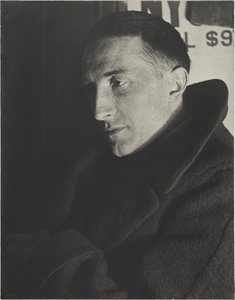
Marcel Duchamp
1887 - 1968 , France
En bref
- Artistes Influencés: ['Franck Scurti']
- Date De Décès: 2 octobre 1968
- Date De Naissance: 28 juillet 1887
- Influence:
- Pablo Picasso
- Henri Matisse
- Lieu De Naissance: Blainville-sur-Mer, France
- Mouvement Artistique:
- Cubisme
- Dadaïsme
- Art conceptuel
- Nationalité: Français-Américain
- Nom Complet: Marcel Duchamp
- Oeuvres Notables:
- Fontaine
- Portrait de joueurs d'échecs
- La Grande Verrière
- Boîte-en-valise
Articles connexes

AllPaintingsStore.com F.A.Q.: Elevate Your Decor with Premium Textured Giclée Prints
Discover the distinction of AllPaintingsStore.com premium textured Giclée prints. Expertly crafted with archival 12-color pigments and museum-grade substrates, our prints offer unparalleled vividness for the discerning collector seeking luxury, durability, and timeless elegance.


