


 Aperçu en situation
 Envoyer
 Partager
 Détails de l'œuvre
 Guide
Guide

 Télécharger l'image
 Articles similaires
 Radiographie
 Diaporama
 Statistiques
Play


 Lire la suite
L’œuvre d'art présentée sur cette page est protégée par le droit d'auteur, ce qui signifie que nous ne pouvons légalement créer ou vendre de reproduction identique. Cette protection est appliquée en vertu d'accords internationaux tels que la Convention de Berne et par les lois nationales, notamment celles énoncées par le Loi américaine sur le droit d'auteur - Titre 17.
Cette méthode est pleinement conforme aux réglementations sur le droit d'auteur car elle ne repose pas sur la copie ou la duplication de l'œuvre protégée. Il s'agit plutôt d'une réinterprétation créative — une nouvelle peinture qui s'inspire de l'original sans pour autant lui être identique.
Giclées et impressions d'art
Impressions giclées ou sur toile de qualité musée, avec une production rapide et des finitions au choix. ( Commander la reproduction peinte à la main Passer au format numérique)




P118B €10

P118H €10

P118W €10

P438Z €10

P508JH €12

P508YH €12

P805H €10

P805Z €10

P919BZ €10

P919G €10

P919XJ €10

P959ZH €10

P968JZ €12

W106C €8

W218G €10

W218JH €8

W218Y €10

W307PJ €10

W316G €10

W316PJ €8

W316Y €10

W398PJ €8

W4111J €10

W500HY €15

W500JH €15

W692G €12

W849H €8

W940BG €15

W953PJ €8




Choisissez parmi nos formats prédéfinis qui respectent les proportions originales de l’œuvre.

Saisissez la largeur et la hauteur souhaitées pour qu'elles s'adaptent à votre cadre ou à votre mur. Une impression peut être recadrée, mais jamais agrandie au-delà de l'image originale ; ainsi, un format de forme différente entraînera la perte d'une partie de l'image. Nous vous envoyons une maquette numérique pour approbation avant toute impression. L'image présentée sur cette page ne montre pas le recadrage réel — seule la maquette le permet.
Livraison dans le monde entier () en 2 semaines au lieu des 4/5 semaines habituelles. (27 octobre)

Livraison express gratuite dans le monde entier

Toile de lin de qualité supérieure

Assurance transport complète

Garantie de remboursement des droits de douane

Garantie de fidélité des couleurs

Politique de retour de 100 jours (uniquement en cas de défaut)

Garantie de remboursement à 100%

Offre de tarifs dégressifs
 L'option verre n'est disponible que pour les dimensions inférieures à 110 cm.

Play
Giclées et impressions d'art
Format de la reproduction
-


Prix total
€ 56
A Moment of Controlled Chaos: Marcel Duchamp’s “Play” (1902)
Marcel Duchamp's "Play," painted in 1902, is more than just a depiction of a woman playing tennis; it’s a carefully constructed meditation on the very nature of artistic creation and perception. This seemingly straightforward scene – a female figure poised mid-swing with a tennis racket – immediately reveals itself to be a pivotal work within Duchamp's burgeoning rebellion against traditional artistic conventions. The painting, imbued with a distinctly vintage aesthetic, speaks volumes about the artist’s evolving approach, moving beyond mere representation towards a conceptual engagement with the subject matter.
The Birth of Conceptual Art
Created during a period of intense experimentation within the European art world – encompassing Impressionism, Post-Impressionism, and the nascent movements of Cubism – “Play” anticipates Duchamp’s later embrace of Dada and his groundbreaking role as one of the first conceptual artists. Duchamp's decision to paint this scene, rather than meticulously rendering it with traditional techniques, signals a deliberate shift in focus. He isn’t interested in capturing an objective reality; instead, he is exploring the *idea* of tennis, the act of play itself, and the viewer’s interpretation of that action.
- Subject Matter: The central figure embodies both grace and tension, a visual paradox that invites contemplation.
- Composition: The carefully arranged balls – one strategically placed near the top left corner, another towards the bottom right – disrupt any sense of naturalistic perspective, further emphasizing the artwork’s conceptual intent.
Technique and Style – A Calculated Simplicity
Duchamp's technique in “Play” is characterized by a remarkable restraint. The brushstrokes are loose and confident, suggesting a deliberate avoidance of excessive detail. This simplicity isn’t a sign of carelessness; rather, it’s a calculated choice that amplifies the painting’s impact. The muted color palette – predominantly earthy tones with subtle hints of white – contributes to the vintage feel and adds to the overall sense of quiet contemplation. The artist's skill lies not in technical virtuosity but in his ability to distill an idea into its purest form.
Symbolism and Emotional Resonance
Beyond the literal depiction of a tennis game, “Play” carries significant symbolic weight. The act of play itself represents a release from constraint, a moment of unburdened joy and spontaneity – qualities that Duchamp increasingly sought to explore in his work. The woman’s posture suggests both power and vulnerability, inviting viewers to consider the complexities of human experience. It's a scene frozen in time, capturing an ephemeral moment of intense concentration and potential victory.
A Legacy of Innovation
"Play" stands as a crucial early work by Marcel Duchamp, demonstrating his nascent desire to challenge established artistic norms. Its influence can be seen throughout the 20th century, paving the way for movements like Dada and Surrealism. Today, this painting remains a powerful testament to Duchamp’s revolutionary spirit – a reminder that art can be found not just in what is created, but also in what is questioned.
Questions et réponses
Quelle taille de reproduction est suggérée pour «Play» de Marcel Duchamp ?
Une reproduction en Large est suggérée pour «Play» de Marcel Duchamp. Le format peut être ajusté tout en conservant les proportions.
Quelle atmosphère se dégage de « Play » ?
L'atmosphère générale de «Play» de Marcel Duchamp est Nostalgic. Cette ambiance décrit l'impression globale de l'œuvre.
Quel format et quelle orientation d'impression sont suggérés pour «Play» de Marcel Duchamp ?
Pour une impression de «Play» de Marcel Duchamp, un format Large avec une orientation Portrait est recommandé.
Œuvres similaires


Biographie de l'artiste
jeune vie et débuts artistiques
marcel duchamp, peintre, sculpteur, joueur d'échecs et écrivain français-américain, est né le 28 juillet 1887 à Blainville-Crevon, en Normandie, France. Sa famille, connue pour ses inclinations culturelles, a encouragé son intérêt précoce pour l’art. Le parcours artistique de Duchamp a commencé avec des styles post-impressionnistes, expérimentant avec les techniques et les sujets classiques.évolution artistique et œuvres notables
- L'œuvre de marcel duchamp est associée au cubisme, à l’art conceptuel et au dadaïsme, bien qu'il soit prudent quant à son utilisation du terme dada.
- L'une de ses œuvres les plus célèbres, Fountain (1917), un urinoir signé « r. mutt », est un exemple de ses ready-mades, remettant en question la notion de ce qui constitue l’art.
- Portrait de joueurs d'échecs (1911), une œuvre cubiste, met en évidence son intérêt pour le jeu et ses aspects stratégiques.
- To be looked at (from the other side of the glass) with one eye, close to, for almost an hour (1945) est une autre œuvre notable, reflétant ses inclinations dadaïstes.
influence et héritage
L'impact de Duchamp sur l’art du XXe siècle est immense. Il, avec Pablo Picasso et Henri Matisse, a défini les arts plastiques au début du XXe siècle. Son approche conceptuelle de l’art a influencé des générations d’artistes.- Explorez davantage les œuvres de Duchamp sur AllPaintingsStore : Marcel Duchamp | œuvres
- Découvrez le Musée Ohara d'art, au Japon, qui présente des collections d’art occidental, dont certaines influencées par le style de Duchamp : Musée Ohara d'art, Japon
- Apprenez-en davantage sur le lettrisme, un mouvement influencé par le dadaïsme et le surréalisme, dans lequel Duchamp participait : Mouvement artistique du lettrisme
conclusion
L’approche énigmatique de l’art de Marcel Duchamp, combinant des éléments conceptuels et dadaïstes, a laissé une marque indélébile sur le monde de l’art. Son héritage continue d'inspirer les artistes et d'influencer le développement de l’art moderne et contemporain. Franck Scurti, artiste français connu pour son art conceptuel, suit les traces de cet artiste pionnier.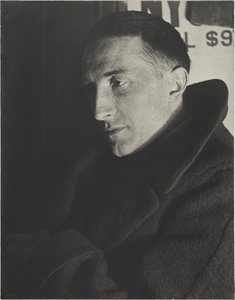
Marcel Duchamp
1887 - 1968 , France
L'essentiel de l'artiste
- Artistes Influencés: ['Franck Scurti']
- Date De Décès: 2 octobre 1968
- Date De Naissance: 28 juillet 1887
- Influence:
- Pablo Picasso
- Henri Matisse
- Lieu De Naissance: Blainville-sur-Mer, France
- Mouvement Artistique:
- Cubisme
- Dadaïsme
- Art conceptuel
- Nationalité: Français-Américain
- Nom Complet: Marcel Duchamp
- Oeuvres Notables:
- Fontaine
- Portrait de joueurs d'échecs
- La Grande Verrière
- Boîte-en-valise
Articles connexes

AllPaintingsStore.com F.A.Q.: Elevate Your Decor with Premium Textured Giclée Prints
Discover the distinction of AllPaintingsStore.com premium textured Giclée prints. Expertly crafted with archival 12-color pigments and museum-grade substrates, our prints offer unparalleled vividness for the discerning collector seeking luxury, durability, and timeless elegance.


