


 Aperçu en situation
 Partager
 Partager
 Détails

 Télécharger l'image
 Articles similaires
 Radiographie
 Voir le diaporama
Two angels and two devils
 Acrylic
- WallArt
- Early Renaissance
 1469
1469 43.0 x 351.0 cm
 Afficher la suite
Giclées et impressions d'art
Impressions giclées ou sur toile de qualité musée, avec une production rapide et des finitions au choix. ( Acheter la peinture faite à la main Acheter l'image)




P118B $10

P118H $10

P118W $10

P438Z $10

P508JH $12

P508YH $12

P805H $10

P805Z $10

P919BZ $10

P919G $10

P919XJ $10

P959ZH $10

P968JZ $12

W106C $8

W218G $10

W218JH $8

W218Y $10

W307PJ $10

W316G $10

W316PJ $8

W316Y $10

W398PJ $8

W4111J $10

W500HY $15

W500JH $15

W692G $12

W849H $8

W940BG $15

W953PJ $8




Choisissez parmi nos formats prédéfinis qui respectent les proportions originales de l’œuvre.

Vous pouvez saisir vos propres dimensions pour vous adapter à un cadre ou à un espace spécifique. Si la taille sélectionnée ne correspond pas aux proportions de l'image originale, nous recadrerons l'œuvre ou étendrons l'image avec une bordure en miroir ou une couleur unie. Une maquette numérique vous sera envoyée pour approbation avant le début de la production.
Veuillez noter que l'aperçu à l'écran ne reflète pas le recadrage ou l'extension réelle. Seule la maquette montrera avec précision la composition finale.
Bien que des tailles personnalisées soient disponibles, nous vous recommandons de choisir une dimension dans la liste prédéfinie afin de préserver les proportions originales.
Livraison dans le monde entier () en 2 semaines au lieu des 4/5 semaines habituelles. (24 août)

Livraison express gratuite dans le monde entier

Toile de lin de haute qualité

Assurance transport complète

Garantie de remboursement des droits de douane

Garantie de fidélité des couleurs

Politique de retour de 60 jours (uniquement en cas de défaut)

Garantie de remboursement à 100%

Tarifs dégressifs sur quantité
 L'option verre n'est disponible que pour les dimensions inférieures à 110 cm.

Two angels and two devils
Giclées et impressions d'art
Format de la reproduction
-


Prix total final
$ 64
Description de la pièce
A Pioneering Vision of Spiritual Drama: Paolo Uccello’s “Two Angels and Two Devils”
Paolo Uccello's "Two Angels and Two Devils," completed in 1469, stands as a cornerstone of Early Renaissance art—a testament to his revolutionary approach to perspective and an embodiment of the period’s fascination with theological narratives. More than just a depiction of biblical figures, this painting represents a profound exploration of moral duality and the human struggle between good and evil, skillfully rendered through meticulous observation and innovative artistic techniques. Giorgio Vasari famously recounted Uccello's obsessive dedication to mastering linear perspective, spending countless hours studying mathematical principles to achieve an unprecedented illusion of depth within his canvases—a pursuit that cemented his legacy as a true innovator.The Anatomy of Perspective: Uccello’s Mathematical Breakthrough
Uccello wasn’t merely interested in portraying beauty; he sought to represent reality itself with astonishing accuracy. His meticulous calculations and diagrams, documented in his own treatise “Lives of the Most Excellent Painters,” Sculptors, and Architects, demonstrate a commitment to scientific rigor rarely seen at the time. He painstakingly constructed a stage-like setting—a dining room adorned with furniture, beds, couches, and a landscape backdrop—to illustrate the principles of aerial perspective. This technique cleverly simulates atmospheric haze, reducing color intensity and blurring distant objects, creating an immersive experience for the viewer that transcends mere visual representation. The artist’s deliberate framing contributes to this illusion, guiding the eye towards a central vanishing point – a pivotal element in conveying spatial realism.Symbolism Within Sacred Narrative
The composition itself is laden with symbolic significance. The two angels, positioned on the left side of the painting, represent divine grace and righteousness—their flowing robes and majestic wings convey an aura of serenity and spiritual authority. Their posture exudes calm contemplation, reflecting the virtues associated with God’s benevolent influence. Conversely, the devils dominate the right side, embodying temptation and darkness. Their grotesque features and twisted postures underscore their opposition to angelic ideals, symbolizing evil's insidious intrusion into human affairs. The central figure—a man lying on a bed—represents humanity caught between these opposing forces—a poignant reminder of the ongoing battle for moral fortitude.A Window Into Florentine Renaissance Thought
“Two Angels and Two Devils” reflects the broader intellectual climate of Florence during Uccello’s era – a period marked by burgeoning humanist scholarship alongside fervent religious devotion. The painting exemplifies the Renaissance preoccupation with reconciling faith and reason, mirroring the philosophical debates surrounding Augustine's theology and its influence on artistic interpretation. Uccello’s masterful use of color—particularly the vibrant reds and blues—further enhances the dramatic impact of the scene, capturing not only visual beauty but also conveying emotional intensity. It is a piece that invites contemplation on themes of morality, spirituality, and the human condition – enduring legacies of Uccello's artistic vision.A Legacy Enduring Through Reproduction
Today, reproductions of “Two Angels and Two Devils” continue to inspire admiration for their technical brilliance and profound symbolic depth. AllPaintingsStore offers exceptional quality prints that allow collectors and interior designers alike to experience the captivating artistry of Paolo Uccello firsthand—bringing a masterpiece of Early Renaissance art into homes around the world.Œuvres similaires


Biographie de l'artiste
jeunesse et formation
Paolo Uccello, né Paolo di Dono, était un peintre et mathématicien italien distingué de Florence. Il est connu pour ses travaux pionniers sur la perspective visuelle dans l’art. Né en 1397, la jeunesse d'Uccello n'est pas bien documentée, mais il est connu qu'il a été apprenti du célèbre sculpteur Lorenzo Ghiberti de 1412 à 1416.carrière et œuvres notables
La carrière d'Uccello s’est étendue sur plus de quatre décennies, au cours desquelles il a produit de nombreux œuvres d’art, notamment des peintures, des fresques et des altarpieces. Certaines de ses œuvres les plus notables comprennent :- La naissance de la Vierge (Renaissance primitive, huile), une peinture présentant son utilisation de la perspective pour créer un sentiment de profondeur.
- Fresques de San Miniato al Monte 03 (Renaissance primitive, huile), une fresque démontrant son utilisation innovante de la couleur et de la lumière.
- Adoration du bambino (Renaissance primitive, huile), une peinture présentant une représentation très détaillée et naturaliste de la forme humaine.
- Studio di cavaliere (Renaissance primitive, huile), un autoportrait présentant son utilisation confiante de sujets autonomes dans l’art.
influence et héritage
Le travail d'Uccello a eu un impact significatif sur le développement de l’art de la Renaissance. Son utilisation de la perspective et son accent sur la création d’un sentiment de profondeur dans ses peintures ont influencé de nombreux artistes, dont Albrecht Dürer, qui était également connu pour son travail pionnier dans le domaine de la perspective. principales mouvements artistiques :- l’art de la Renaissance primitive
- Renaissance italienne
- gothique tardif
- Paolo Uccello (1397-1475)
- Albrecht Dürer (1471-1528)
- Lorenzo Ghiberti (1379-1455)
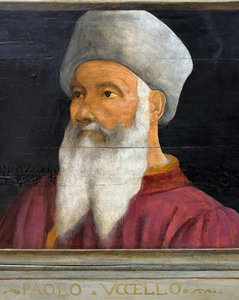
Paolo Uccello
1397 - 1475 , Italie
En bref
- Artistes Influents:
- Lorenzo Ghiberti
- Donatello
- Date De Décès: 1475
- Date De Naissance: 1397
- Influence Sur Les Artistes: ['Albrecht Dürer']
- Lieu De Naissance: Pratovecchio, Italie
- Mouvement Artistique: Renaissance primitive
- Nationalité: Italienne
- Nom Complet: Paolo Uccello
- Oeuvres Notables:
- La Bataille de San Romano
- Naissance de la Vierge
- Saint Georges et le Dragon
Articles similaires

Italian Renaissance Art: A Procurement Guide to Timeless Masterpieces for High-End Hotel Interiors
A professional procurement guide for hotel designers seeking Italian Renaissance masterpieces. Discover how to utilize chiaroscuro, custom oil reproductions, and large-scale murals to elevate hospitality interiors with timeless, high-impact classical art.


