


The Mechanics of the Vanishing Point
 Filippo Brunelleschi
. Renaissance architect and engineer who pioneered linear perspective and designed Florence's dome.
To understand how a flat surface can appear to hold infinite space, we must first look at how light and geometry interact. Linear perspective is a mathematical system designed to mimic how the human eye perceives the world. It relies on the optical fact that an object appears smaller as its distance from the observer increases. This is not a mere suggestion of depth; it is a calculated reconstruction of reality. When we look at a straight road stretching toward the horizon, the parallel edges do not stay parallel in our vision; they appear to move toward a single, central point. This point is the vanishing point, and it sits upon the horizon line, which is positioned at the eye level of the viewer.
In the history of art, this was a radical departure from the medieval tradition. Before these mathematical rules were formalized, artists often used hierarchical scaling, where the size of a figure was determined by their religious or social importance rather than their physical position in space. A king might be painted much larger than a soldier, even if they stood on the same ground. The shift toward a single vanishing point changed the viewer's relationship with the image. Instead of looking at a symbolic arrangement, the viewer began to look through a window into a measurable, logical world.
This transition is visible in the early experiments of Filippo Brunelleschi. Around 1420, he demonstrated his discovery by using a mirror and a small hole to show how a painted building could align perfectly with the actual architecture in front of him. By establishing a fixed point of view, he provided artists with a tool to organize a unified scene, ensuring that every element occupied a specific, logical place in a three-dimensional environment.
The vanishing point acts as the anchor for the entire composition. It dictates where the eye travels and how the viewer perceives the scale of the world depicted on the canvas.
The Mathematical Foundation of Spatial Logic
 Leon Battista Alberti
 (1404-1472): Renaissance polymath! Architect, writer, mathematician & humanist. Explore his groundbreaking designs like Palazzo Rucellai & Tempio Malatestiano and theories on perspective.
The transition from intuitive depth to precise mathematical perspective required a rigorous understanding of geometry. While Brunelleschi pioneered the practical application of these ideas, it was Leon Battista Alberti who helped formalize the rules in his treatise De pictura around 1435. He provided the framework that allowed painters to move beyond simple approximations. This mathematical rigor ensured that the receding lines, known as orthogonals, would meet at a single point, creating a sense of order and logic that the human brain recognizes as "real."
This logic is not just about lines; it is about the relationship between the observer and the subject. The system assumes an imaginary flat plane placed in front of the object being observed. By drawing straight lines from every point of an object to the observer's eye, the artist can map exactly where those points intersect the picture plane. This method transforms a two-dimensional surface into a three-dimensional stage, making the painted space feel like a natural extension of the room where the artwork hangs.
We see this precision in the works of Piero della Francesca, who expanded upon Alberti's ideas. In his writings, such as De Prospectiva pingendi, he moved beyond the ground plane to explain how complex solids and shapes should appear when viewed from different angles. His work brought a level of scientific accuracy to painting that had never been seen before, treating the canvas as a field of geometric truth.
By applying these mathematical principles, artists moved from creating symbols to creating environments that obey the laws of physics.
Foreshortening and the Illusion of Volume
If vanishing points provide the structure, foreshortening provides the life. Foreshortening is the technique used to represent an object as it appears to the eye when it is not perpendicular to the viewer. When an object is parallel to your line of sight, its dimensions appear shorter than they actually are. A limb reaching toward the viewer, or a pillar receding into the distance, must be painted with these compressed proportions to maintain the illusion of volume. Without foreshortening, a figure would look like a flat cutout rather than a solid body occupying space.
This technique is essential for creating the sensation of weight and mass. When an artist correctly calculates how a body or an object recedes, they are essentially tricking the brain into perceiving depth through scale reduction. The perceived size of an object decreases in direct proportion to its distance, and foreshortening ensures that the orientation of that object feels natural within the established perspective.
Consider the works of Donatello, who used geometrical perspective to give his sculptures and paintings a sense of physical presence. By mastering the way limbs and drapery recede, he allowed his figures to inhabit a space that felt tangible. This ability to render volume through mathematical distortion is what separates a flat illustration from a living scene.
Foreshortening turns a collection of shapes into a collection of bodies, giving the viewer the sensation that they could reach out and touch the subjects.
Architectural Anchors and Compositional Flow
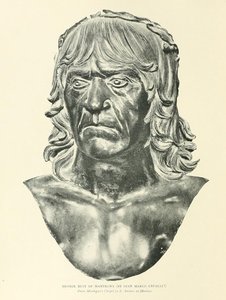 Andrea Mantegna
. Italian Renaissance master of sculptural precision and illusionistic perspective, known for his monumental Triumphs of Caesar and frescoes.
Perspective is not merely a way to show depth; it is a powerful tool for composition. Architects and painters used converging lines to guide the viewer's gaze through a complex scene. By placing a vanishing point in a specific location, an artist can control exactly where the viewer looks first, second, and last. This creates a visual hierarchy, ensuring that the most important part of the story is the focal point of the image.
In many Renaissance works, architecture serves as the skeleton of the composition. Columns, floor tiles, and ceiling beams act as visual tracks. These elements lead the eye toward the central subject, often a religious figure or a significant event. This use of architecture creates a sense of stability and permanence, grounding the narrative in a structured, orderly environment.
Andrea Mantegna utilized this to great effect in his depictions of grand interiors, such as the Gonzaga palace. He used meticulous attention to detail—from the polished marble floors to the receding arches—to create a startling sense of depth. The architecture does not just sit in the background; it actively directs the viewer into the heart of the scene, making the space feel vast and immersive.
Architecture provides the framework that holds a composition together, turning a chaotic scene into a directed, meaningful experience.
Atmospheric Depth and the Sfumato Effect
 Perspectiva para la Adoración
, Leonardo da Vinci
While linear perspective handles the mathematical side of depth, the atmosphere handles the sensory side. As objects recede into the distance, they are not just smaller; they also change in color and clarity. This is due to the air and moisture between the eye and the object. In a real landscape, distant mountains appear lighter, bluer, and less detailed than the objects in the foreground. This phenomenon is known as atmospheric perspective.
Leonardo da Vinci was a pioneer in integrating this observation with linear perspective. He understood that geometry alone was not enough to create a perfect illusion. To achieve true realism, he developed sfumato, a technique involving the subtle, smoky blending of colors and tones. This softens the edges of objects, mimicking the way light and air blur the outlines of distant forms.
In his 1481 work, Perspectiva para la Adoración, Leonardo demonstrates this balance. While the architectural elements follow strict linear rules, the distant landscape begins to soften and lose its sharpness. This combination of mathematical precision and atmospheric softness creates a sense of infinite space, where the world does not simply end at the horizon but fades into the haze of the atmosphere.
By layering mathematical lines with the soft textures of light and air, artists create a sense of space that feels both structured and natural.
The Evolution of Complex Perspective Systems
 Albrecht Dürer
. German Renaissance master of intricate woodcuts and engravings, known for profound detail and the precise use of the metal burin.
As the understanding of optics grew, the complexity of perspective systems expanded. While one-point perspective is the most common method for creating depth, artists eventually mastered more difficult geometric arrangements. Two-point perspective, for example, utilizes two vanishing points on the horizon line. This technique is used when a viewer looks at the corner of an object, such as a building, where each side recedes toward a different point. This adds a layer of realism to the depiction of three-dimensional structures, allowing for a more naturalistic view of corners and edges.
The mastery of these systems allowed for significant experimentation with how the eye perceives space. By the time Albrecht Dürer demonstrated two-point perspective in 1525 in his work Unterweisung der Messung, the mathematical foundation of art had become a highly sophisticated science. Artists were no longer just attempting to show depth; they were exploring the limits of visual perception. This included the use of anamorphosis, a form of perspective distortion where an image appears distorted unless viewed from a specific angle, as seen in Hans Holbein the Younger’s The Ambassadors (1533).
This evolution shows that perspective is not a static rule, but a growing understanding of human vision. From the early experiments of Filippo Brunelleschi to the complex geometric studies of the later Renaissance, the goal remained the same: to bridge the gap between the flat canvas and the three-dimensional world. For those looking to incorporate these technical achievements into a space, AllPaintingsStore.com offers a wide range of hand-painted oil reproductions and digital prints. Our artists can recreate the specific geometric precision of these historical masters, providing options from custom commissions to large-format murals for both residential and commercial projects.


