Alexandre Falguière: Sculptor of Myth and Majesty
Alexandre Falguière (7 September 1831 – 20 April 1900) stands as a towering figure in French sculpture of the late nineteenth century, renowned for his monumental works imbued with classical ideals and masterful execution. Born in Toulouse amidst modest circumstances—his father a mason—Falguière’s artistic journey began at the École des Beaux-Arts, where he honed his skills alongside luminaries like Auguste Rodin and Frédéric Bouchardy, securing a prestigious Prix de Rome scholarship that propelled him to Rome and cemented his reputation as a sculptor of exceptional talent. This formative period profoundly shaped his aesthetic sensibilities, grounding him in the traditions of Greek sculpture while simultaneously fostering an innovative spirit.- Early Influences: Falguière’s artistic vision was undeniably influenced by the Romantic movement, particularly Eugène Delacroix's dramatic landscapes and theatrical compositions. However, he swiftly embraced the principles of Neoclassicism championed by Jacques-Louis David, recognizing its capacity to convey grandeur and moral virtue—values that would permeate his oeuvre throughout his career.
- The Breakthrough: His breakthrough came in 1864 with “Le Vainqueur au Combat de Coqs,” a daring bronze sculpture depicting a victorious warrior battling a cock – an audacious challenge to prevailing artistic conventions. This piece immediately captivated audiences and critics alike, establishing Falguière as a sculptor of considerable originality and ambition.
Major Sculptural Achievements: Joan of Arc and Beyond
Falguière’s most celebrated achievement undoubtedly resides in his depiction of Joan of Arc—a colossal marble statue erected in Rouen Cathedral commemorating the Maid’s martyrdom. This monumental undertaking exemplifies Falguière's mastery of sculptural technique, capturing Joan’s unwavering faith and heroic spirit with breathtaking realism. The statue’s sheer scale testifies to Falguière’s ambition and his conviction that sculpture could serve as a vehicle for conveying profound spiritual truths. Beyond Joan of Arc, Falguière produced an impressive array of sculptures encompassing mythological figures—Diana, Eve, Juno and the Peacock—biblical narratives—the Beheading of St John the Baptist—and portraits honoring prominent intellectuals and statesmen—including Honoré de Balzac and Marquis de Lafayette.- Technique: Falguière’s sculptural process involved meticulous modeling in clay followed by casting in bronze or marble, utilizing techniques honed over decades of experience. He possessed an unparalleled understanding of material properties and employed innovative methods to achieve remarkable textural detail and expressive dynamism—characteristics that define his distinctive artistic style.
- Legacy: Falguière’s influence extended far beyond his own lifetime, inspiring subsequent generations of sculptors and shaping the aesthetic landscape of France during the Belle Époque. His unwavering commitment to classical ideals and his masterful execution continue to resonate with audiences today, securing his place as one of the foremost sculptors of his era—a testament to his enduring artistic legacy.
Notable Paintings: Exploring Color and Emotion
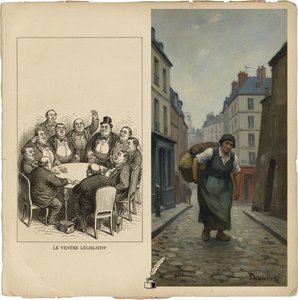
While primarily recognized for his sculptures, Falguière also pursued painting with considerable dedication, albeit achieving less renown than his sculptural endeavors. His canvases demonstrate a keen sensitivity to color and tone—elements he skillfully employed to convey emotion and capture the essence of his subjects. Works such as “The Wrestlers” (1875) and “Fan and Dagger” (1882), alongside “The Dancer,” based on Cléo de Mérode, exemplify Falguière’s artistic versatility and his ability to translate visual ideas into compelling compositions. His paintings offer a complementary perspective on his artistic vision—illuminating the breadth of his creative spirit and underscoring his mastery across multiple mediums.Influence and Artistic Development
Falguière's artistic development was marked by constant experimentation and refinement, driven by an unwavering pursuit of excellence. He absorbed inspiration from diverse sources—ranging from Romanticism to Neoclassicism—synthesizing these influences into a singular aesthetic style characterized by grandeur, dynamism, and psychological depth. His students included prominent sculptors like Francis Edwin Elwell and Laurent Marqueste, who carried forward his artistic legacy—demonstrating the enduring impact of Falguière’s pedagogical influence on the trajectory of French sculpture during the late nineteenth century.Questions et réponses
Puis-je explorer les œuvres de Alexandre Falguière par mot-clé ?
Les œuvres de Alexandre Falguière peuvent être explorées par mot-clé sur la page Par mots-clés de l'artiste. Chaque mot-clé regroupe les œuvres associées.
Existe-t-il un récit chronologique de la carrière de Alexandre Falguière ?
Un récit chronologique de l'œuvre de Alexandre Falguière est disponible sur la page Chronologie de l'artiste, où les œuvres défilent par ordre de création, chapitre par chapitre.
Combien d'œuvres de Alexandre Falguière sont disponibles à la consultation ?
Vous pouvez parcourir 9 œuvres d'art œuvres de Alexandre Falguière sur la page Toutes les œuvres.
Comment puis-je voir toutes les œuvres créées par Alexandre Falguière ?
Chaque œuvre de Alexandre Falguière sur ce site web peut être consultée depuis la page Toutes les œuvres de l'artiste.
Comment puis-je trouver toutes les œuvres de Alexandre Falguière dans une technique donnée ?
La page Tous les médiums regroupe les œuvres de Alexandre Falguière par technique.
Où trouver les œuvres de Alexandre Falguière classées par couleur ?
L'Index spectral de Alexandre Falguière est une page qui organise les œuvres de l'artiste par couleur.
Quelles couleurs Alexandre Falguière a-t-il le plus souvent utilisées ?
Le profil chromatique des œuvres de Alexandre Falguière est présenté sur la page Génome de la palette de l'artiste.
Quelles œuvres de Alexandre Falguière sont les plus consultées ?
Les statistiques relatives aux œuvres de Alexandre Falguière sont disponibles sur la page Statistiques de l'artiste.