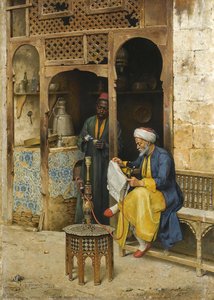
Arthur von Ferraris: A Hungarian Visionary of the Orient
Arthur von Ferraris (1856-1936) emerged from Budapest, Hungary, as a painter captivated by the exotic allure of the East – specifically Egypt and Persia. His artistic journey wasn’t merely about depicting landscapes; it was an attempt to capture the soul of cultures vastly different from his own upbringing, reflecting a burgeoning fascination with anthropology and comparative religion during the late 19th century. Unlike many artists of his time focused on grand narratives or idealized representations, Ferraris sought authenticity, meticulously observing daily life and striving for nuanced portrayals that conveyed both visual splendor and psychological depth—a singular ambition that distinguished him from his contemporaries.Early Life & Education
Born into a wealthy family with connections to the Austro-Hungarian Empire, Arthur von Ferraris benefited from an exceptional education prioritizing classical studies alongside artistic pursuits. Initially enrolled at Budapest University, he pursued independent explorations throughout Europe, absorbing influences from Impressionism and Academic painting. This formative period instilled in him a profound appreciation for observation and detail—qualities that would become hallmarks of his distinctive artistic style.Cairo Inspirations: The Birth of Orientalist Vision
Ferraris’s artistic breakthrough arrived during his expeditions to Egypt between 1890 and 1905. These voyages irrevocably altered his worldview, fueling a series of paintings that captured the vibrant essence of Cairo's marketplaces, bustling streets, and solemn religious ceremonies. Recognizing the power of Impressionist techniques—particularly atmospheric perspective and luminous color palettes championed by Claude Monet—Ferraris skillfully translated these sensory experiences onto canvas. His aim wasn’t simply to reproduce what he saw; it was to convey the emotional resonance of Egyptian life, mirroring his own intellectual curiosity about cultural diversity. Consider “Driving A Bargain,” where Ferraris meticulously renders the textures of fabrics and faces alike, conveying not just a transaction but also the palpable energy of the marketplace—a testament to his ability to infuse his paintings with psychological insight.Technique & Artistic Style: Precision and Symbolism
Ferraris’s artistic technique was characterized by unwavering dedication to realism combined with subtle symbolic undertones. He painstakingly rendered textures – from the rough stone walls of mosques to the folds of robes worn by Egyptian merchants – demonstrating an impressive mastery of oil paint. His brushstrokes were deliberate, conveying movement and capturing fleeting moments of human interaction; he wasn’t merely copying what he observed but actively shaping it into a visual narrative imbued with meaning. Furthermore, Ferraris's meticulous attention to detail—a trait shared with Franz Seraph von Lenbach—established him as one of Hungary’s foremost painters of the Belle Époque—a period defined by artistic innovation and intellectual fervor.Notable Works & Patronage: Recognition Within Hungarian Artistic Circles
Ferraris gained considerable acclaim within Hungarian artistic circles, securing patronage from influential figures including Emperor Franz Joseph I. His paintings graced the walls of royal residences and were exhibited at prestigious salons in Paris and Vienna—a testament to his talent and the esteem accorded to him by his peers. Among his most celebrated pieces are “Blind Man At The Mosque” and “The Blind Man,” which exemplify Ferraris’s humanist approach, prioritizing observation and psychological insight over romanticized clichés. These works powerfully depict marginalized individuals with compassion and dignity—reflecting Ferraris's belief in the transformative potential of art to foster empathy and understanding.Legacy & Influence: A Pioneer of Orientalist Painting
Arthur von Ferraris’s enduring legacy extends beyond mere aesthetic beauty; he championed a humanist perspective that challenged prevailing artistic conventions. His meticulous attention to detail and masterful use of color solidified his place as one of Hungary’s most distinguished painters—a figure whose work continues to inspire artists today who strive for truthful depictions of cultures outside the Western canon. Today, reproductions of Ferraris’s paintings can be found in museums worldwide—a lasting reminder of his artistic brilliance and his pioneering spirit—affirming his contribution to the history of art and his unwavering commitment to exploring the complexities of human experience.Questions et réponses
Puis-je explorer les œuvres de Arthur Von Ferraris par sujet ?
La page Index thématique répertorie les œuvres de Arthur Von Ferraris par sujet.
Où et en quelle année Arthur Von Ferraris est-il né ?
Arthur Von Ferraris est né à Budapest en 1856.
Puis-je trier les œuvres de Arthur Von Ferraris par couleur ?
Les œuvres de Arthur Von Ferraris peuvent être explorées par couleur sur la page Par couleur de l'artiste.