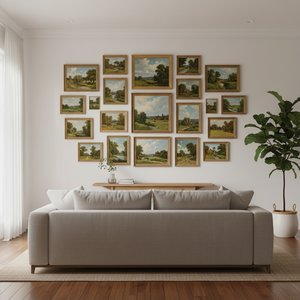
A Lost Voice of the English Countryside
The story of Brian Hatton is one of remarkable, if tragically curtailed, artistic promise. Born in 1887 amidst the idyllic landscapes of Broomy Hill, Herefordshire, Hatton emerged as a significant figure in British landscape painting during the formative years of the twentieth century. His life and work were inextricably linked to the rural traditions of his homeland, yet his vision was shaped by much broader horizons. Though his career was cut short by his untimely death in action during the First World War at just twenty-eight years old, he left behind a profoundly moving body of work that offers a poignant glimpse into a disappearing world—a testament to the power of capturing beauty amidst impending change.
Hatton’s artistic journey began with an early fascination for drawing and sketching, nurtured by a supportive family who recognized his burgeoning talent. As he matured, his sensibilities were profoundly shaped by exposure to influential European movements. Through visits to Paris, he encountered the transformative techniques of Impressionism and Neo-Romanticism, absorbing the methods of masters such as Monet and Sisley. These encounters encouraged him to prioritize the capture of fleeting moments of light and atmosphere, a hallmark of his distinctive approach that would define his later mastery.
Technique, Light, and the Human Element
In his execution, Hatton skillfully blended meticulous observation with a rich, imaginative spirit. His canvases were not merely topographical records of the Worcestershire countryside; they were emotive explorations of texture and mood. He possessed a unique ability to render the physical world—the rugged textures of hedgerows, the weathered stone of walls, and the sprawling fields of Morehampton Manor—with such precision that the viewer can almost feel the dampness of the earth or the warmth of the sun. His style often utilized bold brushstrokes and a vivid yet balanced palette to create depth and visual tension.
Beyond the purely pastoral, Hatton’s oeuvre is notable for its deep humanist element. He frequently infused his landscapes with figures engaged in the quiet dignity of everyday life. Whether through figure studies or more narrative scenes like “Saddling Up,” he portrayed a profound connection between humanity and the land. His portraits and figure paintings, such as the serene “Reclining Nude” (1912), demonstrate a sensitive touch regarding gesture and expression, revealing a psychological depth that complemented his technical accuracy.
Legacy and Historical Significance
The trajectory of Hatton’s career was marked by significant milestones, most notably his exhibition at the Hereford Museum in 1913. This showcase served as a pivotal moment, garnering recognition for his ability to synthesize local identity with modern artistic sensibilities. His work, ranging from the Post-Impressionist echoes in “The Falcon” (1909) to the evocative autumn tones of “The Wye, Belmont Woods,” showcases an artist constantly evolving and pushing the boundaries of British landscape tradition.
Today, Brian Hatton is remembered as a "lost voice" of the early twentieth century. His death in 1916 represents more than just the loss of a single talented individual; it symbolizes the silencing of a promising artistic movement that might have bridged the gap between traditional ruralism and modernism. His surviving works remain vital pieces of British art history, preserved in collections such as the Hereford Museum and Art Gallery, serving as enduring echoes of a landscape and a way of life that were forever altered by the dawn of the modern age.
Questions et réponses
Quel est le degré de popularité des œuvres de Brian Hatton ?
La page Statistiques de Brian Hatton présente des statistiques calculées à partir des œuvres de l'artiste répertoriées sur ce site web.
Comment la carrière de Brian Hatton est-elle divisée en périodes ?
Un récit chronologique de l'œuvre de Brian Hatton est disponible sur la page Chronologie de l'artiste, où les œuvres défilent par ordre de création, chapitre par chapitre.
Puis-je explorer les œuvres de Brian Hatton par mot-clé ?
La page Par mots-clés de Brian Hatton regroupe les œuvres de l'artiste par mots-clés.
Existe-t-il une visite virtuelle en 3D des œuvres de Brian Hatton ?
Les œuvres de Brian Hatton sont visibles dans une galerie 3D sur la page Musée 3D de l'artiste.
Où puis-je voir les œuvres de Brian Hatton par ordre chronologique ?
Les œuvres de Brian Hatton peuvent être consultées par ordre chronologique sur la page Chronologie des œuvres de l'artiste.
Quelles émotions les œuvres de Brian Hatton expriment-elles ?
La page L'ambiance par émotion de l'artiste présente les œuvres de Brian Hatton classées par atmosphère.
Existe-t-il une liste complète des œuvres de Brian Hatton ?
Chaque œuvre de Brian Hatton sur ce site web peut être consultée depuis la page Toutes les œuvres de l'artiste.
Puis-je parcourir les œuvres de Brian Hatton par palette de couleurs ?
Pour trouver des œuvres de Brian Hatton dans une palette spécifique, utilisez la page Par palettes de l'artiste.