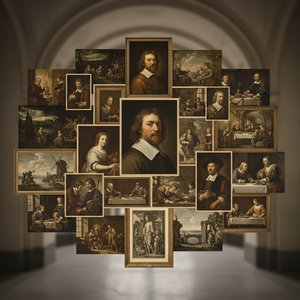
The Serene Vision of Dirk van Bergen
In the golden twilight of the Dutch Golden Age, few artists captured the quiet pulse of the countryside with as much tenderness as Dirk van Bergen. Born in the vibrant artistic hub of Haarlem around 1645, Van Bergen emerged during an era when the Netherlands was redefining the boundaries of landscape painting. His work does not shout with the dramatic turbulence found in some of his contemporaries; instead, it whispers of pastoral peace, inviting the viewer into a world where time seems to slow beneath a soft, atmospheric sky. Through his eyes, the Dutch landscape became more than mere topography—it became a sanctuary of light and tranquility.
Van Bergen’s artistic foundation was laid in Amsterdam under the watchful eye of Adria rien van de Velde, one of the most esteemed masters of the era. This apprenticeship was transformative, gifting him a profound understanding of atmospheric perspective and the delicate balance required to compose a scene that feels both expansive and intimate. From Van de Velde, he inherited a mastery of light that allowed him to render the subtle shifts in a midday sun or the hazy glow of an approaching dusk. As his style matured, he began to weave subtle threads of classical mythology into his rural settings, creating a unique dialogue between the humble reality of Dutch farming life and the lofty ideals of humanist tradition.
Technique and the Art of Detail
To observe a Van Bergen landscape is to embark on a journey of discovery through texture and tone. He possessed an extraordinary ability to render the tactile world, from the coarse hair of a resting bull to the delicate, translucent leaves of a summer canopy. His palette was intentionally restrained, favoring a harmonious blend of earthy browns, deep forest greens, and soft, ethereal blues. This muted color scheme served a higher purpose: it prevented any single element from overwhelming the composition, ensuring that the viewer’s eye could wander freely across the canvas, discovering small wonders in every corner.
While his brushwork was deliberate and precise, there remained an underlying fluidity that breathed life into his subjects. He avoided the harsh, jagged edges of dramatic chiaroscuro, opting instead for soft tonal gradations that mimicked the natural diffusion of light through moisture-laden air. This technique allowed him to create a sense of depth that felt almost palpable, as if one could step directly into the meadow. His ability to capture the weight of livestock and the gentle posture of a shepherdess contributed to a sense of profound realism, grounded in an unwavering commitment to natural harmony.
Legacy of the Pastoral Ideal
The significance of Dirk van Bergen lies in his role as a custodian of the pastoral idyll. While the art world often gravitates toward the revolutionary and the chaotic, Van Bergen’s oeuvre stands as a testament to the enduring power of the serene. His works, such as “Landscape with Mercury and Battus”, demonstrate how he could elevate a simple scene of cattle and shepherds into something timeless by infusing it with classical narrative. He bridged the gap between the everyday and the eternal, making the local Dutch landscape feel part of a much larger, universal story.
Though many of his paintings remain in small, intimate formats, their impact is monumental. His influence can be traced through the way he balanced the realism of the Dutch tradition with a poetic sensibility that would inspire later generations of landscape painters. Today, his legacy survives in the quiet majesty of his compositions, reminding us that there is profound beauty to be found in the stillness of a sun-drenched field and the rhythmic, peaceful existence of the natural world.
Questions et réponses
Existe-t-il une liste complète des œuvres de Dirk Van Bergen ?
Chaque œuvre de Dirk Van Bergen sur ce site web peut être consultée depuis la page Toutes les œuvres de l'artiste.
Existe-t-il une chronologie des œuvres de Dirk Van Bergen ?
Les œuvres de Dirk Van Bergen peuvent être consultées par ordre chronologique sur la page Chronologie des œuvres de l'artiste.
Dans quelle ville et quel pays Dirk Van Bergen est-il/elle né(e) ?
Dirk Van Bergen est né à Haarlem, en Netherlands.
À quelle période historique Dirk Van Bergen a-t-il exercé ?
Dirk Van Bergen a œuvré durant la période Early Modern. Cette période situe l'activité de l'artiste dans l'histoire.
Quelles couleurs Dirk Van Bergen a-t-il le plus souvent utilisées ?
L'usage de la couleur par Dirk Van Bergen à travers les œuvres répertoriées sur ce site web peut être étudié sur la page Génome de la palette de l'artiste.
Quelles œuvres de Dirk Van Bergen sont les plus consultées ?
Une page Statistiques est disponible pour Dirk Van Bergen, présentant des statistiques sur les œuvres de l'artiste sur ce site web.
Puis-je explorer les œuvres de Dirk Van Bergen par mot-clé ?
Les œuvres de Dirk Van Bergen peuvent être explorées par mot-clé sur la page Par mots-clés de l'artiste. Chaque mot-clé regroupe les œuvres associées.
Comment puis-je trouver des œuvres de Dirk Van Bergen dans une palette spécifique ?
La page Par palettes regroupe les œuvres de Dirk Van Bergen par leurs palettes de couleurs.