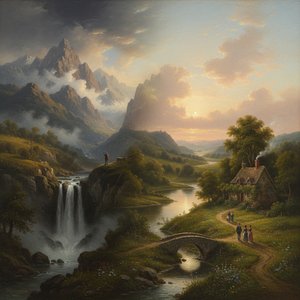
Eugenio Landesio: Bridging Romantic Idealism and Scientific Observation
Born in Altessano, near Turin, Italy, Eugenio Landesio (1810-1879) embarked on an artistic journey shaped by familial traditions – silversmithing – fostering a profound appreciation for craftsmanship and meticulous detail from his earliest years. Recognizing his innate talent for drawing from childhood, his father wisely conceded to Landesio’s passion for painting, propelling him toward becoming one of Mexico’s most revered landscape artists. Landesio's formative education unfolded under the tutelage of Amédée bourgeois in France, followed by intensive training with Károly Markó the Elder, a Hungarian Romantic landscape master who instilled within him an unwavering reverence for portraying the sublime beauty of nature. Like Markó, Landesio embraced the Romantic aesthetic – prioritizing emotion and imagination alongside accurate representation—yet he distinguished himself through an uncompromising dedication to scientific rigor. This duality became the hallmark of his artistic practice, evident in canvases where idealized vistas harmoniously coexist with painstakingly rendered botanical studies and geological sketches. His arrival in Mexico in 1855 constituted a pivotal juncture for Landesio’s career and irrevocably altered the course of Mexican landscape painting. Invited by Pelegrín Clavé, director of the figure painting section at the Academy of San Carlos, Landesio established himself as a teacher and mentor, nurturing the burgeoning talents of younger artists and shaping their comprehension of perspective and ornamentation. He authored three seminal textbooks – “Los Cimientos del Artista Dibujante y Pintor,” “La Pintura General o de Paisaje y la Perspectiva en la Academia Nacional de San Carlos,” and “Escursión a la Caverna de Cacahuamilpa y Ascensión al Cráter del Popocatepetl” – establishing his reputation as a pedagogue and disseminating crucial artistic principles. These texts championed the importance of observation, anatomical accuracy, and compositional balance—influencing generations of Mexican painters. Landesio’s oeuvre is characterized by canvases imbued with tranquility and bathed in soft light, reflecting the Romantic preoccupation with emotion and contemplation. Notable works include “Stramonio,” a breathtaking monochrome ink botanical illustration demonstrating Landesio's unwavering commitment to scientific precision alongside artistic beauty. Simultaneously, “Minas de Real del Monte,” Hidalgo,” captures the industrial landscape of Mexico with dramatic flair—a testament to his ability to convey both grandeur and emotional depth. These paintings stand as enduring symbols of Romantic idealism tempered by meticulous geological observation and botanical taxonomy. Beyond his individual creations, Landesio profoundly impacted Mexican art history by inspiring José María Velasco, whose style embodies Landesio’s influence. His legacy persists today, securing his place as a cornerstone of Mexican artistic heritage—a testament to the transformative power of blending aesthetic vision with intellectual curiosity.Questions et réponses
Où puis-je admirer les œuvres de Eugenio Landesio dans une galerie en 3D ?
La Musée en 3D de Eugenio Landesio vous permet de découvrir les œuvres de l'artiste au sein d'une galerie virtuelle en trois dimensions.
Comment l'art de Eugenio Landesio a-t-il évolué au fil du temps ?
La carrière de Eugenio Landesio se dévoile période par période sur la page Parcours de carrière de l'artiste : une frise chronologique horizontale des œuvres, regroupées en chapitres correspondant aux différentes étapes de sa carrière.
Puis-je explorer les œuvres de Eugenio Landesio par spectre de couleurs ?
L'Par couleur de Eugenio Landesio permet de parcourir les œuvres de l'artiste par couleur.