Franklin C. Courter: Pioneer of Arctic Landscape Painting
Franklin C. Courter (1854 – 1947) stands as a singular figure in American landscape painting, particularly renowned for his immersive depictions of the Arctic wilderness and his masterful execution of tonalist techniques. Born in Grimsby, Lincolnshire, England, Courter’s artistic journey began with formal training at the Royal Academy in London before he emigrated to the United States in 1883, establishing himself as a resident of Indianapolis where he would spend the remainder of his life. His distinctive style—characterized by subdued colors, atmospheric haze, and an unwavering commitment to capturing the essence of natural light—earned him considerable acclaim during his lifetime and continues to inspire admiration among art historians today.- Early Influences: Courter’s formative years were profoundly shaped by the Impressionist movement in Paris, where he encountered luminists like George Inness and Claude Monet. These encounters instilled within him a fascination for capturing fleeting moments of beauty and conveying emotion through subtle tonal variations—a cornerstone of his artistic approach.
- The Arctic Expeditions: Courter’s most celebrated achievements stemmed from his participation in several expeditions to explore the Arctic Circle. Notably, he accompanied Robert Peary's 1898 expedition to North Pole, documenting the desolate landscapes and capturing the arduous realities faced by explorers. His paintings from these voyages—particularly “Lincoln and His Son, Tad”—offer unparalleled insight into the psychological impact of extreme environments on human perception.
- Notable Works: Among Courter’s impressive oeuvre are “Landscape near Sparta, New Jersey,” a serene portrayal of rural New Jersey bathed in autumnal hues; and numerous smaller canvases depicting scenes from Yosemite National Park. These works exemplify his ability to distill complex natural phenomena into evocative compositions that resonate with viewers.
- Legacy: Franklin C. Courter’s contribution to American landscape painting is undeniable. His pioneering use of tonalist techniques—coupled with his unflinching documentation of Arctic expeditions—established him as a visionary artist who captured the sublime beauty and psychological depth of the natural world. Today, reproductions of his paintings are treasured by collectors worldwide, ensuring that his artistic legacy persists for generations to come.
Influence and Artistic Style
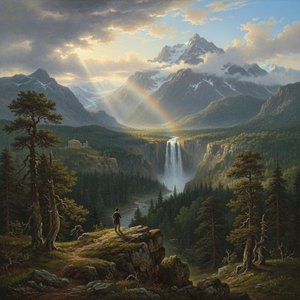
Courter’s stylistic choices were deeply rooted in the tonalist movement, which emerged in the late 1880s as a reaction against Impressionism's emphasis on optical color perception. Tonalists sought to depict landscapes with an unwavering fidelity to observed light and shadow—a pursuit that demanded patience, meticulous observation, and a profound understanding of atmospheric effects. Courter’s canvases often eschewed vibrant hues in favor of muted browns, greens, and grays, prioritizing tonal harmonies over chromatic brilliance.- Symbolism: Courter's paintings frequently incorporated symbolic elements—such as solitary figures contemplating the grandeur of nature—to convey deeper meanings about human experience. These images served as meditations on themes of solitude, contemplation, and the relationship between humanity and the environment.
Museum Exhibitions and Recognition
Courter’s artwork gained considerable recognition during his lifetime through appearances in prestigious exhibitions across the United States. His paintings were showcased at the Pennsylvania Academy of Fine Arts, the Art Institute of Chicago, and numerous other institutions—solidifying his reputation as one of America's foremost landscape painters.Questions et réponses
Où puis-je voir la palette de couleurs des œuvres de Franklin C Courter ?
L'usage de la couleur par Franklin C Courter à travers les œuvres répertoriées sur ce site web peut être étudié sur la page Génome de la palette de l'artiste.
Où peut-on retrouver les œuvres de Franklin C Courter classées par sujet ?
L'Atlas thématique de Franklin C Courter est une page qui répertorie les œuvres de l'artiste par thématiques.
Puis-je visiter un musée virtuel des œuvres de Franklin C Courter ?
Une visite virtuelle est possible : la page Musée 3D de Franklin C Courter présente les œuvres de l'artiste dans une galerie en trois dimensions.