A Life Between Rotterdam and Antwerp
The story begins in Rotterdam, where Hendrik van Minderhout enters the world in 1632. He is a Dutch-born painter, but his trajectory pulls him toward the Flemish territories. By 1652, he arrives in Bruges. The air of this city becomes his professional atmosphere as he moves through the established structures of the art world. In 1663, he secures his place within the Bruges Guild of Saint Luke.
Movement defines his career. He does not remain static in one locale. After years in Bruges, a shift occurs toward Antwerp. By 1672, he is a member of the local Guild of Saint Luke in Antwerp, a position he holds until his death in 1696. His life is marked by these transitions between major Flemish hubs. He even seeks exemptions from guild duties through specific payments, demonstrating a practical, business-minded approach to his residency in Antwerp.
The Mastery of the Marine Scene
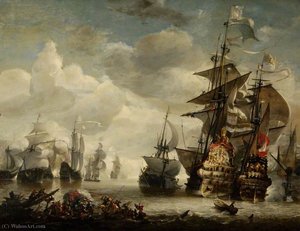
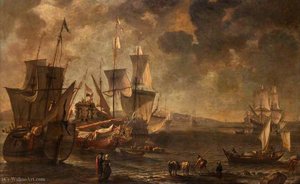
Minderhout finds his true subject on the water. He specializes in marine paintings, capturing the heavy movement of harbors and the tension of naval engagements. His brush captures the ports of Antwerp, Ostend, and Bruges with a realist eye. Yet, he does not limit himself to known geography. He constructs imaginary views of Mediterranean and oriental ports, blending the familiar with the exotic. One such work, A Mediterranean Harbour Scene from 1670, displays the dramatic qualities of the Baroque style.
His technical reach extends beyond his own solo compositions. He functions as a staffage painter, a specialist who breathes life into the landscapes and perspective works of others. He contributes figures to the canvases of colleagues such as Wilhelm Schubert van Ehrenberg and Jacob Balthasar Peeters. His ability to render human presence within vast maritime or architectural settings makes him an essential collaborator in the Flemish tradition.
Legacy and Lineage
The painter’s influence is not merely found in his canvases but in his household. He marries Anna-Victoria Claus in 1673, and their home becomes a site of artistic continuity. Two of his sons, Antoon and Willem Augustin, follow him into the profession. Willem Augustin, in particular, carries forward the family's technical skill, eventually becoming a master himself.
The breadth of his output includes:
- Marine Battles: Detailed depictions of naval conflict, such as The Battle of Lowestoft, 3 June 1665.
- Harbor Scenes: Realistic and imagined views of bustling maritime commerce.
- Cityscapes and Landscapes: Architectural studies and expansive views of urban environments.
He dies in Antwerp on 22 July 1696, leaving behind a body of work that bridges the gap between Dutch origins and Flemish execution.
Questions et réponses
Comment puis-je voir toutes les œuvres créées par Hendrik Van Minderhout ?
Chaque œuvre de Hendrik Van Minderhout sur ce site web peut être consultée depuis la page Toutes les œuvres de l'artiste.
Où peut-on retrouver les œuvres de Hendrik Van Minderhout classées par sujet ?
La page Atlas thématique répertorie les œuvres de Hendrik Van Minderhout par sujet.
Comment puis-je suivre l'évolution de l'œuvre de Hendrik Van Minderhout année après année ?
Une chronologie des œuvres de Hendrik Van Minderhout est disponible : la page Chronologie des œuvres classe les œuvres par date de création.