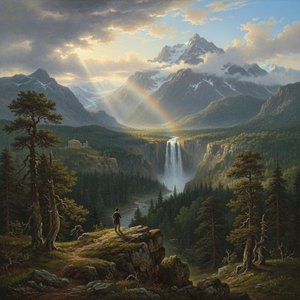
L'Âme du Paysage Italien : Le Génie de Joachim Faber
Dans les annales du romantisme allemand, peu d'artistes ont capturé l'intersection profonde entre la grandeur géologique et la tranquillité spirituelle avec autant de poignance que Joachim Faber. Né dans l'atmosphère maritime de Hambourg en 1778, l'identité artistique primitive de Faber était ancrée dans les traditions rigoureuses de la peinture historique et religieuse. Ses années de formation furent marquées par une quête disciplinée de clarté narrative, illustrée par son poignant retable pour l'église Sainte-Catherine de Hambourg, intitulé Laissez venir à moi les petits enfants. Cette maîtrise précoce des compositions complexes et des motifs sacrés a fourni le fondement technique sur lequel il allait plus tard bâtir une vision bien plus vaste et atmosphérique du monde naturel.
La véritable métamorphose du style de Faber ne s'est pas produite dans les ateliers d'Allemagne, mais sous la lumière rayonnante et transformatrice du soleil italien. En entreprenant un voyage fondateur à travers l'Italie aux côtés de ses confrères artistes J.A. Claude Koch et Reinhardt, Faber a connu un profond bouleversement esthétique. Les récits structurés de sa jeunesse ont cédé la place à une obsession pour le sublime — la beauté brute et indomptée du paysage méditerranéen. Cette période de voyage lui a permis de dépasser la simple représentation, car il a commencé à embrasser le poids émotionnel des décors, trouvant une inspiration profonde dans les falaises escarpées et les panoramas baignés de soleil de régions telles que Sorrente et les environs de Naples.
Une Maîtrise de la Lumière et de l'Atmosphère
L'œuvre mature de Faber se caractérise par une capacité remarquable à manipuler la lumière et la perspective pour évoquer un sentiment d'émerveillement. Fortement influencé par les traditions dramatiques du paysage de Claude Joseph Vernet et les ombres évocatrices d'Alessandro Magnasco, il a développé une technique utilisant la brume atmosphérique et de subtiles gradations tonales pour créer de la profondeur. Ses peintures ne se contentent pas de dépeindre un lieu ; elles invitent le spectateur à en respirer l'air et à en ressentir la température. Que ce soit à l'huile sur toile ou avec la précision délicate du graphite et du lavis, Faber possédait un talent inouï pour capturer la manière dont la lumière dissout les contours et adoucit les montagnes lointaines.
Son répertoire de sujets reflète une intimité profonde avec le terrain italien, allant du monumental à l'intime :
- La Majesté de la Côte : Des œuvres telles que Falaises surplombant une gorge de rivière près de Sorrente démontrent sa capacité à rendre la beauté terrifiante des hauteurs abruptes et des eaux tumultueuses.
- Harmonie Architecturale : Dans des pièces comme La Terrasse des Capucins, il intègre avec maestria les structures humaines au flux organique de la nature, illustrant la coexistence paisible de la civilisation et du sauvage.
- Vestiges Classiques : Ses explorations de ruines, telles que le Temple de Minerva Medica à Rome, servent de méditations poignantes sur le passage du temps et la force durable de l'histoire.
Héritage et Importance Historique
En tant que pionnier du mouvement paysager romantique, Joachim Faber a jeté un pont entre l'académisme structuré de la fin du XVIIIe siècle et la philosophie émotive centrée sur la nature du XIXe siècle. Sa transition des sujets historiques vers l'expression pure du paysage le désigne comme une figure vitale dans l'évolution de l'art allemand. En traduisant l'essence dramatique du paysage italien dans un langage compréhensible par la sensibilité européenne du Nord, il a aidé à cultiver une fascination généralisée pour le « sublime » qui allait définir toute une époque.
Aujourd'hui, l'héritage de Faber survit à travers sa présence dans des collections prestigieuses telles que la National Gallery of Art et l'Alte Nationalgalerie de Berlin. Ses œuvres restent des points de repère essentiels pour quiconque cherche à comprendre la quête romantique consistant à trouver le divin au sein du monde naturel. Par son détail méticuleux et sa profondeur atmosphérique, Faber continue de nous rappeler qu'un paysage n'est jamais seulement une vue, mais une expérience émotionnelle profonde gravée dans la lumière et l'ombre.
Questions et réponses
Où se trouvent les œuvres de Joachim Faber regroupées par palette ?
La page Par palettes regroupe les œuvres de Joachim Faber par leurs palettes de couleurs.
Combien d'œuvres de Joachim Faber sont disponibles à la consultation ?
Vous pouvez parcourir 17 œuvres d'art œuvres de Joachim Faber sur la page Toutes les œuvres.
Puis-je parcourir les œuvres de Joachim Faber par ambiance ?
Les œuvres de Joachim Faber peuvent être parcourues par émotion sur la page L'ambiance par émotion de l'artiste, qui organise les œuvres d'art selon l'ambiance qu'elles dégagent.