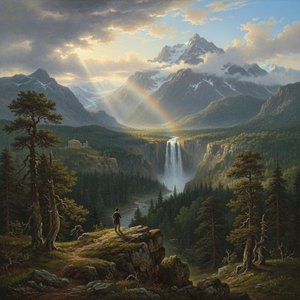
A Visionary Chronicler of the Louisiana Landscape
Marie Adrien Persac stands as a singular, multifaceted figure in nineteenth-century American art—a testament to artistic versatility and an unparalleled chronicler of the evolving Southern landscape. Born in Saumur, France, in 1823, Persac’s early life remains partially shrouded in mystery, though his formative years were undoubtedly shaped by a fascination with engineering and architecture. This technical foundation would later become the bedrock of his creative identity. Driven by an ambitious spirit of exploration, he embarked on a journey to America around 1842, eventually finding his true calling amidst the lush, atmospheric expanses of Louisiana. His work transcends mere depiction; it embodies the Romantic spirit—a fervent embrace of nature intertwined with meticulous observation and a scientific precision that few of his contemporaries could match.
Upon settling in Louisiana, Persac’s career unfolded through a remarkable tapestry of disciplines. He was not merely a painter but a surveyor, cartographer, photographer, lithographer, and architect. This intersection of science and art allowed him to capture the region with a unique depth. As a surveyor, he gained renown for detailed maps that were crucial to the scientific understanding of the territory during a period of rapid expansion. His ability to blend the topographical accuracy required by a cartographer with the emotive light of a painter created a body of work that serves as both art and historical record. Whether through the delicate strokes of watercolor or the bold application of oil, Perscept captured the very soul of the South.
The Painter's Eye: Detail and Devotion
Persac’s distinctive style is characterized by an extraordinary attention to detail, particularly evident in his celebrated plantation scenes. Unlike many of his contemporaries who favored idealized or romanticized representations of rural life, Persac painstakingly rendered buildings, gardens, and the surrounding environment with remarkable accuracy. This commitment to the materiality of his surroundings reflected a profound engagement with the landscape. In works such as Shadows-on-the-Teche, one can observe a masterful use of muted tones and vintage elegance, evoking the historical charm of stately mansions and formal gardens. His ability to capture the interplay of light and shadow—the very "shadows" referenced in his titles—imbues his landscapes with a sense of living history.
His technical repertoire was as diverse as his interests. As a pioneer in early photography, he opened daguerreotype studios in Baton Rouge and New Orleans, a pursuit that undoubtedly sharpened his eye for composition and light. This photographic sensibility is often reflected in his paintings, where the framing of a scene feels both spontaneous and perfectly balanced. His contributions to lithography, including his work on Norman's Chart of the Lower Mississippi River, further demonstrate his ability to marry intricate illustration with geographical truth. Through these various mediums, Persac documented the bustling maritime commerce of New Orleans in works like Port and City of New Orleans and the serene, pastoral beauty of rural life in pieces such as Prarie Sorrel.
Legacy and Historical Significance
The historical significance of Marie Adrien Persac cannot be overstated. For historians of the American South, his oeuvre serves as a vital visual archive. His meticulous property drawings and landscape watercolors provide a window into a vanished era of Louisiana plantation life and urban development. Because he captured the architecture and flora of the region with such fidelity, his work remains an essential resource for understanding the physical transformation of the Southern landscape during the mid-to-late nineteenth century.
Persac’s legacy is defined by this rare duality: he was both a scientist of the land and a poet of its beauty. He left behind a collection of works that do more than just decorate; they instruct, preserve, and evoke emotion. His life, spanning from the classical influences of France to the rugged expansion of the American frontier, mirrors the very transitions he so beautifully documented. Today, we remember him not just as an artist, but as a visionary who saw the profound beauty in the precise details of the world around him.
Questions et réponses
Où puis-je voir la palette de couleurs des œuvres de Marie Adrien Persac ?
La ADN de la palette de Marie Adrien Persac présente le profil chromatique de l'ensemble de son œuvre.
Dans quels mouvements Marie Adrien Persac a-t-il travaillé ?
La page Tous les mouvements artistiques regroupe les œuvres de Marie Adrien Persac par mouvement artistique.
Où trouver les œuvres de Marie Adrien Persac regroupées par mots-clés ?
Explorez les œuvres de Marie Adrien Persac par mot-clé sur la page Par mots-clés de l'artiste. Chaque mot-clé regroupe les œuvres associées.