Paul Hankar: The Pioneering Spirit of Belgian Art Nouveau
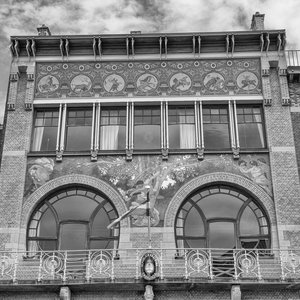
Paul Hankar (December 11, 1859 – January 17, 1901) stands as a pivotal figure in the history of Belgian art and architecture, inextricably linked to the flourishing movement known as Art Nouveau. Born in Frameries, Hainaut, Belgium—the son of a stonemason—Hankar’s formative years instilled within him an appreciation for craftsmanship and material innovation that would profoundly shape his artistic vision. His early career focused on sculptural commissions, honing his skills in manipulating stone before he embarked upon formal architectural studies at the Royal Academy of Fine Arts in Brussels. There, he forged a crucial partnership with Victor Horta, establishing a collaborative spirit that mirrored and amplified their shared fascination for groundbreaking techniques—particularly the transformative potential of wrought iron. Influenced by Eugène Viollet-le-Duc’s advocacy for blending historical inspiration with modern materials like iron and glass, Hankar embraced these principles wholeheartedly. This intellectual grounding fueled his ambition to redefine domestic architecture, resulting in iconic structures that epitomized the Art Nouveau aesthetic—namely, the Hankar House (1893) and Hôtel Ciamberlani (1897), considered among Belgium’s earliest expressions of this revolutionary style. These commissions weren't merely exercises in design; they represented a deliberate challenge to conventional norms. The facades of these buildings—particularly the Hôtel Ciamberlani—employed asymmetrical compositions and undulating surfaces, mirroring organic forms found in nature. Furthermore, intricate ironwork graced interiors and exteriors alike, creating mesmerizing patterns that captivated visitors and cemented Hankar’s reputation as a visionary innovator. Beyond his architectural endeavors, Hankar’s mastery extended to furniture design, where he skillfully blended Art Nouveau motifs with functional considerations. His creations—characterized by flowing lines, floral ornamentation, and delicate craftsmanship—became emblems of the era's aesthetic ideals. Notably, his shopfront for Chemiserie Niguet (1896), located on Rue Royale in Brussels, achieved international acclaim for its audacious use of Japanese-inspired window bars and decorative tracery. Hankar’s legacy transcends stylistic trends; he championed the role of artists within urban planning. His concept for “New Brussels,” envisioned as a harmonious blend of art and architecture—a bold departure from prevailing urban landscapes—demonstrates his unwavering belief in artistic expression as a catalyst for societal progress. He believed that Horta's work was excessively lavish; he called it “Louis XV”. His influence extended beyond Belgium’s borders, notably impacting Otto Wagner's Majolikahaus in Vienna (1898), where he collaborated on the design of monumental decorative panels. Paul Hankar died prematurely in 1901, leaving behind an indelible mark on Belgian art history and securing his place as one of Art Nouveau’s foremost architects—a testament to his unwavering dedication to innovation and artistic vision.Questions et réponses
Où puis-je voir les œuvres de Paul Hankar par ordre chronologique ?
Une chronologie des œuvres de Paul Hankar est disponible : la page Chronologie des œuvres classe les œuvres par date de création.
À quelle période historique Paul Hankar a-t-il exercé ?
Paul Hankar a œuvré durant la période XIXe siècle. Cette période situe l'activité de l'artiste dans l'histoire.
Puis-je parcourir les œuvres de Paul Hankar par ambiance ?
La L'ambiance par émotion de Paul Hankar est une page qui organise les œuvres de l'artiste par ambiance.