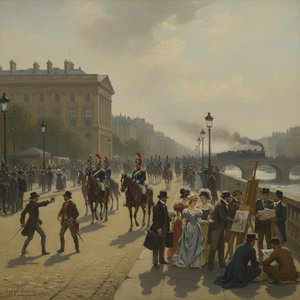
The Chronicler of Béarn: The Life and Legacy of Jean Baptiste Butay
In the quiet, sun-drenched landscapes of Southwestern France, there existed a painter whose brush served as a bridge between the fleeting moments of daily life and the enduring weight of history. Jean Baptiste Butay, born on December 10, 1759, was more than a mere observer; he was a visual historian of his era. His life, spanning nearly a century until his passing on June 28, 1853, coincided with some of the most transformative periods in French history. While much of the art world focused on the grand, sweeping movements of Paris, Butay found his profound inspiration in the intimate textures of local life, particularly within the Béarn region. His work possesses a rare, nostalgic warmth, capturing the essence of a world that was slowly transitioning from the traditions of the 18th century into the complexities of the modern age.
The artistry of Butay is characterized by a remarkable ability to blend historical reverence with a gentle, realistic charm. He did not merely paint scenes; he reconstructed atmospheres. Whether depicting the noble dignity of royalty or the simple, unadorned beauty of a rural landscape, his technique relied on a mastery of light and tone that breathed life into every subject. His compositions often feature muted, earthy palettes that evoke the very soil of France, creating a sense of timelessness. In works such as 'Henri IV chez ces parents nourriciers à Billère', one can feel the poignant weight of domestic intimacy, where the historical significance of the monarch is softened by the tender, realistic portrayal of his early years in a nurturing environment.
A Tapestry of Portraits and Landscapes
Butay’s oeuvre is a diverse collection of human emotion and regional pride. His talent was particularly evident in his portraiture, where he moved seamlessly between the formal requirements of depicting nobility and the soulful, candid nature of capturing common folk. He had an uncanny knack for portraying character through subtle facial expressions and the careful rendering of period attire. This versatility allowed him to document a wide spectrum of society, from the Envoyés béarnais in their quest for leadership to the quiet, melodic stillness found in 'Portrait de deux jeunes filles au piano'.
Beyond the human figure, Butay’s connection to the land was deeply spiritual. His landscapes, such as the evocative 'Vue de Pau et du gave', serve as vital records of the French topography. Through his eyes, we see the rivers and valleys not just as geographical features, but as characters in a larger narrative of regional identity. His ability to capture the interplay of light over water and the ruggedness of the terrain demonstrates a profound respect for the natural world—a theme that resonates through his entire body of work.
Historical Significance and Artistic Endurance
The significance of Jean Baptiste Butay lies in his role as a custodian of memory. In an era of rapid political and social upheaval, his paintings provided a sense of continuity and local pride for the people of Southwestern France. He captured the legends and the everyday realities that defined their heritage, ensuring that the spirit of the Béarn region would not be lost to the passage of time. His work stands as a testament to the power of regional art to hold profound truth, often overlooked by the grander narratives of art history but essential to the cultural fabric of France.
Today, the legacy of Butay continues to inspire those who find beauty in the authentic and the historical. His paintings remain much more than mere oil on canvas; they are windows into a vanished world, inviting contemporary viewers to rediscover the quiet majesty of the past. Through his meticulous attention to detail and his deep emotional connection to his subjects, Butay ensured that the stories of his people, their leaders, and their landscapes would endure for generations to come.
प्रश्न और उत्तर
Butay Jean Baptiste की कलाकृतियाँ कला आंदोलन (art movement) के आधार पर कहाँ समूहबद्ध हैं?
सभी कला आंदोलन पेज Butay Jean Baptiste की कलाकृतियों को कला आंदोलन (art movement) के आधार पर वर्गीकृत करता है।
मैं Butay Jean Baptiste के कार्यों की कलर प्रोफाइल कहाँ देख सकता हूँ?
Butay Jean Baptiste का पलेट जीनोम एक ऐसा पेज है जो कलाकार के संपूर्ण कार्यों के कलर प्रोफाइल को प्रस्तुत करता है।
मैं Butay Jean Baptiste की कलाकृतियों को 3D गैलरी में कहाँ देख सकता हूँ?
एक वर्चुअल यात्रा संभव है: Butay Jean Baptiste का 3D संग्रहालय पेज एक थ्री-डायमेंशनल गैलरी में कलाकार की कृतियों को प्रस्तुत करता है।