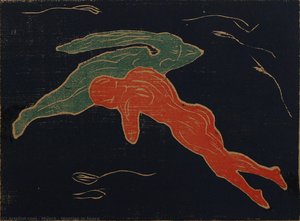
1905. Ulje na platnu, 120.0 x 70.0 cm. Kunsthaus Zürich.

§ 1Katalogski podaci

- 120.0 x 70.0 cm


§ 2Apstraktno
Opis kolekcionarskog predmeta
Edvard Munch's 'Herbert Esche in the Library' captures a contemplative scene within a blurred library setting. Explore emotional intensity, muted blues & yellows, and Munch’s signature Expressionist style.
 Prikaži više
Biografija umjetnika
Otkrijte Edvarda Muncha (1863-1944), norveškog slikara i pionirom ekspresionizma! Istražite 'Krik' i djela koja istražuju anksioznost, smrt, ljubav i psihološke teme. Ključna figura moderne umjetnosti.
§ 3Komentar
A Moment of Quiet Intensity: Edvard Munch’s “Herbert Esche in the Library”
Edvard Munch's "Herbert Esche in the Library," painted in 1905, is more than just a portrait; it’s a carefully constructed tableau of intellect, contemplation, and a subtle undercurrent of melancholy. This work, housed at the Kunsthaus Zürich, offers a rare glimpse into the private world of Herbert Eugen Esche, a textile industrialist who sought refuge in the company of one of the most influential artists of his time – Munch himself. The painting immediately draws the viewer in with its muted palette dominated by blues and yellows, creating an atmosphere both serene and subtly unsettling. It’s a testament to Munch's ability to imbue a seemingly simple scene with profound emotional resonance.
The composition is anchored by Esche’s figure, positioned slightly off-center within the frame, yet commanding considerable presence. He stands as a study in restrained dignity, his gaze direct but not overtly engaging – suggesting a man of quiet reserve and perhaps even a certain melancholy. Behind him, the library interior dissolves into an abstracted wash of color; bookshelves laden with books become blurred shapes, hinting at the vastness of knowledge and the potential distractions that lie beyond Esche’s immediate focus. This deliberate lack of detail isn't a failure of observation but rather a stylistic choice, characteristic of Munch’s Expressionist approach – prioritizing emotional impact over photographic realism.
The Influence of Henry van de Velde and the Chemnitz Context
The genesis of this painting is deeply intertwined with the architectural vision of Henry van de Velde. In 1902-1904, Van de Velde designed and built a villa for Esche in Chemnitz, Germany – a landmark of the Art Nouveau movement. The commission brought Munch to Chemnitz, where he spent three weeks amidst the industrial landscape, a stark contrast to his usual bohemian circles in Paris or Kristiania (Oslo). The painting reflects this specific setting; it’s not merely a portrait but a snapshot of Esche within his environment, commissioned by a man who valued both artistic expression and functional design. The presence of Max Linde, a Lübeck doctor who facilitated the meeting between Munch and Esche, adds another layer to the narrative – highlighting the interconnectedness of art, medicine, and social circles of the early 20th century.
Munch’s Expressionist Techniques: Line, Color, and Texture
Munch's distinctive style is immediately apparent in "Herbert Esche in the Library." Loose, expressive lines define the forms, conveying movement and emotion rather than precise detail. The outlines of Esche’s figure are softened, contributing to a sense of fluidity and vulnerability. The color palette—a blend of blues, yellows, and whites—is applied with visible brushstrokes, creating a rich, painterly texture that emphasizes the immediacy of the work. This technique, combined with the flattened perspective, is quintessential Munch – prioritizing emotional intensity over realistic representation. The use of red and green within the books adds subtle pops of color, hinting at the intellectual stimulation contained within the library’s walls.
Symbolism and Emotional Resonance
Beyond its formal elements, “Herbert Esche in the Library” is rich in symbolic meaning. The blurred background can be interpreted as representing the vastness of knowledge or the distractions of the outside world – suggesting that Esche's focus remains firmly within his own thoughts. Esche’s direct gaze, while not overtly engaging, conveys a sense of introspection and quiet dignity. It speaks to a man comfortable in his own mind, perhaps even burdened by it. The painting ultimately evokes a feeling of contemplative melancholy—a poignant reminder of the complexities of human experience and the enduring power of art to capture those elusive emotions.
A Reproduction for Your Collection
AllPaintingsStore offers meticulously hand-painted reproductions of Edvard Munch’s “Herbert Esche in the Library,” capturing the essence of this iconic artwork with exceptional detail and fidelity. Available in a range of sizes, our reproductions provide an authentic representation of Munch's masterful technique and emotional depth. Whether you are an art collector, interior designer, or simply an admirer of Munch’s work, a AllPaintingsStore reproduction is a beautiful and meaningful addition to your collection – bringing the quiet intensity of this remarkable painting into your space.
Pitanja i odgovori
Gdje se preporučuje izlaganje djela "Herbert Esche in the Library" u formatu Visokoprostran?
Svojim Visokoprostran oblikom, reprodukcija djela "Herbert Esche in the Library" idealna je za Dnevni boravak.
Koliko je "Herbert Esche in the Library" popularno unutar pokreta Expressionism?
Unutar Expressionism pokreta, "Herbert Esche in the Library" ima Prepoznatljivost razinu popularnosti.
Koliko je izražen kontrast u djelu "Herbert Esche in the Library" autora Edvard Munch?
Svijetlo-tamni kontrast djela "Herbert Esche in the Library" zabilježen je kao Upečatljiv. Kontrast opisuje razliku u intenzitetu između svijetlijih i tamnijih područja.


 Prebacite na printove


 Za umjetnička djela ili reprodukcije veće od 105 cm (približno 41 inč) na bilo kojoj strani, okvir će biti isporučen u obliku rastavljenog seta za montažu. Ovaj način osigurava sigurnu dostavu i sprječava oštećenja tijekom transporta.