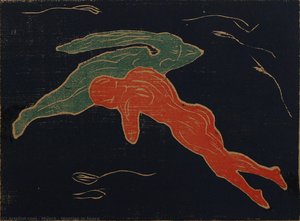
1903. Oil On Canvas.

§ 1Catalogue data


§ 2Abstract
Opis kolekcionarskog predmeta
Explore Edvard Munch's 'Lubeck,' a poignant Expressionist painting depicting a solitary figure gazing at the cityscape. Discover its history & meaning!
 Prikaži više
Biografija umjetnika
Otkrijte Edvarda Muncha (1863-1944), norveškog slikara i pionirom ekspresionizma! Istražite 'Krik' i djela koja istražuju anksioznost, smrt, ljubav i psihološke teme. Ključna figura moderne umjetnosti.
§ 3Commentary
Edvard Munch's "Lübeck": A Window into Expressionist Emotion
Edvard Munch’s “Lübeck,” painted in 1903, is a poignant example of Expressionism, a movement born from a desire to convey intense subjectivity and emotional truth rather than objective reality. Emerging as a reaction against the perceived detachment of earlier art movements, Expressionism embraced distortion, bold colors, and raw handling of materials to depict inner turmoil and psychological states. Munch, a pivotal figure in this movement and renowned for his iconic "The Scream," masterfully utilizes these techniques in “Lübeck” to create a deeply evocative scene.
Subject Matter and Composition
The painting depicts a solitary woman standing before an open window, her back turned towards the viewer. This deliberate positioning creates a sense of mystery and introspection, inviting us to share in her gaze as she observes the cityscape beyond. The title "Lübeck" doesn't refer to the German city itself but rather to Franz von Lenbach, a friend and fellow artist of Munch’s. The composition is striking: the woman’s figure appears almost spectral against the vibrant backdrop of Lübeck’s skyline, emphasizing her isolation and perhaps hinting at a deeper emotional disconnect. The open window acts as a symbolic threshold between the interior world of the woman's thoughts and the external world she observes.
Expressionist Style and Technique
“Lübeck” exemplifies Munch’s signature Expressionist style. Bold, non-naturalistic colors dominate the canvas, creating an atmosphere charged with emotion. The brushstrokes are loose and visible, contributing to a sense of immediacy and rawness. Forms are distorted, not for purely aesthetic reasons but to amplify the psychological impact of the scene. Munch’s use of color is particularly noteworthy; the vibrant hues of the cityscape contrast sharply with the muted tones of the woman's figure, further emphasizing her detachment. The painting isn't about a literal depiction of Lübeck; it's about conveying the *feeling* of being there, filtered through the artist's emotional lens.
Historical Context and Influences
Munch’s personal experiences profoundly shaped his artistic vision. Haunted by childhood illness and loss, he channeled these emotions into his work. “Lübeck” reflects this preoccupation with mortality, isolation, and the complexities of human relationships. The painting draws inspiration from other German Expressionist painters like Emil Nolde, Max Beckmann, George Grosz, Ernst Ludwig Kirchner, and James Ensor, all of whom shared a commitment to expressing subjective experience through art. The rise of Neo-Expressionism later in the 20th century demonstrates the enduring influence of Munch’s pioneering work.
Emotional Impact and Legacy
“Lübeck” resonates with viewers because it taps into universal feelings of loneliness, introspection, and longing. The woman's posture and the vastness of the cityscape evoke a sense of melancholy and quiet contemplation. The painting serves as a powerful reminder of the expressive potential of art to convey complex emotions that transcend language. As an iconic example of Expressionism, “Lübeck” continues to inspire artists and captivate audiences worldwide, solidifying Munch’s place as one of the most important figures in modern art history.
Pitanja i odgovori
Za koju je prostoriju preporučeno djelo "Lubeck" autora Edvard Munch?
Preporučeni prostor za "Lubeck" autora Edvard Munch je Living Room. Ovaj prijedlog se, naravno, može prilagoditi vašem interijeru.
Kakvu atmosferu odiše "Lubeck"?
"Lubeck" odiše Dramatic atmosferom.
Je li "Lubeck" autora Edvard Munch slika, crtež ili grafika?
"Lubeck" autora Edvard Munch klasificirano je kao WallArt. Ova kategorija opisuje vrstu umjetničkog djela kojem original pripada.


 Prebacite na printove


 Za umjetnička djela ili reprodukcije veće od 105 cm (približno 41 inč) na bilo kojoj strani, okvir će biti isporučen u obliku rastavljenog seta za montažu. Ovaj način osigurava sigurnu dostavu i sprječava oštećenja tijekom transporta.