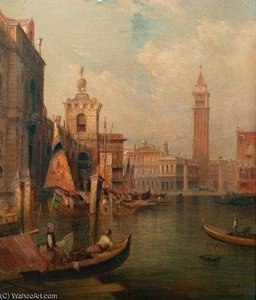
Alfred Pollentine: Capturing the Tranquility of Victorian England
Alfred Pollentine (1836-1890) emerged as a prominent British landscape artist during the Victorian era, leaving behind a legacy of serene depictions of rural England that continue to resonate with collectors and art enthusiasts today. Born in United Kingdom, his artistic journey unfolded against the backdrop of a period characterized by Romantic idealism and burgeoning scientific observation—influences that profoundly shaped his distinctive style.- Early Life & Artistic Training: Details about Pollentine’s upbringing and formative years are scarce. However, biographical records indicate he received formal artistic training at the Royal Academy in London, equipping him with foundational skills in oil painting and compositional principles. This rigorous academic grounding would prove instrumental in honing his craft and establishing him as a respected figure within the British art community.
A Painter’s Vision: Style & Technique
Pollentine's artistic approach was firmly rooted in Romanticism, yet tempered by an astute understanding of atmospheric perspective—a technique championed by luminaries like Turner and Constable. He skillfully employed muted palettes dominated by earthy tones – ochres, browns, and greens – to convey the subtle nuances of light and shadow across his canvases. His brushstrokes were deliberate and expressive, capturing not merely visual appearances but also conveying a palpable sense of mood and emotion. Notably, Pollentine’s meticulous attention to detail ensured that every element within his landscapes—from rolling hills to meandering streams—was rendered with remarkable accuracy.- Notable Works:
- "The Rialto," Venice: This iconic Venetian scene exemplifies Pollentine's mastery of capturing atmospheric beauty. The painting portrays the bustling Grand Canal, bathed in soft light, transporting viewers back to 19th-century Venice and embodying Romantic ideals of sublime grandeur.
- "View Of Venice": Capturing a panoramic vista of Venice’s harbor, “View Of Venice” showcases Pollentine's ability to convey the dynamism of urban life alongside tranquil stretches of water.
- "Venice - View Of Santa Maria Della Salute": A masterful depiction of Santa Maria della Salute basilica, this artwork exemplifies Pollentine’s meticulous observation and artistic skill.
Influences & Artistic Development
Pollentine's artistic sensibilities were undeniably shaped by the prevailing aesthetic currents of his time. The Romantic movement instilled in him a reverence for nature—a belief that art should aspire to capture its grandeur and inspire contemplation. Furthermore, he absorbed lessons from fellow artists like Turner and Constable, adopting their innovative use of light and color to heighten emotional impact. As Pollentine’s career progressed, he refined his technique and expanded his repertoire, producing landscapes that reflected both the idealized vision of Romanticism and the burgeoning realism championed by Impressionists.Historical Significance & Legacy
Alfred Pollentine's contribution to British landscape painting remains significant. His works serve as invaluable documents of Victorian England—providing glimpses into rural life, architectural grandeur, and artistic sensibilities of the era. Today, reproductions of his paintings are treasured by collectors worldwide, ensuring that Pollentine’s serene visions continue to captivate audiences and inspire appreciation for the beauty of the English countryside.Pitanja i odgovori
Postoji li 3D virtualna obilaznost djela umjetnika Alfred Pollentine?
3D galerija umjetnika Alfred Pollentine stranica je koja prikazuje umjetnikova djela u virtualnoj trodimenzionalnoj galeriji.
Koliko je umjetničkih djela autora Alfred Pollentine dostupno u katalogu?
Možete pregledati 71 umjetničkih djela djela autora Alfred Pollentine na stranici Sva umjetnička djela.
Koja raspoloženja izražavaju umjetnička djela umjetnika Alfred Pollentine?
Na stranici Soba po raspoloženju možete pronaći umjetnička djela autora Alfred Pollentine poredana prema njihovoj atmosferi.