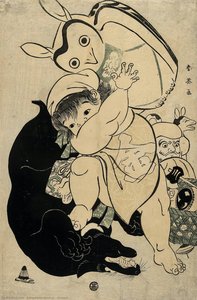
The Master of the Kabuki Stage
In the vibrant, pulsing heart of Edo, a period defined by its floating world of transient pleasures, Katsukawa Shun'Ei emerged as a vital chronicler of human drama and theatrical intensity. Born into a respectable family of landowners under the surname Isoda, his path was destined for the refined yet energetic circles of Japanese art. As a student of the esteemed Katsukawa Shunshō, Shun'ei did not merely inherit a tradition; he breathed new life into it. He became a central figure of the Katsukawa school, eventually succeeding his master as the head of this influential workshop around 1800. His artistry was deeply intertwined with the cultural fabric of Tokyo, Japan, where he moved between the roles of a skilled ukiyo-e designer, an illustrator, and even a performer of gidayū narratives, a musical storytelling tradition that allowed him to experience the emotional depths of the theater from both the artist's desk and the narrator's stage.
Shun'Ei’s work is most profoundly felt in his mastery of yakusha-e, or actor prints. While many artists of his era focused on idealized beauty, Shun'Ei sought a more visceral connection to the performers of the Kabuki stage. He possessed an uncanny ability to capture the mie—that climactic, melodramatic pose where an actor freezes in a moment of extreme emotional tension. Through his meticulous use of line and composition, he could convey the psychological weight behind a furrowed brow or a dramatic gaze. His innovation reached a pinnacle with the development of ōkubi-e, or large-head bust portraits. By stripping away distracting backgrounds and focusing entirely on the face and shoulders, he created an intimacy that was revolutionary for the time, allowing the viewer to confront the raw, unshielded humanity of the actors.
Technique and Artistic Legacy
The technical brilliance of Shun'Ei’s prints often relied on a sense of luxury and visual depth that captivated the urban masses. He was a pioneer in utilizing sophisticated backgrounds, such as kuro-kira-e, which employed black mica to create a shimmering, dark void that made the subject appear to emerge from the shadows. This use of mica powder added a tactile, glittering quality to his work, particularly in his more experimental formats like the aiban and ōban prints. His versatility extended beyond the theater; he was equally adept at rendering the powerful physiques of sumo wrestlers in sumo-e and the heroic exploits of legendary warriors in musha-e. Even within the competitive realm of bijin-ga, or prints of beautiful women, his work maintained a standard of high quality, particularly in his depictions of onnagata actors playing female roles.
The historical significance of Katsukawa Shun'Ei lies in his role as a bridge between the classical traditions of the late eighteenth century and the evolving tastes of the nineteenth. Though he faced the rising dominance of the Utagawa school, his influence remained etched in the techniques passed down to his notable students, such as Katsukawa Shuntei and Katsukawa Shunsen. His life was not without its tribulations; in 1804, he was among several prominent artists, including Utamaro and Toyokuni, who faced the heavy hand of censorship, being jailed and manacled for prints depicting historical figures. Yet, through political upheaval and shifting artistic fashions, Shun'Ei’s legacy endured as a testament to the power of the woodblock print to capture the fleeting, beautiful, and often turbulent essence of the human spirit.
Pitanja i odgovori
Koje je boje Katsukawa Shun'Ei najčešće koristio/la?
Upotrebu boje u djelima umjetnika Katsukawa Shun'Ei koja su navedena na ovaj web-mjesto moguće je proučiti na umjetnikovoj stranici Genom palete.
Koliko su popularna umjetnička djela umjetnika Katsukawa Shun'Ei?
Postoji stranica Statistika za Katsukawa Shun'Ei, koja prikazuje statistiku o umjetninama tog umjetnika na ovaj web-mjesto.
Mogu li pregledati djela umjetnika Katsukawa Shun'Ei prema mediju?
Djela umjetnika Katsukawa Shun'Ei možete pregledavati prema mediju na umjetnikovoj stranici Svi mediji.