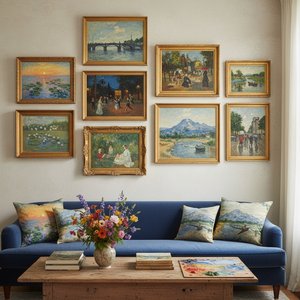
Oil On Canvas.

§ 1Katalógusadatok


§ 2Absztrakt
A gyűjtemény leírása
A serene landscape of a sun-drenched meadow by Claude Monet captures the fleeting essence of Impressionism through dappled light and tranquil nature, inviting you to bring this timeless masterpiece into your collection.
 Összes részlet megjelenítése
A művész életrajza
Fedezze fel Claude Monet világát, az impresszionizmus mesterét, aki ikonikus tájképein, mint a Vízililiomok és a Szénaszúnyogok, a múló fény és szín lenyűgöző pillanatait örökítette be.
§ 3Magyarázat
A Symphony of Light and Tranquility: Exploring Claude Monet’s Untitled (821)
Claude Monet, a name inextricably linked to Impressionism, wasn't merely an artist who painted landscapes; he was a profound observer of the ephemeral beauty of nature—a translator of light into pigment. Born in Paris on November 14, 1840, his formative years were marked by a relocation to Le Havre, Normandy, where his family established roots just five years later. This early exposure to the coastal environment would profoundly influence his artistic vision and become a recurring motif throughout his prolific career. Initially pursuing a path toward commercial success dictated by his father’s ambitions, Monet’s innate passion for art swiftly asserted itself—beginning with charcoal caricatures sold locally – demonstrating both his considerable talent and entrepreneurial spirit. Yet, it was the mentorship of Eugène Boudin that truly ignited his artistic trajectory. Boudin championed the revolutionary concept of *plein air* painting—working directly from nature—a practice that would become Monet’s guiding principle and solidify his legacy as a pioneer of Impressionism.The Painting's Essence: Landscape Impressionism
“Untitled (821)” exemplifies Monet’s signature style – landscape impressionism. Unlike academic painters who meticulously rendered details with precise realism, Monet sought to capture the fleeting effects of sunlight and atmosphere on a serene rural scene. The canvas depicts a tranquil meadow dotted with trees, bathed in dappled light—a quintessential representation of Impressionist aesthetics. This deliberate rejection of traditional techniques underscores Monet’s unwavering commitment to conveying subjective experience rather than objective observation. He prioritized capturing the *impression* of a moment, prioritizing color and texture over precise delineation.Technique and Material Considerations
Monet employed oil paints on canvas—a common medium for Impressionist artists—allowing him to achieve luminous colors and blended brushstrokes that effectively simulate the way light interacts with surfaces. The artist’s meticulous layering of paint, visible in subtle variations of tone and hue, contributes significantly to the painting's textural richness. Monet’s masterful handling of color is particularly noteworthy; he utilized complementary hues – blues and oranges—to heighten visual vibrancy and create a harmonious balance within the composition. Careful attention was paid to capturing the nuances of light filtering through foliage, resulting in an ethereal quality that embodies the Impressionist ideal.Symbolism Within Nature’s Embrace
Beyond its aesthetic beauty, “Untitled (821)” carries symbolic resonance rooted in Monet's broader artistic philosophy. The meadow itself represents fertility and renewal—themes frequently explored by Romantic artists preceding Monet. However, Monet transforms these concepts into something more subtle: a celebration of the everyday sublime – the awe-inspiring grandeur found within seemingly unremarkable natural landscapes. The solitary woman tending to her garden symbolizes resilience and connection with the earth, mirroring Monet’s own fascination with capturing the beauty of rural life. Furthermore, the birds soaring above—a common motif in Impressionist art—represent freedom and aspiration, elevating the scene beyond mere visual representation.Emotional Impact and Artistic Legacy
“Untitled (821)” evokes a palpable sense of peace and tranquility—a feeling deliberately cultivated by Monet to transport viewers into the immediacy of his artistic vision. The painting’s soft color palette and diffused light create an atmosphere conducive to contemplation, inviting observers to immerse themselves in the beauty of the natural world. Monet's influence extends far beyond Impressionism; he fundamentally altered the course of art history by prioritizing perceptual experience over academic convention—inspiring generations of artists to embrace spontaneity and explore the transformative power of color. Reproductions of this masterpiece offer a captivating glimpse into Monet’s artistic genius and his enduring contribution to the canon of Western art.Kérdések és válaszok
Megtekinthetném „untitled (821)”, Claude Monet alkotása alkotást más megvilágítás mellett is?
A „untitled (821)”, Claude Monet alkotása X-ray felvétel oldala egy interaktív nézegető, amely lehetővé teszi a mű alkotásának eleven optikai rétegei közötti görgetést, beleértve az röntgenszerű felvételt is.
Honnan érkeznek a „untitled (821)”, Claude Monet alkotása látogatói?
A "untitled (821)" számára létre van hozva egy Statisztikák oldal. Ez az oldal ábrázolja a mű és a művész többi alkotásának havi látogatottságát, országon és nyelvenként bontva.
Hol tekinthető meg a(z) "untitled (821)" előnézete?
A „untitled (821)”, Claude Monet alkotása előnézete megtekinthető a mű Előnézet oldalán.


 Váltás nyomtatványra


 A bármely oldalsó méretét túlszálaló 105 cm (kb. 41 hüvelyk) meghaladó műalkotások vagy reprodukciók esetében a keret összeszerelhető készletként, szétszerelve kerül szállításra. Ez a módszer biztosítja a biztonságos szállítást, és megakadályozza a szállítás során fellépő sérüléseket.