


 Megtekintés
 Küldés
 Megosztás
 Részletek
 Útmutató

 Letöltés
 Hasonló darabok
 X-ray felvétel
 Diavetítés
 Statisztika
The Night Train
 Acrylic On Canvas
- WallArt
- Romanticism
 1849
1849 280.0 x 380.0 cm
 City Art Gallery
 Összes részlet megjelenítése
Giclée / Műnyomat
Múzeumi minőségű giclée vagy vászonnyomat, gyors gyártással és rugalmas finomítási lehetőségekkel. ( Kézzel festett másolat rendelése Áttérés digitális képre)




P118B Ft10

P118H Ft10

P118W Ft10

P438Z Ft10

P508JH Ft12

P508YH Ft12

P805H Ft10

P805Z Ft10

P919BZ Ft10

P919G Ft10

P919XJ Ft10

P959ZH Ft10

P968JZ Ft12

W106C Ft8

W218G Ft10

W218JH Ft8

W218Y Ft10

W307PJ Ft10

W316G Ft10

W316PJ Ft8

W316Y Ft10

W398PJ Ft8

W4111J Ft10

W500HY Ft15

W500JH Ft15

W692G Ft12

W849H Ft8

W940BG Ft15

W953PJ Ft8




Válasszon előre meghatározott méreteink közül, amelyek megfelelnek a műalkotás eredeti arányainak.

Írja be a keretének vagy a falának megfelelő szélességet és magasságot. A nyomatot csak le lehet vágni, soha nem tehető nagyobbá, mint az eredeti kép, így egy eltérő alakú méretnél a kép egy része elveszik. Mielőtt bármit kinyatintanánk, küldünk egy digitális próbamodellt jóváhagyásra. Az oldalon látható kép nem tartalmazza a valós levágást — ezt csak a próbamodell mutatja meg.
Világszerte történő kiszállítás területére mindössze 2 hét alatt, a szokásos 4-5 hét helyett. (26 október)

Ingyenes globális expressz szállítás

Prémium minőségű len vászon

Teljes körű szállítási biztosítás

Vámvisszatérítési Garancia

Hiteles színarányosság garancia

100 napos visszaküldési lehetőség (csak hibás termékek esetén)

100% pénzvisszatérítési garancia

Több darab vásárlásakor kedvezmény
 Az üvegkeretes opció csak 110 cm alatti méretben érhető el

The Night Train
Giclée / Műnyomat
Reprodukció mérete
-


Összesített ár
Ft 20545
The Night Train: A Watercolor’s Evocative Journey
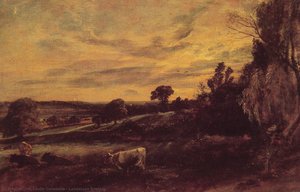
David Cox's "The Night Train," painted in 1849, isn’t merely a depiction of a locomotive traversing the countryside; it’s a profound meditation on movement, atmosphere, and the sublime power of nature. Created during a pivotal period of artistic evolution – bridging the Romantic era with nascent influences of Impressionism – this watercolor captures a fleeting moment imbued with both drama and tranquility. Cox, a key figure in the Birmingham School of painting, masterfully employed loose brushstrokes and a muted color palette to evoke not just what he saw, but how he *felt* observing the scene.
The composition immediately draws the eye into a dynamic landscape dominated by a swirling, almost turbulent sky. Dark, brooding clouds – rendered with remarkable sensitivity to light and shadow – press down upon the viewer, hinting at an impending storm while simultaneously illuminating the distant horizon. Below this dramatic expanse unfolds a rolling countryside, painted in washes of deep greens, browns, and blues. The artist’s technique is deliberately loose; individual brushstrokes are visible, contributing to the sense of movement and immediacy. This approach was revolutionary for its time, moving away from the rigid detail favored by earlier landscape painters.
A Glimpse into a Romantic Vision
“The Night Train” firmly resides within the Romantic tradition, a movement that prioritized emotion, imagination, and the awe-inspiring power of nature. Unlike the Neoclassical emphasis on reason and order, Romantic artists sought to capture subjective experiences – feelings of wonder, terror, and spiritual connection – in their work. Cox’s painting embodies this spirit perfectly. The train itself, a symbol of progress and industrialization, is presented not as a triumph but as an element within a larger, more ancient landscape. It's a reminder of humanity’s place within the vastness of nature.
The inclusion of figures on the train – two individuals observing the scene – adds another layer of interpretation. Are they travelers seeking adventure? Or perhaps simply observers contemplating the beauty and power of the natural world? Their presence invites the viewer to project their own experiences and emotions onto the scene, transforming it into a shared moment of contemplation.
Symbolism and Emotional Resonance
Beyond its immediate visual appeal, “The Night Train” is rich in symbolism. The train, as mentioned, represents progress but also carries an element of displacement – a journey away from familiar surroundings. The turbulent sky suggests both the potential for destruction and renewal, while the horses galloping across the foreground embody untamed energy and instinct. Cox’s masterful use of light and shadow creates a powerful emotional atmosphere, evoking feelings of mystery, anticipation, and perhaps even a touch of melancholy.
The painting's overall effect is one of profound beauty and quiet drama. It’s not simply a landscape; it’s an experience – a journey into the heart of nature’s power and the human spirit’s capacity for wonder. “The Night Train” remains a testament to David Cox’s artistic vision and his ability to capture the essence of a fleeting moment with remarkable skill and sensitivity.
Reproductions & Artistic Legacy
High-quality reproductions of “The Night Train” are available, offering art enthusiasts a chance to bring this evocative masterpiece into their homes. Considerations for framing should complement the painting’s atmospheric qualities – a simple, natural wood frame would best enhance its romantic feel. The watercolor's delicate washes and subtle details benefit from archival-quality paper and printing techniques to preserve its original beauty.
Cox’s influence extends beyond this single work; he is considered a precursor to Impressionism, paving the way for artists who sought to capture fleeting moments of light and color. Studying “The Night Train” provides valuable insight into the development of landscape painting and the enduring power of Romantic art.
Kérdések és válaszok
Mekkora méretű az eredeti "The Night Train"?
A „The Night Train”, David Cox alkotása eredeti mérete 280 x 380 cm.
Hol találhatok egy útmutatót a(z) "The Night Train" alkotáshoz?
A „The Night Train”, David Cox alkotása alkotáshoz elérhető egy Útmutató oldal: ez egy kinyomtatható információs lap a műről, amelyet diákok számára és tantervhez készült használatra terveztek.
A "The Night Train" egy híres Romanticism művészeti alkotás?
A katalógban a Romanticism művek körében a "The Night Train" Recognized rangsorolást kapott.
Hasonló műalkotások



A művész életrajza
Early Life and Training
David Cox, a name now synonymous with the evocative beauty of British landscape painting, was born on April 29th, 1783, in Deritend – a suburb of Birmingham – into a family deeply rooted in the city’s industrial heart. His father, Joseph Cox, was a skilled blacksmith and whitesmith, supplying vital components to the burgeoning Birmingham gun trade; a testament to the region's manufacturing prowess. His mother, however, possessed a remarkable distinction: she hailed from a farming background but had received an unusually thorough education, imbuing David with a sharp intellect and a strong character – qualities that would profoundly shape his artistic journey. The early years of his life were marked by a grounding in practical skills; he initially enrolled at the academy of Joseph Barber in Great Charles Street, where he found himself amongst fellow students, Charles Barber and William Radclyffe. This formative period exposed him to the fundamentals of art, laying the groundwork for his future endeavors. Crucially, at the age of fifteen, Cox became apprenticed to Albert Fielder, a Birmingham painter specializing in the delicate art of portrait miniatures and decorative paintings – often adorning snuffboxes and other luxurious objects. This apprenticeship proved invaluable, providing him with essential technical skills and an understanding of meticulous detail, a characteristic that would later inform his approach to landscape painting. It was during this time that he developed a keen eye for color and composition, absorbing the techniques of a seasoned craftsman.Career Development & Artistic Journey
The year 1804 marked a significant turning point in David Cox’s life: he moved to London, seeking new opportunities and a broader artistic landscape. There, he married his landlord's daughter, Mary Ragg – a union that provided him with stability and companionship. However, it was a trip to Wales in 1805, undertaken alongside Charles Barber, that truly ignited his artistic spirit. This journey proved transformative, exposing him to the dramatic beauty of the Welsh countryside – its rugged mountains, verdant valleys, and ever-changing light. It became the genesis of numerous sketching tours throughout his lifetime, profoundly influencing his distinctive style. Cox’s early career was characterized by a dedication to detailed watercolor landscapes, often depicting rural scenes and architectural subjects with remarkable precision. He initially earned a living as a drawing master, instructing young gentlemen in the art of draughtsmanship – a role that honed his observational skills and deepened his understanding of artistic principles. Colonel Hon. H. Windsor became one of his first pupils in 1808, further solidifying Cox’s position within London's artistic circles. His early works were admired for their meticulous detail and skillful rendering of light and shadow, establishing him as a promising talent.Artistic Style & Influences
Cox’s artistic style underwent a remarkable evolution over the course of his career. Initially focused on precise topographical depictions – aiming to capture landscapes with unwavering accuracy – he gradually embraced a more expressive and atmospheric approach. This shift reflects a growing interest in capturing not just what was *seen*, but also what was *felt* by nature. His work demonstrates an undeniable affinity for the Dutch landscape painters of the 17th century, particularly their masterful use of light and color to evoke mood and atmosphere. He was deeply influenced by artists like Jacob van Ruisdael and Jan van Goyen, whose techniques he meticulously studied. Furthermore, Cox possessed a keen observation of nature, reminiscent of Constable – another pivotal figure in British landscape painting. He became renowned for his loose brushwork, vibrant colors, and ability to capture the fleeting effects of light and weather. This mastery of color and texture allowed him to create paintings that were both visually stunning and emotionally resonant. His later oil paintings, particularly those depicting dramatic skies and atmospheric conditions, are considered groundbreaking achievements in British art.Major Achievements & Legacy
David Cox’s artistic output was prodigious, spanning over three hundred works painted in oil during the latter half of his career. These paintings, now recognized as “one of the greatest, but least recognised, achievements of any British painter,” represent a remarkable testament to his dedication and skill. He consistently exhibited at the Royal Academy from 1805 until his death in 1859, gaining recognition for his unique vision and technical prowess. Cox’s work is characterized by its emotional depth, atmospheric intensity, and masterful use of color. His paintings capture not just the beauty of the British countryside but also the spirit of a changing nation. He played a pivotal role in establishing British landscape painting as a distinct genre, moving away from purely topographical representations towards more expressive and emotional interpretations of nature. Cox’s legacy extends far beyond his individual works; he profoundly influenced subsequent generations of landscape artists, shaping the course of British art for decades to come. His paintings continue to be admired for their beauty, sensitivity, and enduring appeal, serving as a powerful reminder of the transformative power of art.Historical Significance
David Cox is recognized as an early precursor to Impressionism. While he predates the movement’s formal emergence in France, his emphasis on capturing fleeting atmospheric effects – particularly the shifting qualities of light and color – and his loose, expressive brushwork anticipated many of the techniques later adopted by the Impressionists. His work demonstrated a willingness to prioritize subjective experience over strict realism, paving the way for a more emotionally resonant approach to landscape painting. He played a crucial role in establishing British landscape painting as a distinct genre, moving away from purely topographical representations towards more expressive and emotional interpretations of nature. Cox’s paintings are not merely depictions of scenery; they are windows into the soul of the English countryside – capturing its beauty, its drama, and its enduring spirit. His work continues to be studied and admired for its profound insights into the human experience and its lasting contribution to the history of art.
David Cox
1783 - 1859 , Egyesült Királyföld
Rövid információk
- Artistic Movement Or Style: Angliai tájképfestészet
- Artists Or Movements Influenced By This Artist: ['Impressionizmus előfutára']
- Artists Who Influenced This Artist:
- Albert Fielder
- Charles Barber
- Date Of Birth: 29 Április 1783
- Date Of Death: 7 Junnius 1859
- Full Name: David Cox
- Nationality: Angol
- Notable Artworks:
- A Heath szélén
- Falu Herefordshire-ben
- A Severn és a Wye csomópontja Chepstowban
- Place Of Birth: Birmingham, Anglia
Kapcsolódó cikkek

Ephemeral Visions: Exploring the Artistic Legacy & Nuances of Watercolor Painting
Explore the captivating world of watercolor painting! Discover its rich history, essential techniques, influential artists & collecting tips from art experts. A comprehensive guide for enthusiasts.

A festészet forradalma: 10 ikonikus akvarellművészeti remekmű, melyek örökre megváltoztatták a művészetet
Fedezze fel a 10 legikonikusabb akvarell festményt, melyek megváltoztatták a művészetet! Ismerje meg Turner, Monet és más mesterek történetét. Vásároljon prémium minőségű reprodukciókat a AllPaintingsStore.com-on – inspiráló faliképek otthonába!

Ephemeral Visions: Exploring the Artistic Legacy & Contemporary Practice of Watercolor Painting
Explore the captivating world of watercolor painting! Discover its rich history, essential techniques, influential artists & collecting tips. A comprehensive guide for art enthusiasts from AllPaintingsStore.

Ephemeral Visions: Exploring the History & Emotional Resonance of Watercolor Painting
Explore the captivating history of watercolor painting, from ancient techniques to modern masters like Kandinsky & Blake. Discover essential artists, collecting tips & the emotional power of this luminous medium. Expert insights for art enthusiasts.

David Cox the Elder: Landscape, Light & the Romantic Vision of Rural England
Explore the captivating landscapes of David Cox the Elder, a pivotal figure in British Romanticism. Discover his masterful watercolour techniques, enduring legacy & find timeless art for your home at AllPaintingsStore.

