


 Előnézet
 Megosztás
 Megosztás
 Részletek
 Útmutató

 Letöltés
 Hasonló darabok
 X-ray felvétel
 Diavetítés
 Statisztika
The Chancel of the Church of the Nativity (or St. Helena), Bethlehem
 Watercolor
- WallArt
- Historical Painting
 1842
1842 32.0 x 47.0 cm
 Nemzeti Múzeumok Liverpool
 Tovább olvasom
Kézzel készített olajfestmény reprodukció
Kézzel festett olajvastú vászon, az Ön által választott méretben és keretben, művészeink készítik meglévőre. ( Váltás nyomtatványra Áttérés digitális képre)




P118B $10

P118H $10

P118W $10

P438Z $10

P508JH $12

P508YH $12

P805H $10

P805Z $10

P919BZ $10

P919G $10

P919XJ $10

P959ZH $10

P968JZ $12

W106C $8

W218G $10

W218JH $8

W218Y $10

W307PJ $10

W316G $10

W316PJ $8

W316Y $10

W398PJ $8

W4111J $10

W500HY $15

W500JH $15

W692G $12

W849H $8

W940BG $15

W953PJ $8




Válasszon előre meghatározott méreteink közül, amelyek megfelelnek a műalkotás eredeti arányainak.

Ön megadhat saját méreteket egy adott kerethez vagy térhez igazításhoz. Ha a kiválasztott méret nem egyezik az eredeti kép arányával, akkor a műalkotást levágjuk, vagy további kézzel festett elemekkel meghosszabbítjuk a festményt. A gyártás megkezdése előtt küldünk Önnek egy digitális előnézetet jóváhagyásra.
Kérjük, vegye figyelembe, hogy a képernyőn megjelenő előnézet nem tükrözi a tényleges vágást vagy kiterjesztést. Csak az előnézet fog pontosan mutatni a végső kompozíciót.
Bár egyedi méretek állnak rendelkezésre, javasoljuk, hogy válasszon egy méretet az előre meghatározott listából az eredeti arányok megőrzése érdekében.
A rendelést követően a AllPaintingsStore.com csapata e-mailt küld az ügyfélnek az instrukciókért, és biztosít egy előnézeti képet (mockup).
Világszerte elérhető szállítás () 3-4 hét alatt a szokásos 5 hét helyett. (21 szeptember). A minőség nem kérdőjelezhető.

Ingyenes globális expressz szállítás

Prémium minőségű len vászon

Teljes körű szállítási biztosítás

Vámvisszatérítési Garancia

Tökéletes színarányosság garancia

100 napos visszaküldési garancia (csak gyártási hibás termékek esetén)

100% pénzvisszatérítési garancia

Több darab vásárlásakor kedvezmény
 Az üvegkeretes opció csak 110 cm alatti méretben érhető el

The Chancel of the Church of the Nativity (or St. Helena), Bethlehem
Reprodukciós technika
Reprodukció méretei
-


Összesített ár
$ 483
A Glimpse into Sacred Space: David Roberts’ Masterpiece
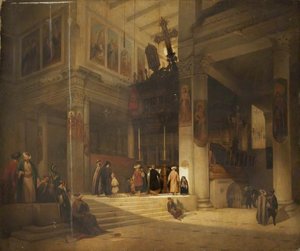
David Roberts' "The Chancel of the Church of the Nativity (or St. Helena)," painted in 1842, isn’t merely a depiction of a building; it’s an immersion into a profound atmosphere of reverence and historical significance. This watercolor, rendered with meticulous detail and imbued with a subtle luminosity, transports the viewer to the heart of Bethlehem – the birthplace of Jesus Christ. Roberts, a Scottish painter celebrated for his evocative depictions of the Middle East during the Victorian era, masterfully captures not just the physical architecture but also the spiritual essence of this ancient site.
The painting immediately draws the eye into a vast interior space dominated by towering columns and intricately carved arches. The perspective is carefully constructed to emphasize the monumental scale of the chancel, creating a sense of both grandeur and intimacy. Roberts’ use of watercolor lends itself beautifully to this effect; the soft washes build up layers of tone and texture, suggesting the cool stone surfaces, the rich fabrics of the vestments, and the diffused light filtering through unseen windows. Notice how he skillfully employs glazing techniques – applying thin, transparent layers of color over dried underlayers – to achieve a remarkable sense of depth and luminosity within the shadowed recesses of the church.
A Window into 19th-Century Orientalism
Roberts’ work falls squarely within the tradition of 19th-century Orientalist painting, a genre that sought to document and romanticize the cultures and landscapes of the Middle East. However, unlike many of his contemporaries who focused solely on exotic spectacle, Roberts demonstrates a deep respect for the subject matter, evident in his careful attention to detail and his avoidance of overly theatrical compositions. He wasn’t simply illustrating; he was striving to capture an authentic experience of this sacred space.
The painting reflects the artistic sensibilities of its time – a fascination with historical accuracy combined with a desire to convey emotional impact. The composition, reminiscent of 19th-century historical paintings, emphasizes the solemnity and importance of the religious ceremony taking place within the chancel. The figures are arranged in a deliberate manner, guiding the viewer’s eye through the complex space and highlighting key elements such as the prominent cross above the altar and the wall paintings depicting biblical scenes.
Symbolism and Historical Context
Beyond its aesthetic qualities, “The Chancel of the Church of the Nativity” is rich in symbolism. The central element – the manger where Jesus was born – immediately anchors the scene in its religious significance. The presence of numerous figures engaged in prayer and worship underscores the enduring importance of this site to Christians worldwide. Furthermore, Roberts’ inclusion of details such as the wall paintings depicting biblical narratives connects the present moment with the foundational stories of Christianity.
Painted in 1842, during a period of intense exploration and imperial expansion, the painting offers a valuable glimpse into the perceptions of the Middle East held by Victorian travelers and artists. It’s important to note that Roberts' work was part of a larger project – his ‘The Holy Land: Syria, Idumea, Arabia, etc., 1842-1849’ – which aimed to document the region through meticulously rendered watercolors and lithographs. These images played a crucial role in shaping Western understanding of the Middle East during a period of significant cultural exchange and colonial influence.
A Timeless Masterpiece
“The Chancel of the Church of the Nativity (or St. Helena)” is more than just a beautiful painting; it’s a testament to David Roberts' artistic skill, his historical awareness, and his ability to capture the spiritual essence of a sacred place. Its enduring appeal lies in its capacity to evoke a sense of awe, reverence, and connection to one of Christianity’s most important sites. Reproductions of this remarkable watercolor offer a captivating window into the past, inviting viewers to contemplate the beauty, history, and profound significance of Bethlehem.
Hasonló műalkotások




A művész életrajza
David Roberts: A Life in Art
David Roberts (1796-1864) was a Scottish painter celebrated for his detailed Orientalist scenes and meticulous lithographs. His work provides invaluable visual documentation of the Middle East during the 19th century, bridging artistic representation with historical record. He remains an influential figure in Victorian art history, embodying both technical prowess and a profound engagement with distant cultures.Early Life and Career
Born on October 24, 1796, in Stockbridge near Edinburgh, Roberts’s formative years instilled within him a dedication to craftsmanship. At the age of ten, he commenced an apprenticeship under Gavin Beugo, honing his skills as a house painter and decorator – experience that would prove invaluable later in his artistic endeavors. This practical grounding complemented his evening art studies, fostering a balanced approach to artistic development. His initial professional commissions included redecorating Scone Palace in 1815, demonstrating early aptitude for transforming spaces through visual artistry. Subsequently, he transitioned into scene painting for James Bannister’s circus, refining his ability to create immersive environments and capturing the dynamism of theatrical productions. These formative experiences established a solid foundation for his burgeoning career as a respected Orientalist painter.Artistic Journey and Influences
Roberts' artistic trajectory was propelled by an expanding curiosity about diverse cultures and landscapes. While initially focused on theatrical scenery – a skill honed during his circus work – he gradually pursued independent artistic explorations, driven by a desire to transcend conventional boundaries. His voyage to Spain in 1832 served as a catalyst for heightened attention to architectural detail and exotic locales, shaping his visual sensibilities. However, it was his extensive expeditions into Egypt and the Near East (1838-1840) that truly cemented his artistic legacy. These journeys yielded a wealth of sketches and observations – meticulously documented – which he subsequently translated into his most celebrated works. Notably, Roberts wasn’t significantly influenced by any singular artist; rather, his style emerged from careful observation and unwavering technical mastery—a testament to his dedication to capturing the essence of his subjects with unparalleled accuracy.Notable Works and Achievements
Roberts achieved lasting renown primarily through The Holy Land, Syria, Idumea, Arabia, Egypt, and Nubia – a series of breathtaking lithograph prints that captivated audiences across Europe. These images powerfully conveyed the grandeur of ancient sites—Jerusalem, Damascus, Petra—and the vibrant tapestry of daily life in the region. The meticulous detail with which Roberts rendered architectural facades, costumes, and landscapes established him as a pioneer in documenting historical environments. Furthermore, he was elected as a Royal Academician in 1841 – an honor reflecting his profound contribution to British art and scholarship. His lithographs stand as enduring records of a bygone era, continuing to inspire admiration for their artistic merit and historical significance.Artistic Style and Characteristics
Roberts’s distinctive artistic style is characterized by several key elements:- Orientalism: He embraced the Romantic movement's fascination with “the Orient,” portraying scenes from Egypt and Persia with remarkable sensitivity and precision.
- Technical Mastery: Roberts possessed exceptional skill in rendering textures, light, and perspective—techniques honed through years of experience as a painter and decorator.
- Landscape Painting: His canvases frequently depicted expansive vistas—mountains, deserts, rivers—infused with atmospheric effects that conveyed both beauty and grandeur.

David Roberts (festő)
1796 - 1864 , Egyesült Királyság
Gyors információk
- Artistic Movement Or Style: Orientalism
- Artists Who Influenced This Artist:
- Jenaro Pérez Villaamil
- Alexander Nasmyth
- Country: United Kingdom
- Date Of Birth: October 24, 1796
- Date Of Death: 1864
- Full Name: David Roberts
- Nationality: Scottish
- Notable Artworks: ['The Holy Land, Syria, Idumea, Arabia, Egypt, and Nubia']
- Place Of Birth: Stockbridge
Kapcsolódó cikkek

Watercolor Art Guide: Mastering Transparency and Light for Professional Hospitality Decor
Elevate hospitality interiors with our professional guide to watercolor art. Discover how transparency and light enhance hotel decor through expert selection of high-quality, custom reproductions and large-scale murals tailored for designers and procurement managers.


