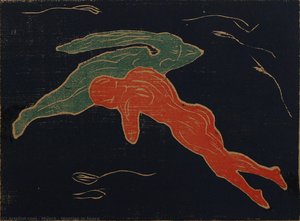
1907. Oil On Canvas.

§ 1Catalogue data


§ 2Abstract
A gyűjtemény leírása
Experience Edvard Munch's "Jealousy" – a visceral Expressionist masterpiece depicting raw emotion and psychological turmoil. Explore the painting’s symbolism, technique & Munch’s haunting vision.
 Összes részlet megjelenítése
A művész életrajza
Munch: A modern művész, aki a szorongást, a halált és az érzelmek viharát ábrázolta a festészetével. Fedezd fel a 'Sikoly' ikonikus alkotását és a norvég expresszionista géniuszát!
§ 3Commentary
Jealousy: A Descent into Emotional Turmoil
Edvard Munch, a titan of modern art, continues to captivate audiences with his unsettling visions and masterful exploration of human psychology. Among his most poignant creations is “Jealousy,” painted in 1907 – an oil on canvas masterpiece that embodies the core tenets of Expressionism and serves as a chilling testament to the corrosive power of emotion.
- Subject Matter: The painting depicts three figures—two men and one woman—engaged in a fraught interaction. Munch meticulously captures the palpable tension between them, conveying the suffocating atmosphere of suspicion and unspoken desire.
- Composition & Style: Munch’s deliberate compositional choices amplify the emotional impact. The central woman dominates the frame, her mouth agape in a dramatic gesture indicative of rage or despair, while the man on the left wears a bow tie—a symbol of formality and perhaps repressed emotion—and the man on the right stares off into the distance, hinting at detachment and preoccupation.
- Technique: Munch employed bold brushstrokes and vibrant colors – predominantly reds and yellows – to express inner turmoil rather than objective reality. The textured surface of the canvas contributes to the painting’s visceral quality, mirroring the turbulent emotions depicted within.
Expressionism's Emotional Landscape
“Jealousy” exemplifies Expressionist principles championed by Munch himself and fellow artists like Ernst Ludwig Kirchner and Emil Nolde. Unlike Impressionists who sought to capture fleeting moments of light and color, Expressionists prioritized conveying subjective feelings—fear, anxiety, grief—above all else. Munch’s artistic vision was profoundly influenced by personal experiences of loss and illness, mirroring the pervasive sense of dread that characterized his life.
- Symbolism: The colors employed – particularly the fiery reds – are laden with symbolic significance, representing passion, anger, and danger. The woman’s gesture embodies frustration and vulnerability, while the man's gaze speaks to a profound disconnection from the emotional drama unfolding before him.
- Historical Context: Created during a period of intellectual ferment—marked by Nietzsche’s exploration of nihilism and existential angst— “Jealousy” resonates with broader philosophical concerns about human nature and the struggle for meaning in a chaotic world.
A Legacy of Psychological Depth
"Jealousy" remains remarkably relevant today, prompting contemplation on themes of insecurity, desire, and the complexities of interpersonal relationships. Its enduring power stems from Munch’s ability to distill profound emotional experience into a single image—a haunting portrayal of psychological vulnerability that continues to inspire artists and viewers alike.
- Relevance to Modern Thought: The painting's exploration of inner turmoil aligns with contemporary discussions about mental health and the importance of confronting uncomfortable truths.
- Further Exploration: For a deeper understanding of Munch’s artistic philosophy and his broader contribution to Expressionism, consider visiting Edvard Munch at AllPaintingsStore.com or delving into Nietzsche's philosophical ideas on Wikipedia.
Experience the emotional intensity of “Jealousy” through a stunning hand-painted reproduction – available exclusively at AllPaintingsStore.com.
Kérdések és válaszok
„Jealousy”, Edvard Munch alkotása festmény, rajz vagy grafika?
A „Jealousy”, Edvard Munch alkotása művészeti alkotás a WallArt kategóriába tartozik. Ez a besorolás határozza meg az eredeti alkotás típusát.
A „Jealousy”, Edvard Munch alkotása a keresett Expressionism művészeti alkotások közé tartozik?
A „Jealousy”, Edvard Munch alkotása a Iconic kategóriába tartozik, és a Expressionism irányzat részeként tekinthető.
Van-e rozšíngtott valóság (AR) előnézete a(z) "Jealousy" alkotásnak?
A „Jealousy”, Edvard Munch alkotása mű kiterjesztett valóság technológiával, egy kompatibilis eszközön keresztül, a mű Kiterjesztett valóság előnézet oldalán megtekinthető a saját falán is.


 Váltás nyomtatványra


 A bármely oldalsó méretét túlszálaló 105 cm (kb. 41 hüvelyk) meghaladó műalkotások vagy reprodukciók esetében a keret összeszerelhető készletként, szétszerelve kerül szállításra. Ez a módszer biztosítja a biztonságos szállítást, és megakadályozza a szállítás során fellépő sérüléseket.