Painting.

§ 1Catalogue data


§ 2Abstract
A gyűjtemény leírása
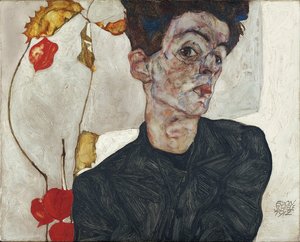
Egon Schiele’s haunting ‘Untitled (680)’ captures raw vulnerability through bold Expressionist lines and unsettling intimacy—a woman draped in repose yet exposed—reflecting the artist's exploration of mortality during Vienna’s turbulent era. Discover this evocative masterpiece.
 Összes részlet megjelenítése
A művész életrajza
Fedezd fel Egon Schiele expresszionista művészi világát! Mély psihológiai elemzés, vonal és érzelmi erővel – részletes információkat és képeket itt találhatsz!
§ 3Commentary
A Portrait of Vulnerability: Decoding Egon Schiele’s Untitled (6830)
Egon Schiele's "Untitled (6830)" stands as a haunting testament to the anxieties and psychological complexities characteristic of Expressionism, capturing a moment of profound intimacy—and unsettling vulnerability—within a single frame. Painted in 1917 during his formative years, this artwork transcends mere depiction; it delves into the artist’s inner turmoil and confronts viewers with an unflinching gaze at the human condition. The painting portrays a woman lying on her back, partially undressed, presenting a posture that immediately conveys both repose and exposure—a deliberate juxtaposition designed to provoke contemplation about themes of fragility and desire.
The Expressionist style is masterfully employed here to convey the artwork's emotional core. Schiele utilizes a distinctive technique marked by thick, agitated brushstrokes that ripple across the canvas, mirroring the turbulent emotions simmering beneath the surface. He eschews traditional realism, prioritizing expressive distortion to communicate psychological states rather than objective observation. Lines dominate the composition—bold, angular lines define the woman’s body and create a sense of dynamism despite her stillness. This stylistic approach aligns perfectly with the broader Expressionist movement, which sought to capture subjective experience and convey feelings of unease and disillusionment in response to the societal upheavals of the early 20th century.
Symbolism and the Fragmented Narrative
Beyond the central figure, subtle symbolic elements enrich the artwork's narrative depth, inviting collectors and enthusiasts to look closer at the details that define Schiele's universe. The inclusion of high heels—a detail often interpreted as representing femininity and aspiration—introduces an element of incongruity against the backdrop of raw vulnerability. Similarly, the presence of a handbag symbolizes practicality and perhaps a guardedness, hinting at a life interrupted or a persona partially hidden. These objects act as anchors to reality within a dreamlike, psychologically charged space, creating a fragmented narrative that feels both deeply personal and universally resonant.
< p>For those looking to bring the profound emotional weight of Austrian Modernism into a contemporary space, this piece offers an unparalleled opportunity. Whether placed in a curated gallery setting or as a focal point in a sophisticated interior, the painting's ability to provoke thought and emotion makes it a timeless choice for art lovers. The raw energy of Schiele’s line work provides a striking contrast to modern minimalist decor, offering a window into the very ache of existence that continues to captivate the art world decades after its creation.Kérdések és válaszok
Használhatom az augmented reality technológiát, hogy megtekintsem a „untitled (6830)”, Egon Schiele alkotása művet a saját szobámban?
A „untitled (6830)”, Egon Schiele alkotása Kiterjesztett valóság előnézet oldala kiterjesztett valóságot használ, hogy az alkotást egy kompatibilis eszközön, az Ön saját környezetében is megmutassa.
Elérhető diaporáma a(z) „untitled (6830)”, Egon Schiele alkotása alkotáshoz?
A „untitled (6830)”, Egon Schiele alkotása diaporámaként tekinthető a mű Diaváltás oldalán.
Hogyan írják le „untitled (6830)”, Egon Schiele alkotása színezetét?
A „untitled (6830)”, Egon Schiele alkotása színek palettáját úgy jellemzik, mint Pastels. Ez a mű színeinek tömör leírása.


 Váltás nyomtatványra


 A bármely oldalsó méretét túlszálaló 105 cm (kb. 41 hüvelyk) meghaladó műalkotások vagy reprodukciók esetében a keret összeszerelhető készletként, szétszerelve kerül szállításra. Ez a módszer biztosítja a biztonságos szállítást, és megakadályozza a szállítás során fellépő sérüléseket.