


 Megtekintés
 Küldés
 Megosztás
 Részletek
 Útmutató

 Letöltés
 Hasonló darabok
 X-ray felvétel
 Diavetítés
 Q&A
Q&A Statisztika
Dolphin skeleton


 Összes részlet megjelenítése
Giclée / Műnyomat
Múzeumi minőségű giclée vagy vászonnyomat, gyors gyártással és rugalmas finomítási lehetőségekkel. ( Kézzel festett másolat rendelése Áttérés digitális képre)




P118B Ft10

P118H Ft10

P118W Ft10

P438Z Ft10

P508JH Ft12

P508YH Ft12

P805H Ft10

P805Z Ft10

P919BZ Ft10

P919G Ft10

P919XJ Ft10

P959ZH Ft10

P968JZ Ft12

W106C Ft8

W218G Ft10

W218JH Ft8

W218Y Ft10

W307PJ Ft10

W316G Ft10

W316PJ Ft8

W316Y Ft10

W398PJ Ft8

W4111J Ft10

W500HY Ft15

W500JH Ft15

W692G Ft12

W849H Ft8

W940BG Ft15

W953PJ Ft8




Válasszon előre meghatározott méreteink közül, amelyek megfelelnek a műalkotás eredeti arányainak.

Írja be a keretének vagy a falának megfelelő szélességet és magasságot. A nyomatot csak le lehet vágni, soha nem tehető nagyobbá, mint az eredeti kép, így egy eltérő alakú méretnél a kép egy része elveszik. Mielőtt bármit kinyatintanánk, küldünk egy digitális próbamodellt jóváhagyásra. Az oldalon látható kép nem tartalmazza a valós levágást — ezt csak a próbamodell mutatja meg.
Világszerte történő kiszállítás területére mindössze 2 hét alatt, a szokásos 4-5 hét helyett. (28 október)

Ingyenes globális expressz szállítás

Prémium minőségű len vászon

Teljes körű szállítási biztosítás

Vámvisszatérítési Garancia

Hiteles színarányosság garancia

100 napos visszaküldési lehetőség (csak hibás termékek esetén)

100% pénzvisszatérítési garancia

Több darab vásárlásakor kedvezmény
 Az üvegkeretes opció csak 110 cm alatti méretben érhető el

Dolphin skeleton
Giclée / Műnyomat
Reprodukció mérete
-


Összesített ár
Ft 20705
Hasonló műalkotások


A művész életrajza
The Legacy of Precision: The Life and Art of Émile Deyrolle
In the heart of nineteenth-century Paris, where the pursuit of scientific discovery met the elegance of fine art, the name Émile Deyrolle resonated as a symbol of unparalleled natural accuracy. Born in Lille in 1838, Deyrolle was not merely an artist in the traditional sense, but a custodian of the natural world. He inherited a profound legacy, stepping into the footsteps of his grandfather, Jean-Baptiste Deyrolle, and his father, Achille, to manage a family institution that would become a global landmark for natural history. His life was defined by a seamless marriage between the rigorous demands of zoology and the delicate touch of an illustrator, creating a body of work that served as both a scientific record and a profound aesthetic tribute to the complexity of life.
The foundation of Deyrolle’s artistry was laid in the quiet, observant atmosphere of his family’s establishment. Under the tutelage of Achille, he developed an eye for the minute details that define biological existence. This education went beyond mere sketching; it involved a deep immersion into the physical reality of specimens. To capture the essence of a creature, Deyrolle understood that one had to look beneath the skin. His process was one of meticulous reconstruction, where he would study the skeletal frameworks and muscular structures of animals to ensure that every line drawn on paper or canvas possessed anatomical truth. This dedication transformed his work from simple illustration into a vital tool for the scientific community, bridging the gap between the collector's cabinet and the researcher's laboratory.
A Mastery of Anatomical Realism
Deyrolle’s artistic technique was characterized by an almost haunting level of realism. While many of his contemporaries focused on the romanticized or stylized depictions of nature, Émile sought the truth found in dissection and observation. His canvases and illustrations were celebrated for their ability to convey the internal architecture of the animal kingdom. Whether rendering the delicate bones of a marine specimen or the robust musculature of a terrestrial predator, his work possessed a clarity that was both intellectually stimulating and visually arresting. This precision allowed him to capture the élan vital—the vital force—of his subjects, making even a skeletal structure feel imbued with the memory of life.
The significance of his work extended far beyond the walls of his Parisian shop at Rue du Bac. As a dealer in natural history specimens, fossils, and taxidermy, he curated an environment where science and beauty were indistinguishable. His contributions to the field of anatomical illustration provided invaluable insights for biologists and medical professionals of the era. Notable examples of his focus on the structural wonders of nature include:
- The Dolphin Skeleton: A masterpiece of marine anatomy that showcases his ability to translate complex biological forms into a clear, educational, and artistic composition.
- Fossilized Fish Casts: Works that demonstrate his skill in capturing the ancient, petrified textures of prehistoric life, blending paleontology with fine art.
- Anatomical Reconstructions: Detailed renderings of musculature and bone that served as essential references for the scientific advancement of the late 19th century.
Historical Significance and Eternal Influence
The era of Émile Deyrolle was a golden age for natural history, a time when the collection of specimens was seen as a noble pursuit of knowledge. Through his stewardship of the Deyrolle establishment, he helped maintain Paris as a central hub for entomology, taxidermy, and mineralogy. His work stood at the intersection of several disciplines, influencing not only the scientific illustrators who followed him but also the collectors of "cabinets of curiosities" who sought to find beauty in the strange and the anatomical. Even as the methods of scientific study evolved, the standard of accuracy set by Deyrolle remained a benchmark for excellence.
Today, the legacy of Émile Deyrolle lives on through the enduring fascination with his anatomical precision. His work continues to appeal to modern collectors of natural history art and enthusiasts of marine biology, offering a window into a period when the act of looking closely at nature was an act of profound discovery. He remains a pivotal figure whose name is forever linked to the delicate balance between the scientific eye and the artist's hand, reminding us that true beauty is often found in the most intricate details of the natural world.

Emile Deyrolle
1838 - 1917 , France
Rövid információk
- Full Name: Émile Deyrolle
- Nationality: French
- Date Of Birth: 1838
- Date Of Death: 1917
- Place Of Birth: France
- Notable Artworks:
- Dolphin skeleton
- Cast of a fossilized fish
- Artistic Movement Or Style: Naturalism
- Artists Who Influenced This Artist: ['Jean-Baptiste Deyrolle']
- Artists Or Movements Influenced By This Artist: ['Courbet']
Kapcsolódó cikkek

The Architecture of Flesh: A Journey Through Anatomical Mastery in Art History
Explore the profound intersection of science and beauty in art history. Discover how masters like Michelangelo used anatomical precision to define the human form through iconic studies of musculature, light, and movement.

Navigating the Depths of Representation: A Historical Exploration of Marine Painting
Explore the rich history of marine painting with AllPaintingsStore. Discover Dutch Masters, Romantic seascapes & renowned artists like Wyllie and Harris. Expert guidance for collectors & custom reproductions.

Leonardo da Vinci 25 Mesterműve: Festmények, Rajzok és a Reneszánsz Zsenije – AllPaintingsStore.com
Fedezze fel Leonardo da Vinci 25 legikonikusabb művét! Ismerje meg a Mona Lisa, az Utolsó Vacsora és más reneszánsz remekművek történetét. Museum-minőségű reprodukciók és inspiráló otthon dekorációs ötletek – AllPaintingsStore.com.

Søren Emil Carlsen: A Study in Danish Luminism & Atmospheric Realism
Explore the captivating world of Søren Emil Carlsen, a master of Danish Luminism and American Impressionism. Discover his exquisite still lifes & landscapes – a study in realism, atmosphere, and enduring artistic beauty.
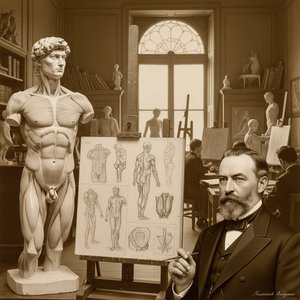
Frederick Bridgman: Anatomical Mastery & the Evolution of Figure Drawing Instruction
Explore the anatomical mastery of George B. Bridgman & his revolutionary figure drawing techniques. Discover how his methods transformed art instruction and continue to inspire artists today. Learn more at AllPaintingsStore.

