Pénzvisszatérítési Garancia · 100 nap Ingyenes világszerte történő szállítás
449 587műalkotások 30 613művészek 4 660múzeumok 32nyelv
Pénznem
    Nyelv
      Ateliér · Alapítva: 2015 · Paris, Francia
      AllPaintingsStore
      allpaintingsstore.com
      Catalogue entry

      Composition for a Mural

      1945. Acrylic, 50.0 x 40.0 cm.

      Fig. 1. Léger Ferenc, Composition for a Mural, 1945. Shown as the reproduction you are specifying: , .

      § 1Catalogue data

      § 2Abstract

      A gyűjtemény leírása

      Explore Fernand Léger’s striking Composition for a Mural – a dynamic blend of geometric abstraction and industrial imagery from 1945. This monumental canvas captures the energy of the machine age through bold reds, whites, and blues, inviting viewers to contemplate its captivating visual language.

      A művész életrajza

      Fedezd fel a modern művészet egyik kiemelkedő alakját, Fernand Léger-t! Tubism, gépek és a modern élet festményei – egy forradalmi festőművész öröksége.

      § 3Commentary

      A Bold Synthesis of Form and Function: Exploring Fernand Léger’s “Composition for a Mural”

      Fernand Léger's "Composition for a Mural," painted in 1945, represents more than just a visually striking image; it embodies the core tenets of Surrealist abstraction—a deliberate rejection of traditional artistic conventions while simultaneously embracing the influence of industrial design and geometric precision. This artwork encapsulates Léger’s singular approach to capturing the anxieties and aspirations of his era, offering a profound meditation on humanity's relationship with technology and its transformative power.
      • Subject Matter: The painting presents a simplified depiction of a human face juxtaposed against a stylized locomotive—a deliberate pairing that immediately establishes a dialogue between organic form and mechanical movement. Léger wasn’t interested in portraying reality as it appeared; instead, he sought to distill its essence into fundamental geometric shapes and colors.
      • Style: Léger firmly positioned himself within the Surrealist movement despite rejecting its dreamlike imagery. He championed “Constructivism,” prioritizing clarity of form and intellectual rigor over emotional expression. This stylistic choice reflects a broader cultural shift toward rationalism and utilitarian design during the mid-20th century.
      • Technique: Léger employed a distinctive technique characterized by bold, flat planes of color applied with thick impasto—a textural approach that lends physicality to his abstract compositions. The use of vibrant reds and whites dominates the face, contrasting sharply with the muted blues of the locomotive background. This deliberate manipulation of pigment contributes significantly to the artwork’s expressive power.

      Historical Context: Navigating the Postwar Landscape

      Painted in the immediate aftermath of World War II, “Composition for a Mural” speaks directly to the pervasive sense of disillusionment and uncertainty that gripped Europe following the devastation of conflict. Léger’s artistic response wasn't one of despair but rather an assertion of optimism—a belief in progress driven by scientific advancement and industrial innovation. The locomotive motif symbolizes this aspiration, representing speed, efficiency, and a yearning for reconnection with civilization after enduring hardship. It’s important to note that Léger was actively engaged in discussions about the role of art within society during this period, advocating for its contribution to rebuilding shattered communities.

      Symbolism Beyond Representation

      While eschewing literal depiction, Léger infused his artwork with symbolic resonance. The fragmented face embodies humanity’s vulnerability and complexity—a reminder that even amidst technological progress, human experience retains its inherent contradictions. However, the locomotive transcends mere mechanical imagery; it symbolizes not just transportation but also transformation and renewal. Léger deliberately avoided sentimentalism, opting instead for a visual language that communicates ideas rather than emotions. The geometric forms themselves represent stability and order—a counterpoint to the perceived chaos of the postwar world.

      Emotional Impact: A Quiet Assertion of Belief

      Despite its bold color palette and assertive technique, “Composition for a Mural” possesses an understated emotional quality. Léger’s aim wasn't to provoke visceral reactions but rather to instill a sense of contemplation—encouraging viewers to consider the implications of technological advancement on human existence. The artwork’s harmonious balance between form and color conveys a feeling of quiet confidence—a conviction that reason and creativity could guide humanity toward a brighter future. It stands as a testament to Léger's enduring legacy as an artist who dared to reimagine art’s role in shaping our understanding of the world.

      Kérdések és válaszok

      Hogyan egyensúlyozza a fényt és a sötétséget a "Composition for a Mural"?

      A "Composition for a Mural" alkotás fényerisége összességében balanced, luminanciája pedig Gentle Luminance.

      Milyen szín vezeti a „Composition for a Mural”, Léger Ferenc alkotása kompozícióját?

      A(z) White (#e7e6e3) a(z) „Composition for a Mural”, Léger Ferenc alkotása domináns színe.

      Milyen telítettséget és intenzitást mutat „Composition for a Mural”, Léger Ferenc alkotása?

      A „Composition for a Mural”, Léger Ferenc alkotása színei Balanced Soft telítettséget és Balanced intenzitást mutatnak be.
      § 4The artist

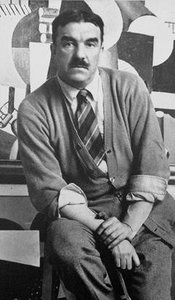
      Léger Ferenc

      Léger Ferenc

      1881 - 1955, Franciaország

      Quick facts about Léger Ferenc

      • Artistic Movement Or Style: Kubizmus, Tubizmus
      • Artists Or Movements Influenced By This Artist: ['Pop Art']
      • Artists Who Influenced This Artist: ['Paul Cézanne']
      • Date Of Birth: 1881. Feb 4.
      • Date Of Death: 1955. Aug 17.
      • Full Name: Fernand Léger
      • Nationality: Francia
      • Notable Artworks:
        • A ülő nő
        • Gépi elem
        • A nagy menet
        • Az animált táj
      • Place Of Birth: Argentan, Francia

      A művész életrajza

      A Life Forged in Form: The World of Fernand Léger

      Fernand Léger, born Joseph Fernand Henri Léger in 1881 amidst the rural landscapes of Argentan, Normandy, stands as a pivotal figure in the evolution of modern art. His journey from the farmlands of his youth to the forefront of Parisian avant-garde circles is a testament to an unwavering artistic vision and a relentless pursuit of capturing the spirit of the machine age. Unlike many of his contemporaries who embraced abstraction as a retreat from representation, Léger sought to *integrate* modernity – its dynamism, its mechanical forms, its very essence – into a new visual language that was both powerfully abstract and deeply rooted in the observable world. His early life, steeped in the physicality of agricultural labor, provided a grounding contrast to the industrialized future he would so passionately depict. Initially destined for architecture, Léger’s path shifted towards painting after arriving in Paris around 1900, supporting himself through drafting work while honing his artistic skills. This period was marked by traditional academic training, but it wasn't until encountering the groundbreaking work of Paul Cézanne that a true transformation began to unfold.

      The Birth of ‘Tubism’ and the Section d’Or

      Cézanne’s retrospective in 1907 acted as a catalyst, liberating Léger from conventional representation and propelling him towards a more geometric and structural approach. He began dismantling forms, analyzing their underlying structures, and rebuilding them on canvas with a newfound emphasis on solidity and volume. This exploration quickly led him into the orbit of Cubism, but Léger wasn’t content to simply replicate the styles of Picasso or Braque. Instead, he developed his own distinct idiom – a personal form of Cubism that critics playfully dubbed “Tubism.” Characterized by cylindrical forms, flattened planes, and bold color contrasts, Tubism celebrated the machine aesthetic long before it became a widespread artistic preoccupation. It was an art born from observing the burgeoning industrial world, recognizing beauty in its functional shapes and mechanical rhythms. Léger’s approach differed significantly; he wasn't interested in dissecting objects into fragmented geometric pieces as Picasso and Braque did. Instead, he sought to capture their essence – their inherent stability and movement – through simplified, almost monumental forms. This resulted in a style that felt both dynamic and strangely static, capturing the feeling of machinery in motion while simultaneously presenting it as a solid, enduring presence. The group *Section d’Or* (The Golden Section), formed with artists like Jean Metzinger, Henri Le Fauconnier, Francis Picabia, and Marcel Duchamp, further nurtured this exploration. This collective sought to apply mathematical principles – particularly the golden ratio – to their art, believing that these proportions held a key to achieving harmony and visual balance. Léger’s work became deeply intertwined with the Section d'Or’s investigations, reflecting a desire for order and rationality within the increasingly chaotic world of modern life.

      War, Mechanization, and a New Aesthetic

      The outbreak of World War I profoundly impacted Léger’s life and work. Serving at the front from 1914 to 1916 exposed him to the brutal realities of modern warfare – artillery barrages, aerial combat, and the dehumanizing effects of mechanized conflict. This experience didn't lead to disillusionment or a rejection of modernity; rather, it solidified his fascination with machines and their power. Sketches made during his service documented the stark beauty of military technology, transforming instruments of destruction into subjects of artistic contemplation. The repetitive patterns of trenches, the gleaming metal of tanks, and the angular forms of aircraft became sources of inspiration for Léger’s evolving style. Upon returning to civilian life, Léger’s aesthetic underwent a further evolution. His paintings began to reflect a more streamlined, mechanistic sensibility, celebrating the dynamism and efficiency of the industrial world. *Soldier with a Pipe* (1916) exemplifies this shift, showcasing simplified forms and bold colors that evoke the feeling of mechanical precision. This wasn't merely an aesthetic choice; it was a philosophical statement – an affirmation of modernity’s potential for progress and renewal, even in the wake of devastating conflict. He began to incorporate industrial materials into his work, experimenting with metal and other unconventional media alongside traditional paint.

      Legacy and Lasting Influence

      In his post-war years, Léger continued to explore the intersection of art and industry, creating works that celebrated modern life with a unique blend of abstraction and figuration. His *Paysages animés* (Animated Landscapes) series from 1921 showcased figures and animals seamlessly integrated into streamlined compositions, blurring the boundaries between organic and inorganic forms. He also experimented with sculpture and filmmaking, expanding his artistic practice beyond the confines of traditional painting. Léger’s influence on subsequent generations of artists is undeniable. His bold simplification of form, his embrace of industrial imagery, and his celebration of popular culture anticipated the emergence of Pop Art decades later. Artists like Roy Lichtenstein and Andy Warhol owe a clear debt to Léger's pioneering work. He bridged the gap between abstract art and figurative representation, demonstrating that it was possible to create works that were both intellectually rigorous and visually engaging. Léger’s legacy is not merely as a painter, but as a prophet of modernity – a visionary who dared to find beauty in the machine age and to translate its energy onto canvas with unparalleled boldness and originality. A true pioneer whose work continues to resonate with audiences today.

      Useful Information

      • Born: Argentan, France (1881)
      • Died: Gif-sur-Yvette, France (1955)
      • Key Works: *The Sitted Woman*, *Machine Element*, *The Great Parade*, *The City*
      • Movement(s): Cubism, Tubism, Modernist Art

      § 5Comparanda

      § 6Questions

      Gyors információk

      • Artist: Fernand Léger
      • Dimensions: 50 x 40 cm
      • Notable elements or techniques: Geometric abstraction; Mechanical forms
      • Title: Composition for a Mural
      • Artistic style: Constructivist
      • Movement: Cubism

      § 7Cite this entry

      AllPaintingsStore.com, “Léger Ferenc, Composition for a Mural (1945)”, https://allpaintingsstore.com/hu/art/fernand-leger-composition-for-a-mural-8XY2JV-en/ (accessed 2 október 2026).

      § 8The reproduction

      Kézzel készített olajfestmény reprodukció

      Kézzel festett olajvastú vászon, az Ön által választott méretben és keretben, művészeink készítik meglévőre. ( Váltás nyomtatványra Áttérés digitális képre)

      It is specified on the order sheet in the margin; the present state of that sheet reads as follows.

      Composition for a Mural

      Reprodukciós technika

      Reprodukció mérete

      -

      Kiváló mesterművész

      Nagyobb részletesség, finomság és bővített gyártási idő

      -

      Reprodukció keretezése

      -

      -

      A bármely oldalsó méretét túlszálaló 105 cm (kb. 41 hüvelyk) meghaladó műalkotások vagy reprodukciók esetében a keret összeszerelhető készletként, szétszerelve kerül szállításra. Ez a módszer biztosítja a biztonságos szállítást, és megakadályozza a szállítás során fellépő sérüléseket.

      Szakmész összeszerelést igényel – ez nem DIY (önösszeszerelhető) termék.
      A készletet egy tapasztalt keretező szakembernek kell összeszerelnie és a vásznat feszítenie kell, fa ragasztó (nem tartalmazza a csomag), vásznfeszítő fogó és szorítók használatával, amelyek a ragasztó száradásáig a keretrészeket egymáshoz vuôngjba tartják. A helytelen összeszerelés vagy a nem egyenletes vásznfeszítés maradandó károsíthatja a műalkotást, és ez nem része a garanciánknak.

      • A készlet tartalmazza az összes tömörfa rudat, pontosan méretre vágva.

      • A mellékelt csavarokkal, valamint a sarokszerekhez szükséges faütő ragasztóval kell összeszerelnie (ez nem tartalmazható a csomagban), így a keretrendezőnek külön kell beszereznie.

      • A csomag nem tartalmazza a szükséges professzionális eszközöket: egy vászonfeszítőt és klipseket a rácsok vízszintes tartásához a ragasztó megszáradásáig.

      Fontos:
      A sarokcsatlakozásokhoz fánylagra van szükség, a keretrudakat szorítókapcsokkal kell rögzíteni, amíg a rag teljesen meg nem szárad, a kész keretre feszített vászonhoz pedig vászonfeszítő fogat szükséges. Ezek egyike sem található meg a készletben. Kérjük, rendelés előtt győződjön meg róla, hogy rendelkezik tapasztalt keretező szakemberrel.

      Névtábla

      -

      -

      Védőréteg (Lakk)

      Fényes lakk (intenzívabb színek, védelem a fény és a nedvesség hatása ellen)

      -

      Műalkotásom egyedi igényre szabása

      Példák a módosíthatóságra: az arc kicserélése az ügyfél fotójára; háziállat hozzáadása (pl. macska helyett kutya); rejtett üzenet elhelyezése a háttérben; a háttér tájainak vagy elemeinek megváltoztatása.

      -

      Sürgős

      Világszerte szóló szállítás () mindössze 3-4 hét alatt, a szokásos 5 hét helyett. (31 október). A minőség nem kérdőjelezhető.

      -

      Express szállítás

      Világszerte elérhető szállítás területre 5 héten belül. (7 november).

      A szállítás díja tartalmazza

      Összesített ár

      Ft 84358

      Included with every order

      • Ingyenes globális expressz szállítás
      • Prémium minőségű len vászon
      • Teljes körű szállítási biztosítás
      • Vámvisszatérítési Garancia
      • Hiteles színarányosság garancia
      • 100 napos visszaküldési lehetőség (csak hibás termékek esetén)
      • 100% pénzvisszatérítési garancia
      • Több darab vásárlásakor kedvezmény
      Order sheet