

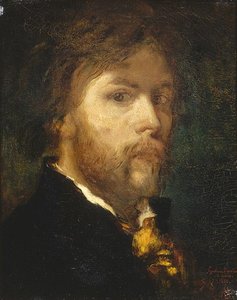
1890. Acrylic On Canvas. Musée Gustave Moreau.

§ 1Catalogue data


§ 2Abstract
A gyűjtemény leírása
Moreau's work aligns with Symbolist principles by prioritizing emotion and imagination over realistic representation. Notable related artworks include 'View of the Villa Borthese,' 'Jacob and the Angel,' 'The Unicorn,' and 'St. Elisabeth of Hungary.' This painting remains a cornerstone of Symbolist art.
 Összes részlet megjelenítése
A művész életrajza
Fedezd fel Gustave Moreau szimbolikus világát! A 19. századi francia festő, aki mitológiai és vallási témákkal alkotott, a képzelet és az álom mestere. Érdemes megnézni a 'Salomé táncol előtted Hérodé' művét!
§ 3Commentary
A Vision of Mythic Reverie: Exploring Gustave Moreau’s Dalila
Gustave Moreau's *Dalila*, painted in 1890, isn’t merely a depiction of biblical narrative; it’s an immersion into the heart of Symbolism—a movement that sought to transcend literal representation and delve into the realm of dreams, emotions, and spiritual truths. Housed within the Musée Gustave Moreau in Paris, this watercolor masterpiece stands as a testament to Moreau's unwavering commitment to forging connections between mythology, religion, and psychology.The Genesis of Symbolism: Moreau’s Artistic Philosophy
Moreau rejected the dominant artistic trends of his era—Realism and Impressionism—finding solace instead in the esoteric traditions of Byzantium and Germanic Romanticism. Influenced by thinkers like Nietzsche and Wagner, he envisioned art as a conduit for accessing deeper levels of consciousness, prioritizing atmosphere and suggestion over precise observation. This philosophical stance profoundly shaped his visual vocabulary, propelling him toward compositions characterized by luminous color palettes, intricate ornamentation, and stylized figures imbued with symbolic significance.A Biblical Narrative Illuminated: Symbolism in Dalila
The painting recounts the biblical tale of Samson and Delilah, portraying Delilah as a woman consumed by desire—a figure rendered with unsettling beauty and languid grace. Moreau’s meticulous attention to detail elevates the scene beyond mere storytelling; it becomes an exploration of feminine allure and the perilous dance between vulnerability and betrayal. The opulent setting—dominated by rich textiles and shimmering gold leaf—amplifies this sense of decadent splendor, mirroring Delilah's seductive influence over Samson.Technique and Texture: Moreau’s Watercolor Mastery
Moreau’s skill as a watercolorist is undeniable. He achieved remarkable luminosity and depth through layering translucent washes of pigment, creating textures that evoke the velvety softness of silk and the ethereal glow of candlelight. The artist skillfully employed hatching and cross-hatching to sculpt form and convey subtle nuances of emotion—particularly evident in Delilah's gaze, which holds both allure and apprehension. Furthermore, Moreau’s masterful use of color contributes significantly to the painting’s mood; reds dominate the drapery, symbolizing passion and danger, while greens evoke a sense of fecundity and concealment.Beyond Representation: Emotional Resonance and Symbolism’s Legacy
*Dalila* transcends its biblical subject matter, resonating with viewers on an emotional level—a contemplation of desire, temptation, and the destructive consequences of yielding to worldly passions. Moreau's deliberate ambiguity invites interpretation, prompting us to consider themes of faith versus doubt, innocence versus corruption, and ultimately, the human condition itself. Like many Symbolist artworks, *Dalila* continues to inspire artists and collectors alike, serving as a poignant reminder that true beauty lies not in capturing reality but in conveying profound psychological truths—a legacy firmly rooted in Moreau’s visionary artistic vision.Kérdések és válaszok
Milyen felhasználásra javasolt a „Dalila”, Gustáv Moreau alkotása?
A „Dalila” nyomtatvány ajánlott felhasználása: Accent.
Milyen technikával készült a „Dalila”, Gustáv Moreau alkotása?
Gustáv Moreau a Acrylic On Canvas technikát alkalmazta a "Dalila" alkotáshoz. A technika határozza meg az eredeti mű anyagösszetételt.
Mi a(z) domináns színe a(z) „Dalila”, Gustáv Moreau alkotása alkotásnak?
A(z) Phthalo Green (#2d1e14) a(z) „Dalila”, Gustáv Moreau alkotása domináns színe.


 Váltás nyomtatványra


 A bármely oldalsó méretét túlszálaló 105 cm (kb. 41 hüvelyk) meghaladó műalkotások vagy reprodukciók esetében a keret összeszerelhető készletként, szétszerelve kerül szállításra. Ez a módszer biztosítja a biztonságos szállítást, és megakadályozza a szállítás során fellépő sérüléseket.


