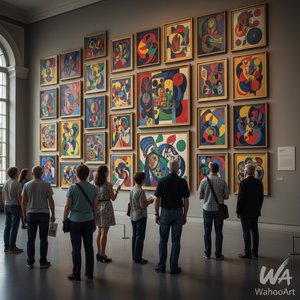
Acrylic On Canvas.

§ 1Katalógusadatok

Ez a műalkotás szerzői jogi védelem alatt áll
Az ezen az oldalon megjelenített műalkotások szerzői jogi védelem alatt állnak, ami azt jelenti, hogy törvényileg nem készíthetünk és nem adhatunk el belőlük pontos másolatokat. Ez a védelem olyan nemzetközi megállapodások alapján érvényesül, mint például a Berni Egyezmény és a nemzeti jogszabályok által, beleértve azokat is, amelyeket meghatározott Az USA szerzői jogi törvénye – 17. cím.
Mint tiszteletes és törvényes alternatívát, olyan egyedi, kézzel festett alkotásokat kínálunk, amelyek az eredetiből merítnek inspirációt. Tapasztalt és professzionális művészeink alaposan tanulmányozzák az eredeti stílusát, hangulatát és művészeti esszenciáját, hogy egy olyan új, egyedi alkotást hozzunk létre, amely ugyanazt az érzést kelti – miközben önálló, eredeti alkotásként létezik.
Ez a módszer teljes mértékben megfelel a szerzői jogi szabályozásnak, mivel nem tartalmazza a védett műalkotás másolását vagy duplikálását. Ehelyett ez egy kreatív újinterpretáció – egy új festmény, amely az eredetivel való összefüggései miatt hatással van rá, de nem az az.
 További információk
§ 2Absztrakt
A gyűjtemény leírása
Woman Before an Eclipse with Her Hair Disheveled by the Wind – This striking black and white abstract painting by Joan Miró depicts a solitary figure confronting an eclipse, characterized by a prominent yellow face and cigarette smoke, alongside other symbolic elements like a bicycle and scattered figures. Exhibited at Hirschhorn Museum and Sculpture Garden in 1980, it reflects Miró's exploration
A művész életrajza
Fedezd fel Joan Miró világát! Szürrealista és absztrakt műalkotásokkal, katalán szimbólumokkal és játékos formákkal! Egy igaz úttörő a modern művészetben – nézd meg minden egyes alkotását!
§ 3Magyarázat
A Catalan Visionary: The Life and Art of Joan Miró
Joan Miró i Ferrà, born in Barcelona in 1893, stands as one of the most significant figures in 20th-century art. His journey was not merely a progression through styles but an exploration of inner worlds, translating dreams, memories, and Catalan identity onto canvas with a uniquely poetic visual language. From humble beginnings marked by illness and initial parental reservations about his artistic pursuits, Miró persevered, driven by an innate need to express the intangible—the emotions, sensations, and subconscious currents that lie beneath the surface of reality. His early life was steeped in the traditions of Barcelona, a city brimming with architectural marvels thanks to Antoni Gaudí, whose organic forms would subtly influence Miró’s later abstractions. The goldsmithing profession of his father instilled an appreciation for meticulous craftsmanship, while the rugged Catalan landscape became a recurring motif and source of inspiraSubject Matter and Composition
“Woman Before an Eclipse with Her Hair Disheveled by the Wind,” created in 1968, presents a striking juxtaposition of organic and geometric forms. At its core lies a monumental black figure—a dominant presence embodying both strength and vulnerability—accompanied by a radiant yellow face, symbolizing hope amidst darkness. Scattered throughout the canvas are smaller figures – a bicycle, stylized animals – contributing to a dynamic interplay of elements that convey a sense of movement and disorientation. Miró deliberately eschewed representational accuracy, prioritizing instead the conveyance of psychological states and emotional resonance. The composition itself reflects the artist’s fascination with Catalan folklore and mythology, hinting at narratives rooted in ancient traditions.Style and Technique
Miró's artistic style is undeniably abstract expressionist, yet it transcends categorization through its distinctive blend of Surrealism and Cubism influences. He employed a technique characterized by bold brushstrokes and textured surfaces—a deliberate rejection of academic conventions—to achieve an effect akin to “automatic drawing,” where the artist relinquishes conscious control in favor of spontaneous gesture. The use of encaustic, a mixture of beeswax and resin pigment, lends the painting remarkable luminosity and depth, capturing subtle variations in tonal color that heighten its visual impact. This meticulous layering process underscores Miró’s commitment to crafting artworks that are both intellectually stimulating and emotionally captivating.Historical Context and Influences
Miró emerged during a period of profound artistic upheaval—the aftermath of World War I and the rise of Surrealism—a movement championed by André Breton, which sought to liberate creativity from rational constraints. Breton’s manifesto explicitly advocated for accessing the subconscious mind as a source of inspiration, mirroring Miró's own preoccupation with dream imagery and symbolic language. Gaudí’s architectural innovations served as an unspoken catalyst, prompting Miró to embrace organic forms and textures that defied Euclidean geometry—a stylistic decision reflecting his deep connection to Catalan identity and heritage.Symbolism and Emotional Impact
The painting's symbolism is multilayered and evocative. The black figure represents resilience and confronting adversity, while the yellow face embodies optimism and spiritual illumination. The bicycle symbolizes freedom and movement—a visual metaphor for overcoming obstacles and pursuing aspirations. Overall, “Woman Before an Eclipse” communicates a profound sense of melancholy mingled with determination—a reflection of Miró’s own personal struggles and artistic convictions. Its enduring appeal lies in its ability to tap into universal themes of vulnerability, courage, and the transformative power of imagination.Conclusion
Joan Miró's “Woman Before an Eclipse” remains a testament to his visionary genius—a masterpiece that embodies the spirit of Catalan art history and continues to inspire audiences worldwide. Its textured surface, luminous encaustic technique, and symbolic imagery solidify its place as one of the most enduring expressions of Surrealist abstraction, inviting viewers to embark on a journey into the depths of human consciousness and artistic creativity.Kérdések és válaszok
Honnan érkeznek a „Mujer ante un eclipse”, Joan Miró alkotása látogatói?
A „Mujer ante un eclipse”, Joan Miró alkotása Statisztikák oldala a nyilvános látogatási statisztikákat mutatja be: az alkotás havi látogatottságát, összehasonlításban a művész legnézettebb alkotásaival, valamint a látogatók származási helyét.
Megtekinthetném a(z) „Mujer ante un eclipse”, Joan Miró alkotása röntgensugárzásos felvételét?
A „Mujer ante un eclipse” rétegről rétegre vizsgálható a mű alkotásának X-ray felvétel oldalán, amely egy restaurátori fényasztal alapján készült interaktív néző, és tizenegyi optikai rétegben mutatja be a képet.
Milyen tónus felé hajlik a "Mujer ante un eclipse"?
A „Mujer ante un eclipse”, Joan Miró alkotása domináns színe a Golden Yellow Range. Ez a szín a paletta alapvető tónusa.


 Váltás nyomtatványra


 A bármely oldalsó méretét túlszálaló 105 cm (kb. 41 hüvelyk) meghaladó műalkotások vagy reprodukciók esetében a keret összeszerelhető készletként, szétszerelve kerül szállításra. Ez a módszer biztosítja a biztonságos szállítást, és megakadályozza a szállítás során fellépő sérüléseket.