Megtekintés
 Küldés
 Megosztás
 Részletek
 Útmutató

 Letöltés
 Hasonló darabok
 X-ray felvétel
 Diavetítés
 Statisztika
Dr. Richard Wright
 Acrylic On Canvas
- WallArt
- Industrial Revolution Art
 1789
1789- 19th Century
 76.0 x 64.0 cm
 Yale Center for British Art
 Összes részlet megjelenítése
Giclée / Műnyomat
Múzeumi minőségű giclée vagy vászonnyomat, gyors gyártással és rugalmas finomítási lehetőségekkel. ( Kézzel festett másolat rendelése Áttérés digitális képre)




P118B Ft10

P118H Ft10

P118W Ft10

P438Z Ft10

P508JH Ft12

P508YH Ft12

P805H Ft10

P805Z Ft10

P919BZ Ft10

P919G Ft10

P919XJ Ft10

P959ZH Ft10

P968JZ Ft12

W106C Ft8

W218G Ft10

W218JH Ft8

W218Y Ft10

W307PJ Ft10

W316G Ft10

W316PJ Ft8

W316Y Ft10

W398PJ Ft8

W4111J Ft10

W500HY Ft15

W500JH Ft15

W692G Ft12

W849H Ft8

W940BG Ft15

W953PJ Ft8




Válasszon előre meghatározott méreteink közül, amelyek megfelelnek a műalkotás eredeti arányainak.

Írja be a keretének vagy a falának megfelelő szélességet és magasságot. A nyomatot csak le lehet vágni, soha nem tehető nagyobbá, mint az eredeti kép, így egy eltérő alakú méretnél a kép egy része elveszik. Mielőtt bármit kinyatintanánk, küldünk egy digitális próbamodellt jóváhagyásra. Az oldalon látható kép nem tartalmazza a valós levágást — ezt csak a próbamodell mutatja meg.
Világszerte történő kiszállítás területére mindössze 2 hét alatt, a szokásos 4-5 hét helyett. (27 október)

Ingyenes globális expressz szállítás

Prémium minőségű len vászon

Teljes körű szállítási biztosítás

Vámvisszatérítési Garancia

Hiteles színarányosság garancia

100 napos visszaküldési lehetőség (csak hibás termékek esetén)

100% pénzvisszatérítési garancia

Több darab vásárlásakor kedvezmény
 Az üvegkeretes opció csak 110 cm alatti méretben érhető el

Dr. Richard Wright
Giclée / Műnyomat
Reprodukció mérete
-


Összesített ár
Ft 20661
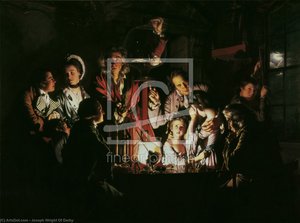
A Portrait of Disquiet: Dr. Richard Wright by Joseph Wright
Joseph Wright’s “Dr. Richard Wright,” painted in 1789, is more than simply a likeness; it's a carefully constructed tableau that speaks volumes about the anxieties and intellectual currents swirling around England at the close of the 18th century. This intimate portrait, measuring 76 x 64 cm, immediately draws the eye to its subject – a man distinguished by his white hair, meticulously styled wig, and an expression of palpable displeasure. The dark background isn’t merely a backdrop; it actively amplifies the sitter's mood, creating a sense of contained tension that resonates with the viewer.
- The Man Himself: Dr. Richard Wright was a prominent physician and surgeon in Derby, a figure deeply involved in the burgeoning medical practices of his time. His colonial attire – a deliberate choice – situates him firmly within the historical context of 18th-century England, hinting at the era’s fascination with classical antiquity and its influence on fashion and social standing.
- Wright's Revolutionary Vision: Wright was a pivotal figure in British art, often considered the first artist to truly engage with the Industrial Revolution. While many artists of his time focused on grand historical scenes or aristocratic portraits, Wright’s work increasingly explored themes of scientific discovery, philosophical inquiry, and the dramatic impact of technological change – all powerfully evident here.
Technique and Style: A Study in Dramatic Light
Wright's masterful technique is immediately apparent. He employs a dramatic chiaroscuro—a bold contrast between light and dark—to sculpt Dr. Wright’s features and imbue the scene with an almost theatrical quality. The meticulous rendering of the wig, the subtle details of his clothing, and the careful attention to texture all contribute to the painting's remarkable realism. Wright’s brushwork is loose yet controlled, creating a sense of movement and immediacy that draws the viewer into the subject’s emotional state. This technique was influenced by Caravaggio and Rembrandt, demonstrating Wright’s deep understanding of classical artistic principles.
- Oil on Canvas: The painting is executed in oil paint on canvas, a standard medium for portraiture at the time, allowing for rich color saturation and detailed rendering.
- Chiaroscuro Mastery: Wright’s skillful use of light and shadow creates depth, volume, and dramatically emphasizes Dr. Wright's expression.
Symbolism and Historical Context
“Dr. Richard Wright” transcends a simple portrait; it’s a reflection of the intellectual ferment of the late 18th century. The subject’s demeanor – his furrowed brow, pursed lips – suggests a man grappling with complex ideas or perhaps frustrated by the limitations of contemporary medicine. The wig itself, a symbol of status and learning, underscores Wright's profession and social standing. Painted in 1789, just before the French Revolution, the painting subtly hints at the growing unrest and questioning of established authority that would soon engulf Europe.
Emotional Impact and Collector’s Value
This reproduction captures not only a likeness but also the very essence of Joseph Wright's artistic vision. “Dr. Richard Wright” is a compelling study in human emotion, rendered with technical brilliance and imbued with historical significance. A hand-painted reproduction offers an unparalleled opportunity to own a piece of art history – a window into the mind of one of England’s most innovative artists and a poignant reflection on the anxieties and aspirations of his time. Its size (76 x 64 cm) makes it suitable for a variety of interior spaces, from formal studies to more contemporary living areas.
Kérdések és válaszok
Hol tekinthető meg a(z) "Dr. Richard Wright" előnézete?
A „Dr. Richard Wright”, Wright of Derby alkotása reprodukciójának megtekintéséhez nyissa meg a mű Előnézet oldalát.
Használhatom az augmented reality technológiát, hogy megtekintsem a „Dr. Richard Wright”, Wright of Derby alkotása művet a saját szobámban?
A(z) "Dr. Richard Wright" kiterjesztett valóság (AR) előnézettel rendelkezik: a mű Kiterjesztett valóság előnézet oldalán kompatibilis eszközön megtekinthető saját környezetében.
Mikor készült a(z) „Dr. Richard Wright”, Wright of Derby alkotása?
A „Dr. Richard Wright”, Wright of Derby alkotása alkotásának éve 1789.
Hasonló műalkotások


A művész életrajza
The Luminary of Derby: Joseph Wright and the Dawn of the Industrial Age
Joseph Wright, known to history as “Wright of Derby,” was more than a painter; he was a visual philosopher who captured a pivotal moment in human existence. Born in 1734 amidst the burgeoning industrial heartland of England, Wright didn’t merely depict his time—he *illuminated* it, both literally and figuratively. His canvases weren't filled with grand historical narratives or aristocratic portraits alone; they pulsed with the energy of scientific discovery, the drama of enlightenment thought, and the stark beauty of a landscape irrevocably altered by human innovation. He stands as the first major artist to truly grapple with, and celebrate, the spirit of the Industrial Revolution, an era that would redefine civilization itself. His early life in Derby, steeped in the practical world of his father’s legal profession, provided a grounding that perhaps informed his later fascination with precision and observation. Though initially destined for law, young Joseph's inclination towards art proved irresistible, leading him to London at seventeen to study under Thomas Hudson, a prominent portrait painter of the day. This formal training laid a foundation, but it was Wright’s innate curiosity and independent spirit that would ultimately forge his unique artistic path.Chiaroscuro and the Spirit of Inquiry
Wright's technical mastery is immediately apparent in his dramatic use of chiaroscuro, a technique borrowed from Baroque masters like Caravaggio but employed with a distinctly modern sensibility. He wasn’t simply interested in creating visual drama; he used light and shadow to symbolize the unveiling of knowledge, the struggle between darkness and understanding. Consider masterpieces such as *An Experiment on a Bird in the Air Pump* (1768), where candlelight throws stark relief upon the faces of onlookers witnessing a scientific demonstration—a scene brimming with both wonder and anxiety. The painting isn’t just about the experiment itself; it's an exploration of humanity’s burgeoning curiosity, its willingness to probe the mysteries of nature, and the ethical implications of such endeavors. Similarly, *A Philosopher Lecturing on the Orrery* (1766) presents a captivating scene where a miniature solar system is unveiled, illuminating not only the faces of the captivated audience but also the expanding universe of scientific thought. These weren’t isolated incidents; Wright consistently sought subjects that allowed him to explore the intersection of science, philosophy, and human emotion. His style was subtly influenced by Alexander Cozens, particularly in his compositional approaches, yet he remained fiercely independent, forging a visual language uniquely his own.Beyond Portraits: Landscapes and the Romantic Sensibility
While Wright is celebrated for his “candlelight pictures,” to limit him to that single aspect of his oeuvre would be a grave disservice. He was also a gifted landscape painter, capturing the rugged beauty of Derbyshire and beyond with an increasingly Romantic sensibility. Works like *Dovedale by Moonlight* showcase his ability to evoke atmosphere and emotion through subtle gradations of light and shadow, transforming familiar scenes into evocative visions. His landscapes weren’t merely topographical representations; they were imbued with a sense of awe and reverence for the natural world—a sentiment that resonated deeply with the growing Romantic movement. Even in these seemingly tranquil scenes, however, there's often an undercurrent of melancholy or mystery, hinting at the fragility of nature and the inevitability of change. *Rydal Waterfall* (1795), exemplifies this skill, showcasing his mastery of capturing both power and serenity within a single composition.A Legacy Forged in Light and Shadow
Wright’s impact on British art was profound, though perhaps not immediately recognized during his lifetime. He faced some resistance from the established artistic circles, notably declining full membership to the Royal Academy after feeling slighted—a testament to his independent spirit. However, his influence extended beyond formal institutions. Artists like William Pether and John Downman were directly inspired by his techniques, particularly his dramatic use of light and shadow. More broadly, Wright’s work paved the way for a new generation of artists who sought to capture the dynamism and complexity of the modern world. He didn't just paint what he saw; he painted what he *felt*—the excitement, the anxiety, the wonder—of an era on the cusp of transformation. His paintings remain powerful reminders of a time when humanity dared to question everything, to explore the unknown, and to embrace the possibilities of a new age. Today, his works are held in major museums worldwide, ensuring that the luminary of Derby continues to illuminate our understanding of art, science, and the human spirit.- Notable Works: *An Experiment on a Bird in the Air Pump*, *A Philosopher Lecturing on the Orrery*, *Dovedale by Moonlight*.
- Influences: Thomas Hudson, Alexander Cozens, Baroque masters like Caravaggio.
- Key Characteristics: Dramatic chiaroscuro, exploration of scientific themes, Romantic landscapes.

Wright of Derby
1734 - 1797 , Egyesült Királyság
Rövid információk
- Artistic Movement Or Style: Chiaroscuro, Romantika
- Artists Or Movements Influenced By This Artist: ['Caravaggio']
- Artists Who Influenced This Artist:
- Thomas Hudson
- Alexander Cozens
- Date Of Birth: 1734. szeptember 3.
- Date Of Death: 1797. augusztus 29.
- Full Name: Joseph Wright of Derby
- Nationality: Angol
- Notable Artworks:
- Madár a légpénzernyélben
- A filozófus előadása...
- Holdfényes Dovedale
- Place Of Birth: Derby, Anglia
Kapcsolódó cikkek

Oil on Canvas: A Historical & Technical Exploration of a Timeless Artistic Medium
Explore the rich history & enduring techniques of oil painting on canvas. Discover the science behind its longevity, conservation practices, and contemporary relevance. Expert insights for art enthusiasts.

The Enduring Legacy of Oil on Canvas: Technique, History & Aesthetic Impact
Explore the rich history & techniques of oil painting – from Renaissance masters to Impressionism. Discover pigments, layering methods, and why this timeless medium endures. Expert insights for artists & art enthusiasts.

Illuminating Enlightenment: Joseph Wright of Derby's Scientific Vision
Explore the captivating world of Joseph Wright of Derby, a pioneer of Enlightenment art. Discover his masterful chiaroscuro, scientific themes & investment potential. Expert analysis for collectors.

The Enduring Power of Painting: A Historical & Contemporary Exploration of Form and Emotion
Explore the rich history & enduring techniques of oil painting with AllPaintingsStore. Discover masterpieces, learn about art collecting, and find authentic handmade reproductions crafted by skilled artists.

Az olajfestészet örökös hagyatéka: technika, történelem és kortárs gyakorlat
Fedezze fel az olajfestészet történetét, technikáit és a kortárs művészeti trendeket! Szakértői útmutatók, híres festők alkotásai és tippek az olajfestmény ápolásához. Inspirálódjon most!