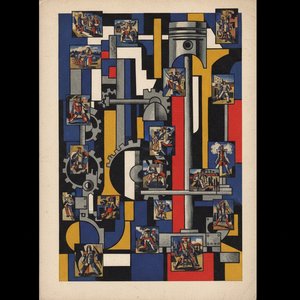
, 48.0 x 71.0 cm. Borys Voznytsky Lviv National Art Gallery.

§ 1Catalogue data


§ 2Abstract
A gyűjtemény leírása
Twilight by Nicholas Roerich embodies Symbolism's spiritual resonance with stylized Himalayan landscapes and observatory motifs—a mesmerizing blend of color, line, and geometric form reflecting Roerich’s profound belief system.
 Összes részlet megjelenítése
A művész életrajza
Roerich: szimbolista festő, a Balett Russe tervezője, a Himalája és a spirituális művészet mestere. Kulturális örökség védelmezője, a Roerich Paktum kezdeményezője.
§ 3Commentary
Twilight: A Himalayan Reverie by Nicholas Roerich
Nicholas Roerich’s “Twilight” is more than just a landscape painting; it's an invitation into a realm of profound contemplation and spiritual resonance. Executed in oil on canvas, measuring 48 x 71 cm, this artwork embodies the spirit of Symbolism and reflects Roerich’s deeply held belief system rooted in Theosophy – a fascinating blend of Eastern mysticism and Western science.
The scene depicts a stylized vista of towering mountains bathed in the ethereal glow of dusk. A dominant dark form on the left establishes compositional stability, drawing the eye towards a central hilltop structure resembling an observatory or temple. Below, a meandering river weaves its way through the landscape, guiding the viewer’s gaze upwards toward the distant peaks – a deliberate tactic to heighten the sense of grandeur and aspiration.
Roerich's masterful technique prioritizes atmospheric perspective, achieved through subtle layering of colors. Cool blues and greens dominate the palette, conveying tranquility and hinting at the mysteries hidden within the twilight hours. Hints of yellow and orange illuminate the hilltop structure and surrounding vegetation, providing a delicate counterbalance to the prevailing coolness.
Stylistically, “Twilight” aligns closely with early Modernism, inheriting influences from Expressionism in its simplified forms and unwavering focus on conveying emotion. Lines are employed sparingly but effectively—angular lines define the mountains’ rugged contours while curved lines delineate the river's flowing surface—creating a dreamlike quality that transcends mere visual representation.
The artwork’s geometric shapes – triangles for the mountains, rectangles for the structure – aren’t intended to depict reality with photographic precision but rather serve as symbolic emblems. These forms communicate Roerich’s philosophical ideas about harmony and cosmic order. The smooth blending of colors and lack of visible brushstrokes contribute to a flattened aesthetic reminiscent of Symbolist painting.
Beyond its visual beauty, “Twilight” speaks volumes about the artist's worldview. It embodies themes of solitude, reverence for nature, and the pursuit of enlightenment – concepts central to Roerich’s spiritual journey. The observatory atop the hill symbolizes aspiration towards knowledge and understanding, mirroring Roerich’s unwavering belief in the interconnectedness of humanity and the cosmos.
This artwork would be particularly captivating within interior design settings where its calming hues and evocative imagery can foster a sense of serenity and contemplation. Its reproduction offers an exceptional opportunity to bring Roerich's vision—a testament to beauty, spirituality, and artistic innovation—into any home.
Kérdések és válaszok
Hogyan találkoznak a korszak és a mű stílusa „Twilight”, Roerich, Nicholas alkotása alkotásban?
„Twilight”, Roerich, Nicholas alkotása alkotásművében a Symbolist Landscape irányzat találkozik a Modern kor korszakkal.
Milyen elhelyezés és milyen térhelyiség ajánlott a(z) „Twilight”, Roerich, Nicholas alkotása számára?
A „Twilight”, Roerich, Nicholas alkotása ajánlott Accent célokra, lehetőleg egy Living Room helyiségbe. A felhasználás módja és a tér kialakítása együtt segít eldönteni, hogy melyik reprodukció illik bele.
A „Twilight”, Roerich, Nicholas alkotása jogtalanul védett (public domain)?
A szerzői jogokkal kapcsolatban a "Twilight" mű közösségi tulajdon – a szerzői jog lejártt.


 Váltás nyomtatványra


 A bármely oldalsó méretét túlszálaló 105 cm (kb. 41 hüvelyk) meghaladó műalkotások vagy reprodukciók esetében a keret összeszerelhető készletként, szétszerelve kerül szállításra. Ez a módszer biztosítja a biztonságos szállítást, és megakadályozza a szállítás során fellépő sérüléseket.