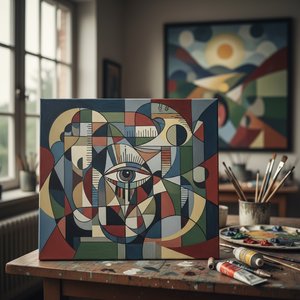
Acrylic On Canvas.

§ 1Katalógusadatok

§ 2Absztrakt
A gyűjtemény leírása
Explore Paul Klee’s ‘Monument on the Border of the Fertile Country.’ A minimalist watercolor abstraction blending nature & civilization. Discover its color, form & legacy.
 Összes részlet megjelenítése
A művész életrajza
Fedezd fel Paul Klee egyedi művészi világát! Színekkel és formával játszik az expresszionizmus, kubizmus és szürrealizmus hatása alatt – Egy igazán különleges német festőművész örökre megmaradó héritéként!
§ 3Magyarázat
A Symphony of Color and Form: Unpacking Paul Klee’s ‘Border’
Paul Klee's “Monument on the Border of the Fertile Country,” a watercolor masterpiece, exemplifies his signature approach to abstraction—a deliberate rejection of representational accuracy in favor of conveying emotion and exploring fundamental visual principles. This piece, alongside others like "Ohne Titel (Tanzende Figuren)" and "Border," reveals Klee’s unwavering commitment to experimenting with color palettes and geometric shapes as vehicles for artistic expression. His exploration into Bauhaus influence is palpable, mirroring the movement's emphasis on functional design combined with artistic innovation. The resulting artwork isn’t merely visually stimulating; it invites contemplation about the relationship between nature and civilization—a core theme resonating throughout Klee’s oeuvre.- Subject Matter: The painting depicts a stylized landscape, dominated by undulating lines and patches of color that suggest rolling hills or fertile plains. However, rather than striving for photographic realism, Klee prioritizes capturing the essence of his subject through abstracted forms.
- Style & Technique: Klee’s technique is characterized by delicate watercolor washes layered upon each other to achieve a luminous effect. He employs hatching and crosshatching—repetitive lines intersecting at angles—to build up texture and depth, creating an illusion of three-dimensionality despite the flatness of the medium.
- Color Palette: The artwork utilizes a restrained yet impactful color palette featuring shades of blue, yellow, and green. Cadmium green is prominent in the lower portion of the composition, subtly grounding the ethereal hues above. This deliberate choice reflects Klee’s fascination with color theory and his belief that it possesses inherent expressive power.
- Historical Context: Created during Klee's prolific period between 1930 and 1940—a time marked by both artistic experimentation and political upheaval—the painting embodies the spirit of Surrealism, albeit filtered through Klee’s uniquely personal vision. It aligns with broader trends in European art toward abstraction and psychological exploration.
- Symbolic Significance: The bird motif—repeated throughout Klee's work—represents freedom, aspiration, and spiritual transcendence. In “Border,” the solitary bird appears to navigate a complex geometric landscape, symbolizing the individual’s journey through life amidst challenges and uncertainties.
Exploring ‘Border’: A Closer Look at Composition & Texture
The composition of "Border" is deceptively simple—a horizontal expanse punctuated by vertical lines and scattered floral elements—yet it achieves remarkable visual harmony. Klee’s meticulous attention to detail is evident in the subtle variations of color and texture across the surface, creating a tactile experience for the viewer. The artist skillfully employs hatching to delineate contours and build up tonal gradations, enhancing the sense of depth and suggesting movement within the seemingly static landscape. This technique underscores Klee's belief that painting should engage all senses—sight being paramount but complemented by an awareness of materiality.Paul Klee: Bridging Expressionism & Surrealism – An Artistic Legacy
Klee’s artistic trajectory spanned decades, encompassing diverse styles and mediums—from drawings and prints to sculptures and ceramics—demonstrating his boundless curiosity and willingness to embrace new ideas. His influence extends far beyond the confines of his own time, inspiring generations of artists who followed in his footsteps. He stands as a pivotal figure in the development of abstract art, forging connections between Expressionism’s emotional intensity and Surrealism's dreamlike imagery—a testament to his ability to synthesize disparate influences into a cohesive artistic vision.Bringing Klee’s Vision Home: Premium Reproductions Available
A high-quality reproduction of “Border” captures the essence of Klee’s masterpiece, allowing you to experience its beauty and contemplation in your own space. AllPaintingsStore offers museum-grade prints on canvas or paper—preserving the vibrancy of color and textural detail—bringing a touch of artistic brilliance into any interior design scheme. Explore our collection today!Kérdések és válaszok
Hová sorolható a "Border" Paul Klee ismétlődő témái közé?
A "Border" a color palette, geometric shapes, bird motif, floral elements, watercolor technique, minimalist composition, swiss art ábrázol, míg Paul Klee dokumentált témái a expressionist color harmony, bauhaus geometric style, swiss folklore imagery, symbolic bird representation, exploring artistic depth. A kettő összevetése megmutatja, hogyan kapcsolódik ez a mű a művész megszokott motívumaihoz.
Milyen hangulatot áraszt egy enteriőrben „Border”, Paul Klee alkotása?
A Calm hangulatával a "Border" című alkotás egy Living Room helyiségbe is javasolt.
Mely paletta és domináns szín határozza meg a "Border" alkotást?
A „Border”, Paul Klee alkotása színek identitása: egy Dark paletta, amelyet Driftwood (#c39359) dominál.


 Váltás nyomtatványra


 A bármely oldalsó méretét túlszálaló 105 cm (kb. 41 hüvelyk) meghaladó műalkotások vagy reprodukciók esetében a keret összeszerelhető készletként, szétszerelve kerül szállításra. Ez a módszer biztosítja a biztonságos szállítást, és megakadályozza a szállítás során fellépő sérüléseket.