Philips Wouwerman: A Life Painted in Motion
Philips Wouwerman, a name synonymous with dynamism and vibrant storytelling within the Dutch Golden Age, was more than just a painter; he was a master of capturing fleeting moments, intense emotions, and the very essence of life. Born in Haarlem in 1619, his artistic journey unfolded against the backdrop of a flourishing cultural landscape, marked by both profound religious conviction and a burgeoning spirit of realism. His legacy rests not only on the sheer volume of his output – estimated at over 1200 works – but also on his unparalleled ability to imbue his scenes with an almost palpable sense of movement and drama.
Early Influences and Artistic Training
Philips Wouwerman’s artistic roots were firmly planted in Haarlem, a city renowned for its vibrant art scene. His father, Pouwels Joostsz Wouwerman, was himself a painter, though his work lacked the widespread recognition of his son. Details regarding Philips' early training remain somewhat elusive, shrouded in the mists of history. However, it’s widely believed that he received his initial instruction from Frans Hals (1581/85–1666), the celebrated Haarlem portraitist. While Hals’ distinctive style didn’t dominate Wouwerman’s mature oeuvre, the foundational training undoubtedly provided a crucial springboard for his artistic development. Early in his career, Wouwerman was significantly influenced by the *bamboccianti* tradition – Italian painters who specialized in scenes of everyday life and genre depictions—particularly the works of Pieter van Laer (1592/99–after 1642). Van Laer’s focus on portraying peasant life, bustling marketplaces, and lively tavern scenes provided Wouwerman with a valuable model for capturing the energy and immediacy of human interaction.
The Emergence of a Unique Style
Wouwerman's artistic trajectory underwent a dramatic transformation in the mid-1640s. Initially emulating the *bamboccianti*, his early works featured depictions of daily life, mirroring the style of his predecessors. However, he soon began to develop a distinctive compositional approach – a key element that would define his lasting legacy. This involved incorporating a diagonal slope of land into his landscapes, often punctuated by a strategically placed tree acting as a repoussoir—a device used to create depth and a sense of spatial recession. Figures, frequently accompanied by horses, populated these dynamic scenes, creating a captivating interplay between man and nature. This shift marked the beginning of Wouwerman’s individual style, characterized by an unparalleled mastery of movement and a remarkable ability to convey both action and emotion.
Mastery of the Horse and Expanding Subject Matter
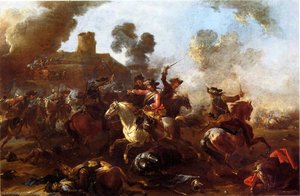
Perhaps the most defining aspect of Wouwerman's artistic achievement lies in his extraordinary skill in depicting horses. Art historian Frederik J. Duparc famously declared him “undoubtedly the most accomplished and successful 17th-century Dutch painter of horses.” He possessed an almost preternatural ability to capture the power, grace, and raw energy of these magnificent animals in motion. His paintings showcase a remarkable understanding of equine anatomy, movement, and behavior—a testament to his meticulous observation and artistic talent. Beyond his equestrian masterpieces, Wouwerman broadened his subject matter considerably during his mature period (c. 1650-1660). He painted genre scenes depicting peasant life, landscapes with travelers, cavalry battles, military encampments, and festive gatherings—a diverse range of subjects that reflected the multifaceted realities of 17th-century Dutch society. His works are often imbued with a subtle humor and anecdotal quality, inviting viewers to step into the heart of these vibrant scenes.
Legacy and Historical Significance
Philips Wouwerman’s impact on the art world is undeniable. He was not only a prolific artist but also a highly sought-after painter during his lifetime, commanding considerable prices for his works. His paintings continued to be admired throughout the 18th century, finding their way into prestigious collections across Europe—including those of princely houses in Dresden and St. Petersburg. His legacy extends beyond individual masterpieces; he profoundly influenced subsequent generations of artists, including Jan van Huchtenburgh, Pieter van Bredael, and Carel van Falens. Wouwerman’s work stands as a testament to the dynamism and vitality of the Dutch Golden Age—a period of unparalleled artistic innovation and cultural flourishing. His paintings continue to captivate audiences today with their remarkable realism, dramatic composition, and enduring sense of movement.


 Összes részlet megjelenítése




 Váltás nyomtatványra


 A bármely oldalsó méretét túlszálaló 105 cm (kb. 41 hüvelyk) meghaladó műalkotások vagy reprodukciók esetében a keret összeszerelhető készletként, szétszerelve kerül szállításra. Ez a módszer biztosítja a biztonságos szállítást, és megakadályozza a szállítás során fellépő sérüléseket.


