Pénzvisszatérítési Garancia · 100 nap Ingyenes világszerte történő szállítás
449 564műalkotások 30 613művészek 4 660múzeumok 32nyelv
Katalógusbejegyzés

Pyross-c

Acrylic On Canvas.

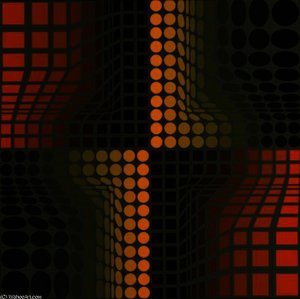
1. ábra. Vasarely, Pyross-c. A megadott reprodukciót mutatja: , .

§ 1Katalógusadatok

§ 2Absztrakt

A gyűjtemény leírása

Discover 'Pyross-c,' a striking abstract work by Victor Vasarely. Explore Op Art’s geometric brilliance & vibrant color palettes – a captivating investment piece.

A művész életrajza

Fedezd fel Victor Vasarely (1906-1997) világát! Op art, kinetikus művészet, geometriai absztrakt képei és a modern művészet meghatározó alakja. Magyar művészettörténet egyik legkiemelkedőbb képviselője.

§ 3Magyarázat

A Symphony in Red: Exploring the Geometric Vision of Victor Vasarely’s *Pyross-c*

Victor Vasarely's Pyross-c is not merely a painting; it’s an invitation to experience reality through the lens of perception itself. This striking work, dominated by a vibrant red background, immediately draws the viewer into a world meticulously constructed from geometric forms – a testament to Vasarely’s pioneering role in Op Art and his profound engagement with kinetic principles. The image captures a moment frozen within a dynamic illusion, a visual trick that plays on our innate ability to interpret movement and depth. The artist's meticulous attention to detail, particularly the varying sizes of the circles, creates a captivating sense of spatial complexity, inviting prolonged contemplation and rewarding repeated viewing.

The Genesis of Optical Illusions: Vasarely and the Bauhaus Legacy

Born in 1906 in Pécs, Croatia – then part of Austria-Hungary – Károly Vaszary, as he was initially known, embarked on a remarkable artistic journey. His early studies in medicine hinted at a conventional path, but his passion for visual expression led him to the Podolini-Volkmann Academy and ultimately, to Sándor Bortnyik’s influential “Műhely” workshop. This environment, deeply rooted in the principles of Bauhaus functional design and geometric abstraction, provided the fertile ground for Vasarely's unique vision to take root. The influence is palpable here – the deliberate arrangement of shapes, the exploration of optical effects, and the rejection of traditional representational art all echo the core tenets of this revolutionary movement.

Decoding the Visual Language: Circles, Rhythm, and Movement

The composition of *Pyross-c* is a carefully orchestrated dance of circles. These aren’t simply decorative elements; they are fundamental building blocks used to create rhythm, depth, and an illusion of movement. Vasarely was fascinated by how the eye perceives these shapes – how they appear to vibrate and shift depending on the angle of observation. The clock subtly integrated into the design adds another layer of complexity, suggesting a temporal dimension within this static image, further reinforcing the artwork's exploration of perception and time. The use of color is equally crucial; the bold red background amplifies the impact of the shapes, creating a visually arresting experience.

A Legacy of Illusion: Vasarely’s Impact on Art and Design

Victor Vasarely (1906-1997) fundamentally altered our understanding of art. His work, alongside that of artists like Bridget Riley and Josef Albers, helped usher in the era of Op Art – a movement dedicated to creating optical illusions through precise geometric arrangements. *Pyross-c* stands as a powerful example of this legacy, demonstrating Vasarely’s mastery of color, form, and perception. Today, reproductions like this offer an accessible entry point into his groundbreaking work, allowing collectors and interior designers alike to bring the dynamism and intellectual rigor of Vasarely's vision into their spaces.

Kérdések és válaszok

Mi a "Pyross-c" formátuma?

A "Pyross-c" formátuma Square. Ez hasznos, amikor tervezünk, hogy a reprodukciót hová helyezzük el.

Erős fény-árnyék kontrasztot mutat-e a "Pyross-c"?

A „Pyross-c”, Vasarely alkotása kontrasztját Serene teszi.

Milyen anyagból készült a "Pyross-c"?

Vasarely a Acrylic On Canvas technikát alkalmazta a "Pyross-c" alkotáshoz. A technika határozza meg az eredeti mű anyagösszetételt.

§ 4A művész

Vasarely

Vasarely

1906 - 1997, Kroatia

Gyors információk Vasarely művészről

  • Artistic Movement Or Style: Op Art, kinetikus művészet
  • Artists Or Movements Influenced By This Artist:
    • Grafikai tervezés
    • Belsőépítészet
  • Artists Who Influenced This Artist:
    • Mondrian
    • Malevich
  • Date Of Birth: 1906. ápril 9.
  • Date Of Death: 1997. március 15.
  • Full Name: Victor Vasarely
  • Nationality: Magyar–francia
  • Notable Artworks:
    • Blue Study
    • Zebra
    • Suomi
  • Place Of Birth: Pécs, Kárpátia

A művész életrajza

A Life Forged in Geometry: The World of Victor Vasarely

Victor Vasarely’s journey to becoming a pioneer of Op Art and kinetic art was anything but predetermined. Born Károly Vaszary in 1906 in Pécs, a city then nestled within Austria-Hungary (now Croatia), his early life hinted at a path far removed from the canvas; he initially pursued medical studies at Eötvös Loránd University in Budapest. However, the allure of visual expression proved too strong, leading him to abandon medicine for the world of painting in 1927, enrolling at the Podolini-Volkmann Academy. This decision marked not merely a change in vocation but the beginning of a lifelong exploration into the fundamental principles governing perception and form. A pivotal moment arrived with his enrollment in Sándor Bortnyik’s workshop – Műhely – a school deeply influenced by the Bauhaus movement. Here, Vasarely absorbed the tenets of functional design and geometric abstraction, seeds that would blossom into his signature style. These formative years weren't simply about acquiring technique; they were about dismantling traditional artistic conventions and embracing a new visual language rooted in logic and precision.

From Early Abstraction to the Dawn of Op Art

The late 1920s and early 1930s witnessed Vasarely’s gradual departure from representational art, as he delved deeper into the realm of geometric abstraction. Works like “Blue Study” and “Green Study,” created in 1929, exemplify this transition – a deliberate shedding of narrative content in favor of pure form and color relationships. While influenced by masters such as Piet Mondrian and Kazimir Malevich, Vasarely wasn’t content to simply emulate their styles. He sought to transcend the static compositions of his predecessors, aiming for a dynamism that would actively engage the viewer's perception. This quest led him to Paris in 1930, where he established himself as a graphic designer and advertising artist, honing his skills while continuing to develop his unique artistic vision. It was during this period that he began experimenting with techniques that would later become hallmarks of Op Art – manipulating shapes and colors to create illusions of movement and depth. The seeds were sown for a revolution in visual experience.

The Systematic Illusion: Defining a Movement

By the 1960s, Victor Vasarely had fully emerged as a leading figure in the burgeoning Op Art movement. Unlike many artists who relied on intuition and spontaneous expression, Vasarely approached his work with a distinctly systematic methodology. He employed grids and mathematical principles to generate patterns that created powerful optical illusions – visual vibrations, swirling effects, and sensations of depth where none physically existed. This wasn’t about trickery; it was about revealing the inherent dynamism within perception itself. He believed in reproducibility and mass appeal, aiming to democratize art by making it accessible beyond the confines of galleries and museums. His work challenged viewers to question their own visual experience, forcing them to actively participate in the creation of meaning. He wasn’t merely painting pictures; he was constructing experiences.

Beyond the Canvas: Kinetic Exploration and a Lasting Legacy

Vasarely’s artistic exploration didn’t stop at static illusions. He increasingly ventured into kinetic art, creating works that incorporated actual movement or appeared to move through carefully orchestrated visual effects. “Georges Pompidou” (1976), a large kinematic object installed at the Centre Pompidou in Paris, stands as a testament to this ambition – an integration of art with architecture and urban design on a grand scale. He also demonstrated remarkable innovation by applying his designs to commercial products, most notably through his collaboration with Rosenthal porcelain, resulting in the iconic “Suomi” tableware series. This willingness to blur the boundaries between fine art and functional objects further underscored his belief in art’s potential to permeate everyday life. The establishment of the Fondation Vasarely in Aix-en-Provence ensured the preservation and promotion of his extensive body of work, while a remarkable event – the inclusion of serigraphs aboard the French-Soviet spacecraft Salyut 7 in 1982 – symbolized the global recognition of his art and its connection to the broader human endeavor of exploration. Victor Vasarely’s legacy extends far beyond the realm of painting; he profoundly influenced graphic design, fashion, interior design, and even early computer graphics, inspiring generations with his innovative vision and unwavering commitment to exploring the possibilities of perception. He remains a pivotal figure in modern art history, a true visionary who dared to challenge our understanding of what art could be.

Historical Significance

Vasarely’s contribution to art history is multifaceted. He moved beyond traditional painting techniques to create works that actively engage the viewer’s perception. His systematic approach challenged conventional notions of artistic creativity and paved the way for computer-generated art and digital design. By embracing reproducibility and commercial applications, Vasarely blurred the boundaries between fine art and popular culture, leaving an enduring mark on both. He wasn't simply creating aesthetically pleasing objects; he was conducting visual experiments that revealed fundamental truths about how we see the world. His work continues to resonate today, reminding us of the power of abstraction, the beauty of geometry, and the endless possibilities of human creativity.

§ 5Hasonló alkotások

§ 6Kérdések

Gyors információk

  • Movement: Op Art
  • Medium: Painting
  • Subject or theme: Abstract shapes
  • Year: 1906-1997
  • Notable elements: Circles, clock

§ 7Idérezze ezt a bejegyzést

AllPaintingsStore.com, “Vasarely, Pyross-c”, https://allpaintingsstore.com/hu/art/victor-vasarely-pyross-c-8EWS2D-en/ArtistReproduction/ (megtekintve: 6 október 2026).

§ 8A reprodukció

Kézzel készített olajfestmény reprodukció

Kézzel festett olajvastú vászon, az Ön által választott méretben és keretben, művészeink készítik meglévőre. ( Váltás nyomtatványra Áttérés digitális képre)

A rendelési sammanbrató szélességi részén rögzítve van; a sammanbrató jelenlegi állapota a következőképpen hangzik.

Pyross-c

Reprodukciós technika

Reprodukció mérete

-

Kiváló mesterművész

Nagyobb részletesség, finomság és bővített gyártási idő

-

Reprodukció keretezése

-

-

A bármely oldalsó méretét túlszálaló 105 cm (kb. 41 hüvelyk) meghaladó műalkotások vagy reprodukciók esetében a keret összeszerelhető készletként, szétszerelve kerül szállításra. Ez a módszer biztosítja a biztonságos szállítást, és megakadályozza a szállítás során fellépő sérüléseket.

Szakmész összeszerelést igényel – ez nem DIY (önösszeszerelhető) termék.
A készletet egy tapasztalt keretező szakembernek kell összeszerelnie és a vásznat feszítenie kell, fa ragasztó (nem tartalmazza a csomag), vásznfeszítő fogó és szorítók használatával, amelyek a ragasztó száradásáig a keretrészeket egymáshoz vuôngjba tartják. A helytelen összeszerelés vagy a nem egyenletes vásznfeszítés maradandó károsíthatja a műalkotást, és ez nem része a garanciánknak.

  • A készlet tartalmazza az összes tömörfa rudat, pontosan méretre vágva.

  • A mellékelt csavarokkal, valamint a sarokszerekhez szükséges faütő ragasztóval kell összeszerelnie (ez nem tartalmazható a csomagban), így a keretrendezőnek külön kell beszereznie.

  • A csomag nem tartalmazza a szükséges professzionális eszközöket: egy vászonfeszítőt és klipseket a rácsok vízszintes tartásához a ragasztó megszáradásáig.

Fontos:
A sarokcsatlakozásokhoz fánylagra van szükség, a keretrudakat szorítókapcsokkal kell rögzíteni, amíg a rag teljesen meg nem szárad, a kész keretre feszített vászonhoz pedig vászonfeszítő fogat szükséges. Ezek egyike sem található meg a készletben. Kérjük, rendelés előtt győződjön meg róla, hogy rendelkezik tapasztalt keretező szakemberrel.

Névtábla

-

-

Védőréteg (Lakk)

Fényes lakk (intenzívabb színek, védelem a fény és a nedvesség hatása ellen)

-

Műalkotásom egyedi igényre szabása

Példák a módosíthatóságra: az arc kicserélése az ügyfél fotójára; háziállat hozzáadása (pl. macska helyett kutya); rejtett üzenet elhelyezése a háttérben; a háttér tájainak vagy elemeinek megváltoztatása.

-

Sürgős

Világszerte szóló szállítás () mindössze 3-4 hét alatt, a szokásos 5 hét helyett. (3 november). A minőség nem kérdőjelezhető.

-

Express szállítás

Világszerte elérhető szállítás területre 5 héten belül. (10 november).

A szállítás díja tartalmazza

Összesített ár

Ft 84529

Minden rendelés mellé tartalmazva

  • Ingyenes globális expressz szállítás
  • Prémium minőségű len vászon
  • Teljes körű szállítási biztosítás
  • Vámvisszatérítési Garancia
  • Hiteles színarányosság garancia
  • 100 napos visszaküldési lehetőség (csak hibás termékek esetén)
  • 100% pénzvisszatérítési garancia
  • Több darab vásárlásakor kedvezmény
Rendelési adatlap