The Sculptural Legacy of Philipp Kittler
Philipp Kittler stands as a distinguished figure in the history of German sculpture, a master whose hands shaped the very fabric of Nuremberg's public landscape. Born in Schwabach, Germany, his journey into the world of fine art was deeply rooted in craftsmanship and tradition. As the son of Emanuel Kittler, a stove manufacturer, Philipp began his professional life not with clay or bronze, but through an apprenticeship as a stove fitter. This early immersion in the tactile, decorative arts provided him with a foundational understanding of form and ornamentation that would later define his sculptural career.
His formal artistic education was a rigorous pursuit of excellence, spanning several prestigious institutions. After attending the Nuremberg School of Arts and Crafts, he sought further refinement at the Academy of Fine Arts in Munich under the guidance of Wilhelm von Rümann. It was during this period of academic study that his talent was formally recognized, earning him the prestigious Great Silver Medal. This blend of technical apprenticeship and classical academic training allowed Kittler to bridge the gap between industrial craftsmanship and high art, a duality that would become a hallmark of his creative output.
A Bridge Between Eras
The work of Philipp Kittler is best understood as a masterful transition between artistic epochs. He acted as a representative of a realism that flourished in the delicate space between Jugendstil and Art Deco. His ability to navigate these shifting aesthetic tides allowed him to create works that felt both timeless and contemporary to his era. Whether working with the flowing, organic lines characteristic of the Art Nouveau influence or the more structured, monumental forms of emerging modernism, Kittler maintained a profound commitment to realism.
His oeuvre is characterized by an extraordinary versatility in medium and subject matter. While he was highly skilled in the creation of commemorative medals and intricate reliefs, his most enduring contributions are found in his free-standing bronze figures. These works often inhabit the public sphere, breathing life into urban spaces through their commanding presence and emotive power. From the delicate Putto to the powerful Discus Thrower Figure, Kittler’s sculptures possess a vitality that transcends the coldness of metal.
Public Monuments and Artistic Contributions
Kittler's influence is etched into the very architecture and parks of Nuremberg and its surrounding regions. His hands shaped much of the city's ornamental identity through various fountains, statues, and architectural decorations. Some of his most notable contributions include:
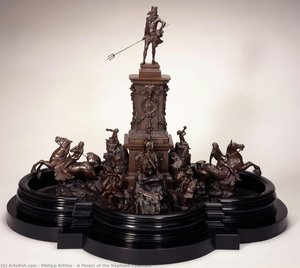
- The bronze model of the Neptune Fountain, a work that captures the grandeur of the sea god.
- The striking bronze figures of Truth and Law located at the portal of the Social Court in Nuremberg.
- The Minstrel Fountain in Rosenau Park, a beautiful integration of bronze and granite.
- The powerful lions guarding the entrance to the Nuremberg Zoo, showcasing his ability to capture animalistic strength.
- The poignant war memorial Grieving Noris at the West Cemetery, a testament to his ability to convey profound human emotion.
Beyond his public monuments, Kittler's professional life was marked by significant academic and commercial achievements. He served as a teacher for elementary modelling at the Nuremberg School of Arts and Crafts and was eventually honored with the title of royal professor in 1918. His career also saw him working as a freelancer for the renowned Rosenthal company in Selb, further cementing his reputation as a premier sculptor of his time. Through his dedication to both the fine arts and the decorative crafts, Philipp Kittler left an indelible mark on the cultural heritage of Germany.
Kérdések és válaszok
Elérhető-e 3D virtuális túra Philipp Kittler művei között?
Philipp Kittler 3D Galéria egy olyan oldal, amely a művész alkotásait mutatja be egy virtuális, háromdimenziós galériában.
Mennyire népszerűek Philipp Kittler művei?
Philipp Kittler Statisztikák oldala a ez a weboldal felületén található műalkotásokból számított statisztikákat mutatja be.
Hol találhatók Philipp Kittler művei kulcsszavakra csoportosítva?
Philipp Kittler művei kulcsszavakra bontva is felfedezhetők a művész Kulcsszavak szerint oldalán, ahol minden kulcsszó a hozzá tartozó alkotásokat gyűjti össze.