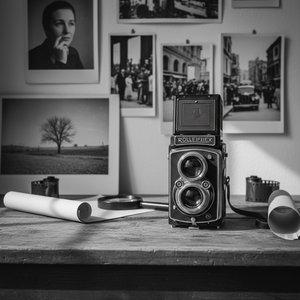
The Dawn of the Lens: Photography's Struggle for Artistic Legitimacy
 Pictorialism: A Search for Artistic Photography's Soul – Aesthetics, Techniques & Legacy
The Dawn of Pictorialism: Challenging Photography's Documentary Role For much of its early existence, photography labored under the weight of expectation – a relentless demand for objective truth. Born from scientific innovation, it was initially per...
In the mid-to-late nineteenth century, a profound tension gripped the burgeoning world of visual culture. As the camera became increasingly accessible, a heated debate erupted within the hallowed halls of art academies: could a machine-driven process truly be considered an art form? To many critics of the era, photography was merely a mechanical recording of reality—a clinical, uninspired documentation of facts that lacked the soul and subjective interpretation inherent in painting. Born from scientific innovation, the medium initially labored under the weight of expectation, perceived as a mirror to reality or a tool for purely objective truth.
This era of photography was defined by its role as a witness rather than a creator. It existed largely within the realm of documentation, providing a relentless demand for accuracy that left little room for the artist's hand. However, this very limitation sparked a quiet revolution. A group of visionary photographers began to challenge the notion that the lens could only capture what was physically present. They sought to prove that photography could possess the same aesthetic power as painting or sculpture, moving beyond the role of a scientific instrument to become a vessel for human emotion and atmosphere.
The Pictorialist Manifesto: Beyond Documentation to Subjective Expression
 Notary
A rare glimpse into 17th-century Spain! This 1592 notary document by Luis de Porras features Latin script and potential Cervantes signatures. A unique historical artifact.
The emergence of Pictorialism marked a pivotal shift in the trajectory of visual history. This international style and aesthetic movement, which dominated photography during the later 19th and early 20th centuries, was born from a burgeoning desire for artistic expression. The core tenet of the movement was not merely to imitate existing art forms but to harness photography's unique capabilities to express a personal vision. For the Pictorialist, a photograph was a way of projecting an emotional intent into the viewer's realm of imagination, much like a drawing or an engraving.
This movement sought to elevate photography from craft to fine art by prioritizing subjective interpretation over literal representation. Rather than simply recording a scene, photographers manipulated their subjects to create images that evoked mood and nostalgia. This was a deliberate rejection of the "straight" record in favor of evocative suggestion. By focusing on the essence of a subject rather than its minute, clinical details, Pictorialists transformed the mundane into the sublime, fundamentally altering our perception of what a photograph could achieve.
Mastering the Atmosphere: Key Techniques and Painterly Aesthetics
 Pictorialism Unveiled: The Aesthetic Revolution That Elevated Photography to Fine Art
The Dawn of a Revolution: Challenging the Documentary Lens Pictorialism: A Search for Artistic Photography's Soul – Aesthetics, Techniques & Legacy The Dawn of Pictorialism: Challenging Photography's Documentary Role For much of its early existence, ...
To bridge the gap between the mechanical and the artistic, Pictorialist practitioners looked toward the established masters of the canvas. They adopted compositional principles from Impressionism and Tonalism, utilizing techniques that blurred the lines between photography and painting. One of the most recognizable hallmarks of this style was the use of soft focus. By deliberately introducing spherical aberration through specialized lenses or manipulation during printing, photographers could soften textures and create a dreamlike, hazy quality reminiscent of an etching.
The technical mastery involved in these works often extended far beyond the camera itself. The darkroom became a studio for profound manipulation. Artists employed labor-intensive processes such as gum bichromate printing, which allowed for significant control over tone and texture, sometimes even leaving visible brushstrokes on the surface of the print. Furthermore, many Pictorialist images were printed in colors other than standard black-and-white, ranging from warm, sepia browns to deep, atmospheric blues. This manipulation of light, color, and texture ensured that each print was a unique creation, imbued with a tactile depth that resisted the flatness of mere reproduction.
Pioneers of the Movement: The Visionary Work of Alfred Stieglitz and Peers
 Katherine (1905)
A Moment Frozen in Time: Alfred Stieglitz’s “Katherine” (1905) Alfred Stieglitz's "Katherine," created in 1905, is more than just a photograph; it’s a poignant snapshot of early 20th-century life and a testament to Stieglitz’s groundbreaking vision. ...
No discussion of Pictorialism is complete without acknowledging the titans who spearheaded this revolution. Alfred Stieglitz stands as an undeniable figure in photographic history, a man whose unwavering conviction transformed the medium into a respected art form. Through influential publications like Camera Work and the establishment of the Photo-Secession group in 1902, Stieglitz provided the vital platform needed to showcase these works and foster critical discourse. His early work, such as the poignant 1905 portrait Katherine, exemplifies the movement's ability to capture intimacy and drama through carefully controlled tones and textures.
Alongside Stieglitz, artists like Edward Steichen and Gertrude Käsebier played instrumental roles in defining the movement's aesthetic. These photographers were not merely technicians; they were intellectuals who viewed the camera as a tool for profound creative expression. They championed the idea of the photographer as an artist—an individual with a unique vision capable of transforming light into emotion. Through their collective efforts, they successfully navigated the transition from the scientific to the aesthetic, eventually leading to the acquisition of photographs by major art museums worldwide.
The Evolution of Vision: From Pictorialism to the Rise of Straight Photography
Pure photography or straight photography refers to photography that attempts to depict a scene or subject in sharp focus and detail, in accordance with the qualities that distinguish photography from other visual media, particularly painting. Origina...
As the 20th century progressed, the photographic landscape began to shift once again. By the early 1920s, the popularity of Pictorialism began to wane, giving way to a new era known as "Straight Photography." This emerging style, promoted by critics like Sadakichi Hartmann and later by photographers such as Paul Strand, sought to embrace the inherent qualities of the medium rather than mimic those of painting. Instead of soft focus and heavy manipulation, Straight Photography emphasized sharp focus, rich tonality, and a high degree of detail.
This transition represented a new form of modernism, where the beauty of the photograph was found in its clarity and its ability to reveal the underlying geometric structures of the world. While Pictorialism had sought to find photography's soul through imitation, Straight Photography found it through authenticity. This movement paved the way for legendary figures like Ansel Adams and Edward Weston, whose work would define the American West through a lens of breathtaking precision and natural grandeur, completing the evolution of photography from a tool of documentation to a sophisticated, independent art form.
The Enduring Legacy: How Pictorialism Shaped Modern Visual Culture
 Beyond the Lens: Photography's Enduring Influence on Modern & Contemporary Art
The Dawn of Artistic Photography: Pictorialism and its Pioneers Pictorialism: A Search for Artistic Photography's Soul – Aesthetics, Techniques & Legacy Explore the captivating world of Pictorialism – a pivotal movement that transformed photography i...
The legacy of Pictorialism remains deeply embedded in our contemporary understanding of visual art. While the specific techniques of soft focus and heavy manipulation may have fallen out of fashion in favor of modern realism, the fundamental concept—that a creator can manipulate a medium to express an internal truth—remains the cornerstone of fine art photography today. The movement successfully broke the "mechanical" stigma, establishing that the artist's intent is what defines a work, whether it be captured through a lens or applied with a brush.
Today, we see the echoes of Pictorialism in everything from cinematic lighting to the atmospheric textures sought in high-end digital editing. The movement taught us to look beyond the surface of an image to find its emotional resonance. For collectors and enthusiasts, the era of Pictorialism serves as a reminder that art is not merely about what we see, but how we feel about what we see. It remains a testament to the power of human vision to transform light into lasting, soulful masterpieces.