

The Utility of Movement: From Bone Blades to Steel
Long before the bright lights of modern arenas, the ice served a far more utilitarian purpose. In the frozen expanses of northern Asia and Europe, skating was not an exhibition of grace but a necessity of travel. Early inhabitants used bone blades, lashed to footwear, to navigate across frozen lakes and rivers when paths were otherwise impassable. This era of skating was defined by survival and the practical navigation of winter landscapes. It was a matter of energy conservation during long winter journeys, with the earliest evidence of such movement dating back more than 4,000 years to southern Finland.
The transition from transit to pastime mirrors how we view art today—moving from the functional to the aesthetic. Just as a primitive tool eventually becomes an object of study, these early methods of movement laid the groundwork for what would become a disciplined sport. We see this evolution in the way we approach modern decor; we no longer simply need a chair or a painting, but rather a piece that speaks to a specific mood or memory. The utility of the past has matured into the intentionality of the present.
Winter Landscapes: The Dutch Golden Age and the Rise of Pastime
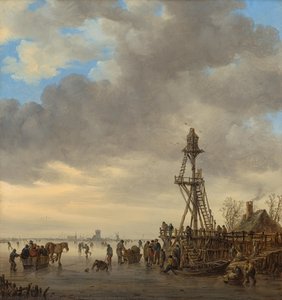
 Winter Landscape with ice-skating
, Adriaen van de Velde
By the 17th century, the frozen canal had become a stage for social life. During the Dutch Golden Age, artists began to document the changing relationship between people and the ice. In works such as Winter Landscape with ice-skating (1660) by Adriaen van de Velde, held at Ca' d'Oro in Venice, we see a world of muted tones and leafless trees under a cloudy sky. These paintings do not just show a season; they show a way of life. Similarly, Barent Avercamp’s Scene with Ice Skating (1650) uses a high horizon line and aerial perspective to capture the bustling activity of a frozen river, populated by figures navigating the white expanse.
This period marked the shift from skating as a survival tactic to skating as a communal ritual. The Dutch added edges to ice skates in the 13th or 14th century, using steel to gain control. This technical advancement allowed for the movement seen in the paintings—a shift from merely gliding to actively steering. This era of art captures the moment when the landscape stopped being an obstacle and started being a venue for human connection.
The Shimmer of Light: Impressionism and the Sensory Experience
 Claude Monet
. French Impressionist of plein air landscapes and water lilies, capturing shifting light through repetitive series of the same subject.
As centuries passed, the focus of the artist shifted from the structural reality of the ice to the way light interacts with its surface. The arrival of Impressionism brought a change in how we perceive the frozen surface. For artists like Claude Monet and Pierre-August Renoir, the winter landscape became an opportunity to record the precise sensation of a single, passing moment. The ice acts as a mirror for the sky, and the movement of skaters becomes a dance of broken brushstrokes and luminous tones.
In Édouard Manet’s Skating (1877), held at the Fogg Museum, we see this through energetic brushwork and visible texture. The painting captures a woman in a black dress with a lace pattern, her form defined by the play of light rather than rigid outlines. This era of painting focused on the ephemeral quality of light as it dissolves solid forms. The rhythmic pulse of movement on the ice is captured not through rigid lines, but through a sensory experience where color and light are inseparable from motion.
The Dance of the Edge: The Influence of Balletic Form
A profound shift occurred in the mid-19th century when the rigid, upright postures of early skating were interrupted by the fluid influence of dance. Jackson Haines, an American ballet dancer, introduced what is now known as the international style, fundamentally changing the mechanics of the sport. This transition moved skating away from the stiff, formal movements of the 18th century—where manuals like Robert Jones's The Art of Figure Skating (1772) focused on basic circles and figure eights—toward a more expressive, athletic art form.
This infusion of dance changed the very tools used on the ice. The development of the figure skate, with its saw-toothed toe picks and concave blades, allowed for jumps, spins, and intricate footwork. The blade became an instrument of expression. Just as the introduction of the steel edge allowed the skater to move from a simple glide to a controlled turn, the influence of ballet allowed the skater to move from a simple path to a choreographed performance.
The Hidden Struggle: Balancing Physical Effort and Artistic Grace
Beneath the appearance of effortless gliding lies an immense physical demand. The technical mastery required for jumps, spins, and intricate footwork is a feat of strength that belies its delicate presentation. There is a quiet tension in the moments between the spectacular tricks—the way an arm is held or how a skater maintains balance during a difficult transition. It is in these small, controlled movements that the true artistry resides.
This duality of effort and ease finds a parallel in the creation of a hand-painted reproduction. A portrait may appear serene on a wall, yet it represents weeks of meticulous labor, from the initial sketching to the final application of Damar varnish. The artist must manage the physical strain of repetitive brushwork and precise color blending to achieve a finished surface that looks natural. We honor this hidden struggle of the process to ensure the final result reflects the same balance of strength and grace found on the ice.
For those looking to bring these historical moments into their own spaces, AllPaintingsStore.com offers a wide selection of high-quality reproductions and custom commissions. Whether you require a large-format mural for a commercial space or a bespoke portrait, our team provides the professional reliability and artistic expertise required for your project.