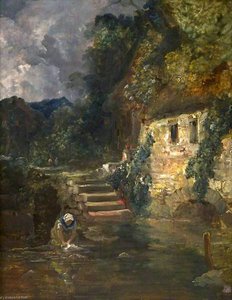
Neolithic Foundations: The Enduring Presence of Stone
The history of Irish visual expression begins long before the arrival of written language, rooted in the heavy, silent permanence of megalithic structures. Around 3200 BC, at sites like Newgrange in County Meath, the builders of the Brú na Boinne complex demonstrated a sophisticated understanding of light and geometry. These stone carvings and passage tombs were intentional intersections of earth and sky. The way sunlight enters the chamber during specific solar alignments suggests a culture deeply attuned to the rhythms of the natural world.
This ancient preoccupation with the physical weight of the land finds an echo in the later development of Irish landscape painting. While the Neolithic builders used massive stones to mark time, artists like John Bold or James Humbert Craig utilized oil and canvas to capture the enduring textures of the terrain. The heavy, grounded presence of a rock in Turf Bog, Connemara mirrors the structural permanence of Newgrange, proving that the Irish artistic impulse has always been anchored by the geological reality of the island.
Insular Artistry: The Intricacy of Sacred Geometry
The Celtic cross is a form of ringed cross, a Christian cross featuring a nimbus or ring, that emerged in Ireland and Britain in the Early Middle Ages. It became widespread through its use in the high crosses erected across Ireland, Britain and parts...
As the fifth century AD brought Christianization to Ireland, a new, highly disciplined aesthetic emerged known as Insular art. This period saw the flowering of illuminated manuscripts, where Mediterranean and Germanic influences merged with local traditions to create works of immense complexity. In pieces such as the Book of Kells, the eye is drawn into a labyrinth of spiral designs, interlaced patterns, and abstract carpet pages. This was an art of intense focus, where every millimeter of vellum was utilized to convey spiritual truths through mathematical precision.
The structural logic of this era is still visible in the monumental High crosses that dot the Irish landscape. These stone monuments, featuring a ringed cross design, provided a physical medium for the same intricate knotwork found in precious metalwork like the Ardagh Chalice. Today, we see these ancient motifs resurfacing through the Celtic Revival and even in contemporary decorative arts, where the disciplined geometry of the past continues to provide a sense of order and continuity.
European Influence: The Emergence of Portraiture and Landscape
--- title: Virtual Tour: Irish Art 1670–1835 url: https://www.nationalgallery.ie/virtual-tour/virtual-tour-irish-art-1670-1835 hostname: nationalgallery.ie description: Wander through Room 21 and explore some Irish art. sitename: National Gallery of ...
Following a period of relative stagnation between 1200 and 1700, the late seventeenth century brought a shift toward European fine art styles. As trade and social structures changed, the influence of the Renaissance and subsequent movements began to reach Irish shores. This era saw the rise of easel painting, primarily focused on portraiture and landscape for the residences of the Protestant Ascendancy. The focus moved from the communal and sacred toward the individual and the domestic, as families sought to document their lineage and status through refined imagery.
This period of transition is captured in the Virtual Tour: Irish Art 1670–1835, which reveals how artists began to adopt Continental models of realism and composition. The establishment of the Dublin Society Drawing Schools in 1746 provided the technical foundation for native artists to move beyond mere documentation. This shift from the abstract, symbolic language of Insular art to a more representational, observational style marked the beginning of a new dialogue between Irish subjects and European aesthetic standards.
James Arthur O’Connor: Bridging Romanticism and the Irish Landscape James Arthur O’Connor (1792-1841) stands as a pivotal, yet often overlooked, figure in 19th-century Irish art. Born in Dublin amidst the burgeoning social and political changes of th...
By the nineteenth century, the movement of Romanticism arrived, bringing with it an obsession with the sublime—the feeling of awe mixed with a hint of terror when faced with the vastness of nature. Artists like James Arthur O’Connor moved away from the polite landscapes of the previous century to embrace the wilder, more turbulent aspects of the Irish coast and mountains. Drawing inspiration from the dramatic compositions of John Martin, O’Connor utilized heavy clouds and rugged topography to evoke a sense of spiritual mystery within the landscape.
This romanticized view of nature finds its technical counterpart in the work of Frank McKelvey. While his training at the Slade School of Art introduced him to the light-drenched philosophies of Impressionism, his mature style retained a profound respect for the atmospheric weight of the Irish terrain. Much like the Romanticists before him, McKelvey sought to capture the fleeting moment—the way light settles upon a glen or how a shadow traverses a hill—connecting the dramatic scale of the nineteenth century to a more intimate, painterly observation of the present.
The Celtic Revival: A Reawakable of Cultural Identity
The Celtic Revival (also referred to as the Celtic Twilight) is a variety of movements and trends in the 19th, 20th and 21st centuries that see a renewed interest in aspects of Celtic culture. Artists and writers drew on the traditions of Gaelic lite...
At the turn of the twentieth century, a conscious effort emerged to reclaim and reinterpret Ireland's ancient heritage through the Celtic Revival. This movement was not merely an aesthetic choice but a cultural reclamation, led by figures such as W.B. Yeats and Lady Gregory, who drew heavily from Gaelic literature and Insular art. Artists during this period looked backward to the spirals and knotwork of the early medieval period to forge a modern identity that felt authentically rooted in the nation's history.
This revival transformed how the world perceived Irish symbols, reintroducing the High cross as the familiar Celtic cross used in funerary and monumental art today. It was a period where the archaic and the modern were intentionally brought into tension, creating a visual language that could express both national pride and contemporary experience. The movement ensured that the intricate patterns of the past would not remain buried in manuscripts but would instead become a living part of Ireland's modern visual vocabulary.
Modern Legacies: The Continuity of Irish Visual Heritage
The Echoes of the Gael: Exploring the Art of t.f. Geoghegan t.f. Geoghegan’s art isn't merely a depiction of Ireland; it’s an immersion into its very soul—a vibrant tapestry woven from ancient lineage, turbulent history, and a profound connection to ...
The evolution of Irish art continues into the present day, characterized by a dialogue between historical memory and contemporary innovation. Modern artists like T.F. Geoghegan carry the weight of ancestral lineage into their work, using "New Realism" to explore themes of identity and land. Even as technology and global influences change the way art is produced, the fundamental elements of the Irish tradition—the light, the landscape, and the intricate pattern—remain central to the creative process.
From the preservation of history in the National Library of Ireland to the contemporary sculptures found in the Ulster Museum, the visual heritage of Ireland remains a dynamic force. Whether through the meticulous hand-painting of Ogham art or the large-scale architectural murals that redefine modern spaces, the spirit of the past is constantly being reshaped. This enduring connection to craftsmanship and landscape ensures that the story of Irish art is never truly finished, but rather continuously reinterpreted for each new generation.
A cura del team editoriale di AllPaintingsStore.com
Scopri Arthur Rackham (1867-1939), maestro dell'illustrazione inglese! Incantevoli fiabe, arte fantasy e disegni iconici come Peter Pan e Gulliver. Esplora il suo mondo!
Esplora i 10 capolavori dell'Astrazione Geometrica: Mondrian, Malevich e Kandinsky rivoluzionano l'arte moderna. Scopri la storia, i colori e le tecniche di questi movimenti iconici. Stampe d'arte di alta qualità su AllPaintingsStore.com!
Esplora l'evoluzione della committenza artistica e ridefinisci il significato di 'possedere' l'arte. Consulenze gratuite, riproduzioni fedeli e opere su commissione con AllPaintingsStore.com.
Esplora l'emozione del Realismo Romantico attraverso 10 capolavori senza tempo. Scopri la storia di maestri come Constable e Friedrich e lasciati ispirare da opere iconiche per il tuo arredamento. Trova riproduzioni d'arte di qualità museale su AllPaintingsStore.com.


 Celtic cross
 James Arthur O Connor
 Celtic Revival
 T.F. Geoghegan