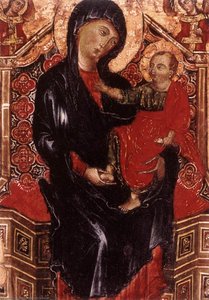
Deodato di Orlandi: Bridging Byzantine Echoes and Giotto’s Dawn
The 13th and 14th centuries in Tuscany witnessed a fascinating confluence of artistic styles, a period of transition where the weighty traditions of Byzantium began to yield to the burgeoning naturalism championed by Giotto. Within this dynamic landscape emerged Deodato di Orlandi (c. 1280 – died before 1331), an Italian painter whose work stands as a crucial bridge between these two influential movements. Active primarily in Lucca and Pisa, Orlandi’s frescoes—particularly those adorning the San Piero a Grado church commissioned by the Caetani family—offer a compelling glimpse into this pivotal moment of artistic evolution.
Orlandi's early career is somewhat shrouded in the mists of history. Like many artists of his time, he likely received training within the established Byzantine tradition prevalent throughout Italy at that period. The influence of this earlier style is immediately apparent in his compositions—a sense of monumental scale, a preference for hierarchical groupings of figures, and a deliberate use of gold leaf to evoke divine splendor. The San Piero a Grado cycle, executed between 1300 and 1312, showcases this Byzantine heritage most vividly. The lower registers depict portraits of Popes from St. Peter to John XVIII, rendered with a formal dignity reminiscent of earlier iconographic conventions. These figures are presented in a stylized manner, their features idealized rather than realistically portrayed – a characteristic deeply rooted in the Byzantine aesthetic.
However, closer examination reveals a subtle but significant shift towards Giotto’s innovative approach. While retaining elements of Byzantine formality, Orlandi introduces a greater sense of spatial depth and volume. The figures begin to possess a more three-dimensional quality, their drapery rendered with a newfound attention to folds and textures. The intermediate panels narrate episodes from the life of St. Peter, mirroring the narratives found in Cimabue’s frescoes at San Francesco in Assisi—a testament to Orlandi's exposure to, and adaptation of, this pioneering Florentine style. The depiction of Constantine’s conversion, for instance, demonstrates a move away from purely symbolic representation towards a more narrative approach, capturing a moment of dramatic emotional intensity.
The Frescoes of San Piero a Grado: A Tapestry of Faith and Narrative
The frescoes within the nave of San Piero a Grado are not merely decorative; they constitute a complex theological and historical tableau. The lower portion of the cycle, as mentioned previously, presents a series of papal portraits—a deliberate act of honoring the Church’s leadership. Above this register unfolds a meticulously detailed sequence of scenes from the life of St. Peter, offering a visual meditation on his martyrdom and ascension. These panels are not simply illustrations; they function as didactic narratives, intended to educate and inspire devotion within the church community.
Perhaps most strikingly, the upper portion of the fresco cycle depicts “The Walls of Heaven City.” This section, largely restored in subsequent centuries, offers a glimpse into Orlandi’s imaginative vision. The depiction is characterized by an ethereal quality, with figures ascending towards a celestial realm bathed in golden light. While drawing upon Byzantine iconography—particularly its emphasis on divine transcendence—Orlandi imbues this scene with a sense of movement and dynamism that anticipates the Renaissance fascination with perspective and spatial illusion.
Technique and Materials: A Synthesis of Tradition
Deodato di Orlandi’s artistic practice was deeply rooted in the techniques and materials of his time. Fresco painting, utilizing pigments mixed with lime plaster, demanded considerable skill and precision. The artist would meticulously grind pigments—often incorporating minerals and organic binders—to achieve the desired hues and textures. Gold leaf, a hallmark of Byzantine art, played a crucial role in creating areas of intense luminosity and emphasizing the sacredness of the subject matter.
Orlandi’s mastery lay not only in his technical proficiency but also in his ability to synthesize these diverse influences. He skillfully blended the monumental grandeur of Byzantine iconography with the emerging naturalism of Giotto, forging a unique artistic style that reflects the complex cultural and intellectual currents of 14th-century Tuscany. The careful layering of pigments, combined with an understanding of spatial recession and human anatomy—albeit within the constraints of Byzantine conventions—resulted in frescoes of remarkable beauty and expressive power.
Legacy and Historical Significance
Deodato di Orlandi’s work holds a significant place in art history as a transitional figure between the Italo-Byzantine tradition and the early Renaissance. His frescoes at San Piero a Grado demonstrate a willingness to embrace new artistic ideas while retaining a deep respect for established conventions. While he may not be as widely celebrated as Giotto or Cimabue, Orlandi’s contribution is nonetheless vital in understanding the evolution of Italian painting during this formative period.
His legacy lies not only in his individual works but also in his role as a conduit between artistic traditions. He represents a crucial link in the chain that ultimately led to the groundbreaking innovations of the Renaissance, demonstrating how established practices could be reinterpreted and transformed by subsequent generations of artists. The San Piero a Grado frescoes continue to offer valuable insights into the artistic and cultural landscape of 14th-century Tuscany, reminding us of the rich tapestry of influences that shaped the course of Western art.
Domande e risposte
È disponibile un tour virtuale 3D delle opere di Deodato Di Orlandi?
Le opere di Deodato Di Orlandi sono visibili in una galleria 3D nella pagina Galleria 3D dell'artista.
Come si è evoluta l'arte di Deodato Di Orlandi nel tempo?
Un resoconto cronologico delle opere di Deodato Di Orlandi è disponibile nella pagina Cronologia artistica dell'artista, dove le opere sono presentate in ordine di creazione, capitolo dopo capitolo.
Dove posso vedere tutte le opere di Deodato Di Orlandi?
Tutte le opere di Deodato Di Orlandi presenti su questo sito web sono consultabili nella pagina Tutte le opere dell'artista.