Dominique Guifard Henri: A Painter of Rural France
Dominique Guifard Henri (1838-1913) remains a quietly significant figure in 19th-century French art, often overshadowed by the brighter lights of Impressionism and Symbolism. His work, deeply rooted in the traditions of rural landscape painting, offers a poignant glimpse into a vanishing world – a France of rolling fields, modest farmhouses, and the rhythms of agricultural life. Henri’s legacy lies not in revolutionary innovation but in a steadfast dedication to capturing the essence of his native region, Cherbourg and Évreux, with remarkable detail and an understated emotional resonance.
Born in Angers, France, Henri's artistic journey began relatively late, around the age of thirty. This delay suggests a life spent initially engaged in other pursuits – details of which remain somewhat obscure. However, his early training is believed to have been influenced by the Barbizon school, a movement that championed painting *en plein air* (outdoors) and focused on depicting the natural world with an emphasis on realism and direct observation. The Barbizon artists, rejecting the academic conventions of the Salon, sought to capture the spirit of rural life, and Henri clearly absorbed this ethos.
The Palette of a Region
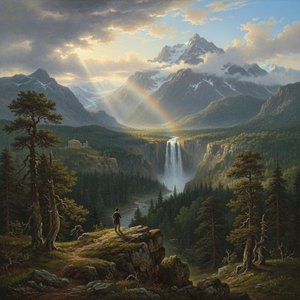
Henri’s distinctive style is immediately recognizable through his masterful use of color and light. He rarely employed dramatic contrasts or vibrant hues; instead, he favored a muted palette dominated by earthy tones – ochres, browns, greens, and blues – that perfectly mirrored the colors of the Normandy countryside. His brushwork is meticulous and precise, meticulously rendering textures such as weathered wood, rough stone walls, and the swaying grasses of his fields. This attention to detail wasn’t merely decorative; it conveyed a deep respect for the subject matter and an understanding of its inherent qualities.
His subjects were predominantly rural scenes: farmers tending their land, livestock grazing in open meadows, and humble farmhouses nestled amongst the trees. These weren't idealized depictions of pastoral bliss but rather honest portrayals of everyday life – the hard work, the simple pleasures, and the enduring connection between people and the land. Henri’s paintings possess a quiet dignity, reflecting a sense of continuity with the past and a profound appreciation for the rhythms of nature.
Influences and Artistic Connections
While firmly rooted in the Barbizon tradition, Henri's work also reveals subtle influences from other movements. The meticulous observation characteristic of his paintings echoes the realism of Jean-François Millet, another key figure in the Barbizon school. Furthermore, there’s a hint of Impressionistic sensitivity in his use of light and atmosphere – particularly evident in the way he captures the shifting qualities of sunlight on water and foliage. It's important to note that Henri never fully embraced the radical innovations of Impressionism, maintaining a more restrained and traditional approach.
His connection with the Musée Thomas-Henry in Évreux is significant; many of his works are housed there, offering visitors a valuable opportunity to experience his art firsthand. The museum’s collection provides a comprehensive overview of Henri's oeuvre, showcasing the breadth of his subject matter and the evolution of his style over time.
Legacy and Historical Significance
Dominique Guifard Henri’s contribution to French landscape painting is often overlooked, yet his work holds considerable historical significance. He represents a vital link between the Barbizon school and the subsequent developments in Impressionism and Post-Impressionism. His paintings offer a valuable record of rural France during a period of rapid social and economic change – a time when traditional ways of life were being transformed by industrialization and urbanization.
His dedication to capturing the authentic beauty of his region, combined with his technical skill and understated emotional depth, ensures that Dominique Guifard Henri’s paintings continue to resonate with viewers today. They serve as a poignant reminder of a disappearing world – a world of quiet dignity, rural simplicity, and an enduring connection between people and the land.
Domande e risposte
Quante opere di Guifard Dominique Henri sono disponibili per la consultazione?
Puoi sfogliare 22 opere d'arte opere di Guifard Dominique Henri nella pagina Tutte le opere d'arte.
Esiste una cronologia della carriera di Guifard Dominique Henri?
Un resoconto cronologico delle opere di Guifard Dominique Henri è disponibile nella pagina Cronologia dell'artista, dove le opere sono presentate nell'ordine di creazione, capitolo dopo capitolo.
Come posso vedere tutte le opere realizzate da Guifard Dominique Henri?
Ogni opera di Guifard Dominique Henri su questo sito può essere consultata nella pagina Tutte le opere d'arte dell'artista.
Dove si trovano le opere di Guifard Dominique Henri raggruppate per movimento artistico?
I movimenti in cui ha lavorato Guifard Dominique Henri sono consultabili nella pagina Tutti i movimenti dell'artista, che raggruppa le opere per movimento.
In quale periodo storico ha operato Guifard Dominique Henri?
Guifard Dominique Henri ha operato nel periodo 19th Century. Tale epoca colloca storicamente l'attività dell'artista.
Posso sfogliare le opere di Guifard Dominique Henri in base all'umore?
La pagina Stanze d'atmosfera dell'artista mostra le opere di Guifard Dominique Henri suddivise per atmosfera.
Esiste una panoramica di tutti i soggetti dipinti da Guifard Dominique Henri?
La pagina Atlante dei soggetti mappa le opere di Guifard Dominique Henri per soggetto.