A Life Forged in Landscape: The World of Jan Asselijn
Jan Asselin, born Jean Asselin around 1610 in Dieppe, France, was a Dutch Golden Age painter whose artistic journey unfolded against the backdrop of religious upheaval and burgeoning artistic innovation. His family, Huguenots fleeing persecution, relocated to Amsterdam in 1621—a vibrant metropolis brimming with commerce and attracting artists from across Europe—establishing a formative connection to the stylistic currents shaping the era’s visual culture. Initially apprenticed under Jan Martszen the Younger, Asselijn honed his skills primarily in battle scenes, absorbing the dramatic conventions of Baroque art and mastering techniques for conveying movement and emotion. However, it was his encounter with Pieter van Laer—nicknamed Bamboccio—and subsequent immersion into the Roman Bentvueghels society that truly ignited his creative spirit.The Italianate Embrace & The Bentvueghels
Like many ambitious Northern European painters of his time, Asselijn recognized the importance of artistic refinement in Italy. Arriving sometime after 1635, he wholeheartedly embraced the *Italianate* style—a genre distinguished by sun-drenched vistas, classical ruins, and pastoral scenes imbued with a romantic sensibility. Joining the Bentvueghels (“Birds of a Feather”), a collective of Dutch and Flemish artists residing in Rome, Asselijn participated in an unconventional artistic milieu characterized by satirical nicknames, rejection of studio practice, and unwavering dedication to painting directly from observation. This immersive experience profoundly impacted his artistic vision, fostering his ability to capture atmospheric nuances and conveying narrative depth within his compositions—a skill that would become central to his oeuvre. He absorbed the stylistic influences of artists like Rembrandt, whose etchings depicting Asselijn at work subtly acknowledged his physical disability – a gesture reflecting sensitivity toward personal challenges during an era marked by artistic ambition.Mastering Light & Symbolism: Key Works
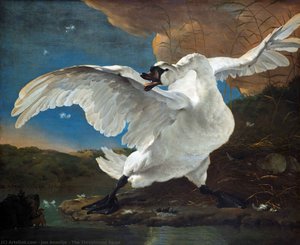
Asselijn’s distinctive style was characterized by exceptional clarity of execution and masterful manipulation of light—qualities that swiftly garnered him acclaim among his contemporaries. While he produced historical and battle paintings, it was his landscapes and animal depictions that cemented his reputation as a singular artistic voice. The Threatened Swan, completed around 1640-45, stands as Asselijn’s most celebrated masterpiece—a painting that transcends mere visual representation to embody Dutch national resilience against external pressures. Interpreted as an allegory for Johan de Witt, the influential Dutch statesman, this dramatic scene captures a moment of crisis with arresting immediacy and symbolic potency. The swan's defiant posture—facing down encroaching danger—became a potent emblem of resistance and was even subjected to elaborate inscriptions by later owners: “Holland” on one of the eggs and “Enemy of the State” beside the menacing dog – underscoring its political significance. Alongside this iconic work, Asselijn produced other notable paintings that exemplify his artistic prowess. Cavalry Charge at Sunset showcases his formative training in battle painting, skillfully conveying movement and dynamism with meticulous detail. Furthermore, he created evocative depictions of rural life—such as *Drovers with Cattle under an Arch of the Colosseum in Rome*, which seamlessly blend Italianate landscape aesthetics with animal studies—demonstrating his ability to synthesize diverse influences into a cohesive artistic vision. Finally, The Breach of Saint Anthony’s Dike near Amsterdam powerfully portrays a pivotal moment in Dutch history—the siege of Saint Anthony's Dike during the Eighty Years’ War—capturing the urgency and drama of the event with remarkable precision.Influence & Legacy: A Lasting Impression
Jan Asselijn’s artistic legacy extends beyond his own prolific output, shaping the trajectory of landscape painting within the Dutch Golden Age. He served as a mentor to Frederik de Moucheron, fostering the dissemination of the Italianate style and inspiring subsequent generations of artists. His meticulous technique—particularly his masterful handling of light—influenced Rembrandt's etching portraits, reflecting mutual admiration for artistic excellence. Asselijn’s works are now housed in prominent museums across Europe, guaranteeing his enduring recognition as a pivotal figure within Dutch art history. He died prematurely in 1652, leaving behind an impressive body of work that continues to captivate viewers with its beauty, emotional depth, and subtle symbolic resonances—a testament to his contribution to the artistic landscape of his time.Domande e risposte
Di dove è Jan Asselyn?
Jan Asselyn è nato/a in Francia.
Quali emozioni esprimono le opere di Jan Asselyn?
La Spazi d'atmosfera di Jan Asselyn raccoglie le opere dell'artista suddivise per umore.
Quali colori ha usato più spesso Jan Asselyn?
Il profilo cromatico delle opere di Jan Asselyn è consultabile nella pagina Profilo Cromatico dell'Artista dell'artista.