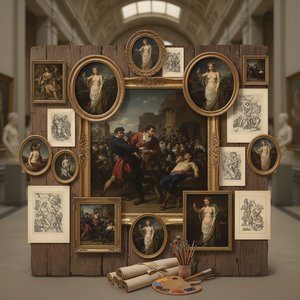
Jean Humbert de Superville: A Portraitist of Distinction
Jean Humbert de Superville (Amsterdam, 7 May 1734 – buried Amstelveen, 22 September 1794) was a Dutch painter of Swiss and French extraction. Born into a family steeped in mercantile tradition—his father, Pierre Humbert, established a successful trading house in Geneva—Jean Humbert’s artistic journey began amidst the intellectual ferment of Enlightenment Europe. He honed his skills initially under the tutelage of Johann Christian Feyens, a prominent Antwerp painter known for his meticulous realism and classical style, absorbing influences that would define his oeuvre. This formative exposure to Genevan artistic circles instilled within him a humanist perspective—a cornerstone of artistic thought during the period—which profoundly shaped his creative endeavors.
Early Life & Training
Superville’s early years were characterized by an immersion in the vibrant cultural landscape of Geneva, where he encountered artists and thinkers who championed reason and human dignity. His father's entrepreneurial spirit fostered a keen understanding of economic realities alongside artistic sensibilities—a duality that would inform his approach to painting throughout his life. The mentorship of Johann Christian Feyens proved instrumental in developing Superville’s technical prowess, equipping him with the skills necessary to achieve unparalleled realism and elegance within his compositions. Feyens’s stylistic rigor served as a guiding force, establishing a foundation for Superville's distinctive artistic vision.
Amsterdam Period (1760-1794): The Zenith of His Career
Jean Humbert swiftly ascended to prominence in Amsterdam’s artistic circles, securing commissions from influential figures—members of the aristocracy and prominent businessmen alike—demonstrating an exceptional talent for capturing character and emotion with remarkable precision. He became a celebrated portrait painter, crafting images that transcended mere likeness; instead, he sought to convey the inner essence of his subjects—their intellect, their passions, and their vulnerabilities. His canvases are particularly renowned for their luminous skin tones achieved through masterful glazing techniques—a technique perfected during the Dutch Golden Age—reflecting an unwavering commitment to capturing the subtleties of human appearance. Superville’s meticulous attention to detail extended beyond surface appearances; he painstakingly rendered fabrics, textures, and accessories, creating immersive scenes that transported viewers into the world of his subjects. Notable commissions included portraits of Abraham du Bois, commissioned by the Director of the Rotterdam Chamber of the Dutch East India Company—a piece lauded for its dignified portrayal and masterful execution—and depictions of members of the Stadhouderlijk Hof (Stadholder’s Court), solidifying his reputation as a leading portraitist of his time.
Technique & Artistic Style
Superville's artistic style was distinguished by a profound respect for observation and an unwavering dedication to conveying psychological depth within his subjects. He eschewed ostentation, favoring instead understated tonal gradations and carefully considered compositions that prioritized clarity and grace—a stylistic hallmark of the era’s finest artists. His palette remained restrained yet expressive, utilizing muted colors to evoke atmospheric moods and emphasizing tonal harmony—a deliberate choice designed to heighten emotional impact. The artist's meticulous rendering of textures—from velvety fabrics to polished metals—further underscored his commitment to realism, creating canvases that possessed an astonishing level of detail. He skillfully employed glazing techniques—a technique perfected during the Dutch Golden Age—to achieve luminous skin tones and imbue his paintings with a sense of ethereal beauty.
Notable Works & Legacy
Among Jean Humbert de Superville’s most celebrated achievements is “Portrait of Abraham du Bois,” which exemplifies his mastery of portraiture painting and embodies the ideals of humanist realism. His work continues to inspire admiration for its elegance, psychological insight, and technical brilliance—a testament to his enduring legacy as one of the Netherlands' foremost artists. Furthermore, Superville’s influence can be discerned in subsequent generations of Dutch painters who embraced his stylistic principles—demonstrating the lasting impact of his artistic vision on the broader art historical landscape. He remains an unforgettable figure in art history, remembered for his unwavering devotion to capturing the human spirit with unparalleled artistry and precision.