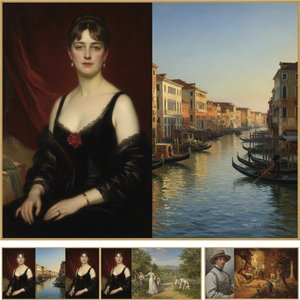
John Reinhard Weguelin: Echoes of Antiquity and Pastoral Dreams
John Reinhard Weguelin (1849 – after 1910) was an English painter and illustrator whose distinctive style captivated audiences during the Victorian era. He achieved renown for his meticulously crafted landscapes imbued with classical references and a profound sensitivity to light, establishing himself as one of Britain’s foremost practitioners of neo-classical art. Weguelin's oeuvre reflects not only artistic ambition but also a deep engagement with intellectual currents shaping the period—particularly the revival of interest in Greco-Roman culture championed by thinkers like John Stuart Mill.
Early Life and Artistic Formation
Born in South Stoke, Sussex, on June 23rd, 1849, Weguelin’s upbringing was marked by a familial shift towards Roman Catholicism following his father's conversion. This formative experience instilled within him a lifelong fascination with the classical world, influencing his artistic vision from its earliest stages. His formal training commenced at Slade School of Fine Art in London, where he honed his skills under influential instructors like Frederic Leighton and Joseph Noel Paton—artists who themselves embraced neo-classical ideals. Weguelin’s initial explorations focused on watercolour painting, mastering the delicate blending techniques favored by luminaries such as Lawrence Alma-Tadema, capturing atmospheric subtleties with remarkable precision. The influence of Alma-Tadema's meticulous realism is palpable in Weguelin’s early works—a testament to his dedication to technical mastery.
The Neo-Classical Style: Influences and Techniques
Weguelin's artistic style owes considerable debt to Edward Poynter and Lawrence Alma-Tadema, artists who meticulously recreated scenes from antiquity and mythology with painstaking realism. Like his contemporaries, Weguelin sought to emulate the grandeur and idealized beauty of classical sculpture and painting, prioritizing meticulous observation and skillful execution. His canvases frequently depicted idyllic landscapes—rolling hills dotted with wildflowers—often bathed in golden light—a technique consciously adopted from Alma-Tadema’s celebrated works. Weguelin's masterful use of chiaroscuro – the dramatic interplay between light and shadow – elevated his paintings beyond mere representation, conveying emotion and psychological depth. He meticulously studied classical frescoes and sculptures, absorbing their compositional principles and expressive gestures. Weguelin’s dedication to capturing the essence of antiquity is evident in his unwavering commitment to artistic excellence.
Subject Matter: Mythological Visions and Everyday Life
Weguelin’s artistic repertoire spanned a diverse range of subjects, reflecting both mythological narratives and scenes from daily life in ancient Greece and Rome. He skillfully rendered figures engaged in pastoral activities—shepherds tending flocks amidst verdant meadows—capturing the serenity and beauty of rural existence. However, Weguelin's fascination extended beyond the tangible world; he drew inspiration from folklore and mythology, portraying ethereal nymphs and mermaids with graceful poses and luminous coloration. Notably, Weguelin’s depictions of female figures often contrasted sharply with those of his contemporary John William Waterhouse, who favored dramatic compositions featuring nude or semi-nude women—a stylistic divergence that underscores Weguelin's unique artistic sensibility. His paintings are imbued with a profound sense of Romantic idealism—a harmonious blend of observation and imagination.
Notable Achievements and Legacy
Weguelin achieved considerable acclaim during his lifetime, exhibiting extensively at the Royal Academy and other prestigious London galleries. His contribution to illustration was equally significant, securing commissions for prominent publications like Macaulay’s *Lays of Ancient Rome*, where he produced evocative images that brought classical history vividly to life. Weguelin's enduring legacy resides in his ability to synthesize artistic virtuosity with intellectual curiosity—a testament to the transformative power of art as a conduit for cultural understanding. Though largely forgotten following World War I, Weguelin’s distinctive style continues to resonate with collectors and scholars alike, securing his place among Britain’s most celebrated painters of the Victorian era. His masterpiece, *Lesbia*, remains an iconic representation of mythological beauty—a poignant tribute to Catullus's muse and a symbol of Weguelin’s unwavering commitment to artistic excellence.