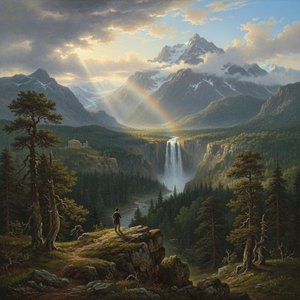
Eugène Cicéri: A Painter of Soul and Alpine Landscapes
Eugène Cicéri (1813 – 1890) was a French landscape painter who emerged from the Bourron-Marlotte School, a movement dedicated to capturing the essence of rural life and the sublime beauty of the French Alps. Though overshadowed by his contemporaries like Jean-François Millet and Frédéric Bazille, Cicéri’s distinctive style—characterized by meticulous realism combined with expressive tonal harmonies—earned him recognition within the Barbizon School and established him as a significant contributor to European Romanticism.- Early Life & Training: Born in Paris, Cicéri received his initial artistic training from Jean-Baptiste Camille Bouchardy, a respected teacher known for his academic approach to painting. This grounding in classical principles would profoundly influence his later work, shaping his meticulous observation of nature and his commitment to portraying it with accuracy.
- The Bourron School & Alpine Inspiration: Cicéri joined the Bourron School around 1840, immersing himself in a collective effort to depict the landscapes of Auvergne and Provence. The school’s ethos—rooted in plein air painting and an idealized vision of rural life—provided Cicéri with fertile ground for experimentation and artistic growth. However, it was his fascination with the Alpine region that truly captivated him, becoming the dominant subject of his oeuvre.
- Technique & Style: Cicéri’s technique was marked by painstaking detail and a masterful command of watercolor pigments. He employed subtle gradations of tone—a hallmark of Barbizon painting—to convey atmospheric depth and luminosity. Unlike some of his peers who favored looser brushstrokes, Cicéri meticulously rendered textures and contours, striving to capture the palpable presence of the natural world.
- Notable Works & Recognition: Cicéri’s landscapes gained considerable acclaim during his lifetime, particularly those depicting Alpine vistas bathed in golden light. Among his most celebrated paintings are “Wallachians,” a dramatic depiction of Romanian peasants amidst rugged mountains, and “Lithograph of Mosburg in Wiesbaden,” showcasing the grandeur of Wiesbaden Castle against a backdrop of snow-capped peaks. His prints were exhibited at the Salon and garnered critical praise for their artistic merit.
- Legacy & Influence: Cicéri’s work continues to resonate with viewers today, embodying the Romantic ideal of communion with nature and reflecting the profound impact of topographical illustration on 19th-century art. Although he didn't achieve the fame of some other Barbizon artists, his dedication to realism and tonal harmony cemented his place as a pivotal figure in French landscape painting—a painter who truly captured ‘the soul’ of Alpine scenery.
Connections & Collaborations
Cicéri's artistic journey intersected with the influential Isabey family, particularly Jean-Hippolyte Isabey Sr., who championed his work and encouraged him to explore lithography as a medium for disseminating landscape prints. This collaboration resulted in stunning topographical illustrations that documented Alpine expeditions and contributed significantly to the visual culture of the era. Furthermore, Cicéri’s artistic sensibilities aligned with those of Eugène Carrière and Frédéric Bazille—fellow Bourron School members—creating a vibrant intellectual and aesthetic environment conducive to artistic innovation.კითხვები და პასუხები
სად და რა წელს დაიბადა Eugène Cicéri?
Eugène Cicéri დაიბადა Paris-ში, 1813 წელს.
რამდენი ნამუშევარია ხელოვან Eugène Cicéri-ის ხელსმოწმენე, რომლის ნახვაც შესაძლებელია?
თქვენ შეგიძლიათ ნახოთ 22 ნამუშევარი ნამუშევარი ხელოვან Eugène Cicéri-ისგან ყველა ნამუშევარი გვერდზე.
როგორ შემიძლია Eugène Cicéri-ის შემოქმედების წლიურ ქრონოლოგიაში თვალი ვადევნო?
მხატვრის ნამუშევრების ქრონოლოგია გვერდზე წარმოდგენილია Eugène Cicéri-ის ნამუშევრები თარიღების მიხედვით, წლითწლიურად დალაგებული.