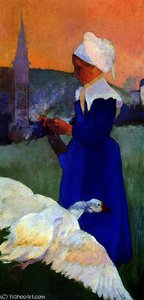
The Soul of Brittany: The Life and Vision of Armand Séguin
Armand Séguin (1869–1903) remains a captivating, yet somewhat enigmatic figure within the landscape of late 19th and early 20th-century French art. Often overshadowed by his more flamboyant contemporaries within the Pont-Aven School—such as Paul Gauguin, Émile Bernard, and Roderic O’Conor—Séguin possessed a unique artistic voice characterized by a profound sensitivity to light, color, and the evocative spirit of Brittany, his homeland. His work, imbued with a sensual intensity and a subtle melancholy, offers a poignant glimpse into the evolving currents of Impressionism and Symbolism, ultimately forging a distinct path that continues to resonate with collectors and historians alike.
Séguin’s early life was marked by a quiet intellectual curiosity, nurtured within a family steeped in scientific tradition. His grandfather, also named Armand Séguin, was a renowned chemist, and this lineage instilled in the artist a meticulous observation of the natural world—a trait that would profoundly influence his artistic approach. While he initially studied at the École des Arts Déments in Paris, he found the rigid academic structure stifling to his creative spirit. Seeking inspiration and a more liberated environment, he gravitated towards the burgeoning avant-garde circles centered around Pont-Aven, a small village nestled in the Breton countryside. It was here that he encountered the transformative influence of Gauguin, which pushed Séguin to explore themes of primitivism, spirituality, and the raw, unvarnished beauty of rural life.
Mastery of Form and the Pont-Aven Influence
The core of Séguin’s artistic development revolved around his evocative depictions of Breton peasants and women. Unlike the often-idealized portrayals of rural subjects prevalent during the era, Séguin captured a remarkable authenticity, imbuing his figures with a palpable sense of vulnerability and quiet dignity. His mastery extended across various mediums, from delicate etchings to profound studies of the human form. In works such as Gleaner Resting with a Sheaf of Flax, he utilizes the stark beauty of black and white to embody the Impressionist mood of the late 1890s, capturing a moment of tranquil labor that feels both timeless and deeply rooted in the Breton soil.
His technical prowess is perhaps most evident in his intimate studies of the nude. In pieces like Nude with hands behind the head, Séguin moves beyond mere anatomical representation to explore the emotional resonance of the human figure. These works are characterized by:
- A profound sensitivity to light: Using contrast to define the soft contours of the body.
- Emotional depth: Creating a sense of intimacy that invites the viewer into a private, contemplative space.
- Symbolic undertones: Blending the physical reality of the subject with a dreamlike, almost spiritual atmosphere.
A Legacy of Quiet Intensity
Though his life was tragically short, ending in 1903 at the age of only thirty-four, Séguin left behind a body of work that serves as a vital bridge between the observational nature of Impressionism and the emotive depths of Symbolism. His ability to capture the "soul" of Brittany—seen in the poignant Seated woman with black bonnet, where a sense of quiet prayer is etched into the subject's very presence—ensures his place in the annals of French art history.
The historical significance of Armand Séguin lies in his refusal to succumb to the purely decorative. He sought the truth in the textures of peasant life and the vulnerability of the human form. While he may not have achieved the global fame of Gauguin, his contribution to the Pont-Aven School provided a necessary layer of intimacy and psychological depth. Today, his works stand as a testament to a brief but brilliant era of artistic experimentation, reminding us of the power of seeing the extraordinary within the ordinary.
질의응답
Armand Seguin 작가는 어떤 사조에 참여했나요?
Armand Seguin 작가가 활동했던 예술 사조는 작품을 사조별로 분류하여 보여주는 작가의 모든 사조 페이지에서 확인하실 수 있습니다.
Armand Seguin의 작품을 팔레트별로 모아둔 곳은 어디인가요?
컬러 팔레트별 페이지에서는 Armand Seguin의 작품들을 색상 팔레트별로 모아볼 수 있습니다.
Armand Seguin 작품의 연도별 타임라인이 있나요?
Armand Seguin의 작품을 연도별로 정리하여 보여주는 작품 연대기 페이지입니다.